“””
Mikel Arteta’s side hold a five-point lead over Manchester City with two matches left, but the champions still have a game in hand and a narrow route back into the fight.
Arsenal remain in control of the Premier League title race after moving five points clear of Manchester City, though the margin remains fragile enough to keep the final weeks of the 2025/26 season alive with tension.
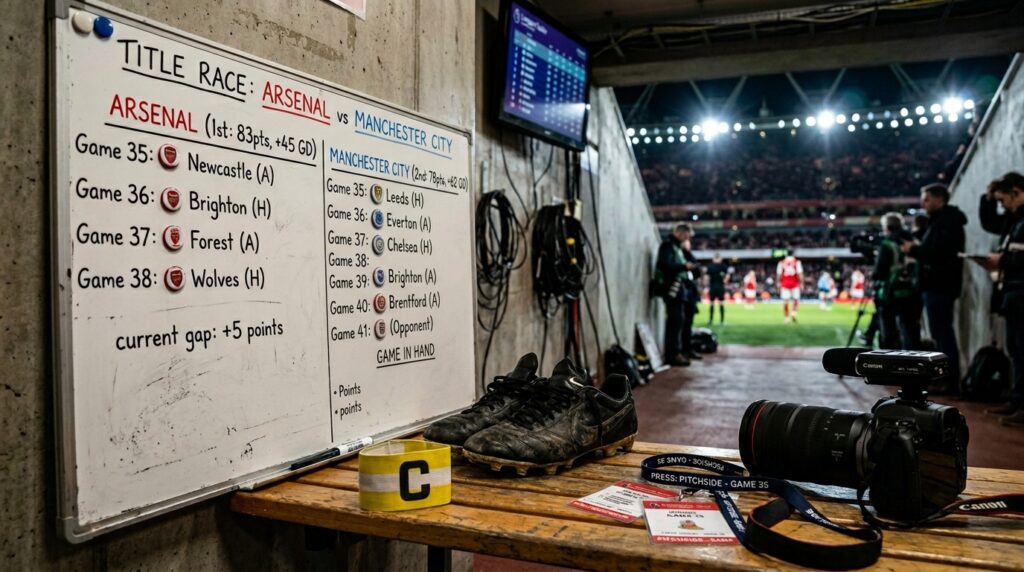
With 36 matches played, Arsenal sit top of the table on 79 points, ahead of Manchester City, who have 74 points from 35 games. The arithmetic is simple but unforgiving: Arsenal can secure the title by winning their final two league matches, while City must win their remaining games and hope for at least one mistake from the leaders.
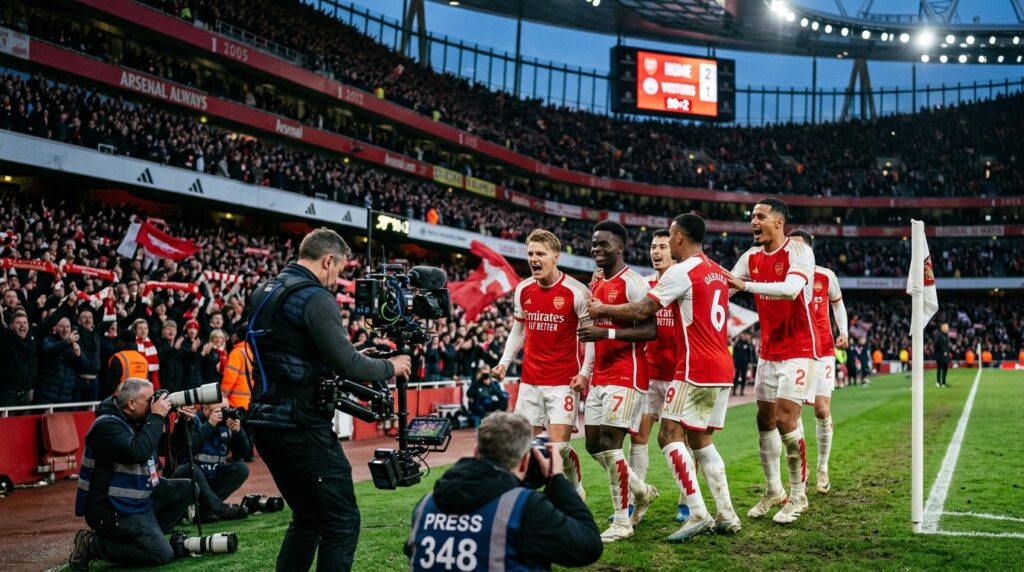
The latest turn in the race came at the London Stadium, where Arsenal beat West Ham United 1-0 in a match shaped by pressure, late drama and a decisive intervention from the video assistant referee. Leandro Trossard scored the only goal in the 83rd minute, giving Arsenal a victory that restored their five-point lead and placed the title firmly within reach. In stoppage time, West Ham thought they had equalised through Callum Wilson, only for the goal to be ruled out after a review for a foul on Arsenal goalkeeper David Raya.
It was the kind of moment that can define a title race. For Arsenal, it preserved three points that may prove decisive. For West Ham, still fighting near the bottom of the table, it deepened frustration in a separate battle for survival. For the Premier League, it ensured that officiating and VAR would again become part of the wider story at the most sensitive point of the season.
Mikel Arteta’s reaction after the match reflected both relief and the weight of the moment. Arsenal have been here before in recent years, close enough to see the trophy but not close enough to touch it. This time, with two league games remaining and their destiny still in their own hands, the challenge is psychological as much as tactical. They no longer need favours. They need control.
That is easier said than done. Arsenal’s remaining league fixtures, at home to Burnley and away to Crystal Palace, appear manageable on paper, but May football rarely follows the logic of a table. Burnley have little to lose, while Palace have already proved capable of making life awkward for stronger sides. Any dropped points would open the door for City, a team whose title-winning habit has become one of the defining features of English football in the past decade.
City’s position is complicated by the calendar. Pep Guardiola’s side still have a game in hand and enough firepower to punish any Arsenal slip. They have also shown signs of late-season acceleration, including a 3-0 win over Brentford after a 3-3 draw at Everton. Their remaining league programme includes Crystal Palace, Bournemouth and Aston Villa, alongside an FA Cup final against Chelsea. That congestion could either sharpen their competitive rhythm or stretch their squad at the worst possible time.
The title race may yet come down to fine margins. Arsenal currently have a goal difference of plus 42, only slightly ahead of City’s plus 40. City have scored more goals, 72 compared with Arsenal’s 68, which could matter if the teams finish level on points and goal difference. The Premier League’s tie-breaking rules would first separate clubs by goal difference, then goals scored, then head-to-head points and away goals in head-to-head matches before any playoff scenario.
That makes every goal meaningful. Arsenal cannot simply manage their way through the final fixtures if the race tightens. They may need not only victories but convincing performances to maintain an advantage in the secondary calculations. City, meanwhile, know that heavy wins could apply pressure even before Arsenal kick a ball.
The contrast between the two teams is striking. Arsenal have built their challenge around defensive solidity, intensity and a squad that has grown more mature under Arteta. They have conceded only 26 league goals, the best defensive record in the division. That foundation has allowed them to survive difficult spells in matches and turn narrow advantages into wins. The victory at West Ham was not a display of dominance, but it was the kind of result title-winning teams often produce when fluent football gives way to nerve.
City, by contrast, remain the more explosive attacking side. Guardiola’s team have scored 72 league goals, more than Arsenal, and still carry the aura of a side capable of turning a title race in a single week. Erling Haaland, Jeremy Doku and Omar Marmoush have all contributed in recent matches, while City’s midfield control remains a threat to any opponent. Their problem is not belief. It is time.
Arsenal’s lead also carries historical weight. The club have not won the Premier League since the unbeaten “Invincibles” season of 2003/04. Since then, supporters have endured near misses, rebuilds, managerial change and painful collapses. Arteta has restored Arsenal to the elite level of English and European football, but the final step remains the hardest. A five-point advantage with two games left is a strong position, yet it is not a coronation.
The pressure is amplified by Arsenal’s European commitments. The club also have the Champions League final against Paris Saint-Germain in Budapest on May 30, six days after the Premier League season ends. That creates the possibility of a historic double, but also forces Arteta to manage emotion, fitness and focus across two enormous objectives. The danger is not physical exhaustion alone. It is the mental strain of knowing that every match may define a generation.
For City, the pursuit is familiar. Guardiola’s teams have repeatedly turned late-season deficits into titles by reducing the race to routine: win, recover, win again. Even when they are not leading, they tend to make rivals feel hunted. Arsenal’s task is to resist that invisible pressure. They do not need to watch City’s every move if they win their own matches, but ignoring City at this stage is impossible.
The race also reflects a broader shift in the Premier League’s competitive landscape. Liverpool, Manchester United, Chelsea and Aston Villa remain important forces, but the 2025/26 title contest has narrowed around Arsenal and City. It is a rivalry built less on hostility than on standards. City have set the benchmark. Arsenal are trying to surpass it not through surprise, but through consistency over 38 matches.
There is little room now for grand tactical reinvention. Arteta’s priorities are clear: protect Raya, keep the defensive line compact, ensure Declan Rice and Martin Odegaard control central spaces, and find enough quality in the final third to turn possession into decisive moments. Trossard’s goal at West Ham showed the value of depth and timing, especially when matches become tight and anxious.
City’s path is equally clear. They must keep winning and make Arsenal feel every point of the chase. Guardiola will demand control, tempo and clinical finishing, especially in the game in hand that can cut the gap from five points to two. A two-point race entering the final stretch would transform the mood instantly.
For now, however, Arsenal have the privilege and burden of leadership. The table says they are first. The fixtures say they are close. The history of the Premier League says nothing is secure until the final whistle of the final relevant match.
Two wins will make Arsenal champions. One mistake could invite Manchester City back into a race they have mastered before. That is the tension hanging over the final days of the season: Arsenal are ahead, but City are not gone.”””