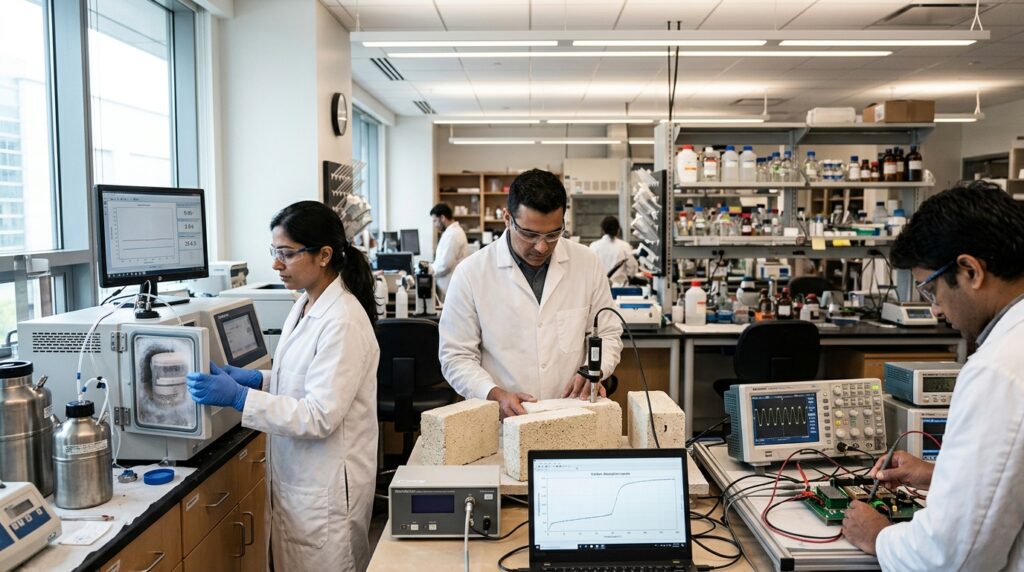
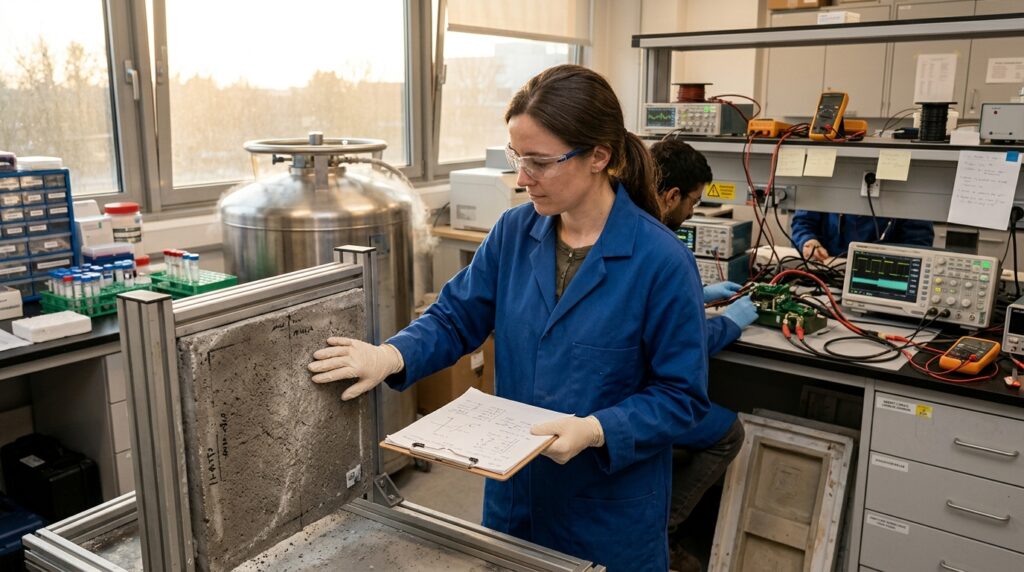
Recent studies highlighted by ScienceDaily point to rapid advances in organ cryopreservation, carbon-absorbing construction materials and high-efficiency silicon-carbide power electronics.
WASHINGTON, May 11 — A series of recent scientific reports is underscoring how quickly applied research is moving from laboratory theory toward technologies that could reshape medicine, construction and energy infrastructure, with advances in frozen organ preservation, carbon-storing building materials and compact power electronics drawing renewed attention from researchers and industry.
The findings, reported separately by ScienceDaily from university and national laboratory research teams, do not represent finished products ready for immediate mass deployment. But taken together, they show a common direction in applied science: solving old problems by combining materials engineering, biology, chemistry and electronics in ways that were difficult to achieve only a decade ago.
In medicine, one of the most closely watched developments involves the long-running effort to preserve transplant organs at extremely low temperatures without damaging them. A research team at Texas A&M University has reported that cracking, one of the major barriers to deep-freeze organ preservation, can be reduced by adjusting the glass transition temperature of cryopreservation solutions.
The work addresses a basic but formidable challenge. Organs are complex, water-rich structures. When cooled too quickly or unevenly, they can suffer fractures that make them unusable. Scientists have long hoped that vitrification, a process in which biological material enters a glass-like state without forming damaging ice crystals, could extend the time organs remain viable outside the body. But preserving large organs safely has remained far more difficult than preserving cells or small tissue samples.
The Texas A&M study suggests that solutions with higher glass transition temperatures may reduce thermal stress cracking. That may sound technical, but its practical meaning is straightforward: if researchers can better control the physical state of tissues during cooling, they may be able to make organ banking more realistic. Long-term organ storage could transform transplantation by giving hospitals more time to match donors and recipients, transport organs across longer distances and plan surgeries under less pressure.
The research is still part of a broader scientific path, not a clinical breakthrough ready for patients. Biocompatibility, toxicity, rewarming, vascular damage and organ function after thawing all remain crucial questions. But the progress matters because organ transplantation is constrained by time. Hearts, lungs, livers and kidneys must be moved and transplanted within narrow windows, and many donated organs are never used. Any method that extends safe storage could have major medical consequences.
In construction, another study points to a different kind of urgency: reducing the climate burden of the built environment. Engineers at Worcester Polytechnic Institute have developed what they call an enzymatic structural material, or ESM, designed to remove more carbon dioxide from the atmosphere than it produces. The material uses an enzyme to convert CO₂ into solid mineral particles, which are then bonded into structural components.
The appeal is clear. Conventional concrete is strong, familiar and widely available, but cement production is one of the major industrial sources of global carbon emissions. The WPI material aims to change the equation by turning carbon from a waste product into part of the material’s structure. According to the research summary, the material can cure within hours, is strong, repairable and recyclable, and requires far less energy to make than traditional construction materials.
If such materials can be scaled economically, the implications could be significant. Buildings, bridges, modular housing and disaster-recovery structures could become carbon storage assets rather than merely sources of emissions. The idea is part of a broader movement in civil engineering that treats construction not only as an emissions problem but also as a potential carbon sink.
Other recent research has moved in a similar direction. Scientists have explored 3D-printed concrete methods that inject captured carbon dioxide into concrete during printing, while researchers at ETH Zurich have developed living materials containing cyanobacteria that can capture CO₂ through photosynthesis and mineral formation. These approaches differ in design and maturity, but they reflect the same shift: construction materials are increasingly being engineered to perform environmental functions beyond load-bearing strength.
The path to adoption, however, is not simple. Construction is a conservative industry for good reasons. Materials must meet strict safety codes, survive weathering, resist fire, support loads and perform reliably for decades. Any carbon-absorbing alternative must prove not only that it stores CO₂ but also that it can compete on cost, durability, availability and ease of use. The most promising laboratory material still has to pass through certification, manufacturing and market acceptance.
In energy, the National Renewable Energy Laboratory has reported progress on a silicon-carbide-based power module called ULIS, short for Ultra-Low Inductance Smart power module. The device is designed to improve how electricity is converted and delivered, a less visible but increasingly important part of the global energy transition.
Power electronics sit inside many modern systems, from electric vehicles and renewable-energy equipment to data centers and industrial machinery. They regulate how electricity flows between components, converting voltage and current into forms that machines can use. As artificial intelligence, electrified transportation and advanced manufacturing increase electricity demand, small gains in conversion efficiency can produce large benefits across entire systems.
NREL’s ULIS module uses silicon carbide semiconductors, which can operate efficiently at high voltages, high temperatures and fast switching speeds. The laboratory says the module can achieve five times the energy density of earlier designs and reduce parasitic inductance by seven to nine times compared with advanced existing silicon-carbide modules. In practical terms, that could mean smaller, lighter and more efficient power converters.
The module is designed for demanding applications, including data centers, electrical grids, microreactors, advanced aircraft and heavy-duty vehicles. Its 1200-volt, 400-amp rating points to serious industrial use rather than consumer gadgetry. NREL also says the design emphasizes manufacturability, using a flatter layout intended to reduce cost and complexity.
The energy implications are broad. Data centers that support AI workloads are placing growing pressure on power systems. Electric vehicles require efficient conversion between batteries, motors and charging equipment. Renewable grids need reliable power electronics to manage variable generation. Advanced aircraft and future industrial platforms need compact systems that deliver high power without excessive weight or heat loss.
The importance of such a module is not that it creates new electricity. It is that it could allow existing electricity to be used more efficiently. In a world where energy demand is rising and grid expansion is slow, efficiency becomes infrastructure. Better power conversion can reduce waste, lower cooling requirements and help more equipment operate within the same electrical footprint.
Across these three areas, the common pattern is convergence. The organ-preservation work uses thermodynamics, glass physics and cryobiology. The carbon-storing construction material combines enzymes, mineralization and structural engineering. The silicon-carbide module links semiconductor physics, packaging design and energy systems. Applied science is moving fastest where disciplines overlap.
That convergence also explains why breakthroughs now often arrive as systems rather than single inventions. A better cryopreservation solution is useful only if it works with cooling and rewarming protocols. A carbon-negative building material must fit into construction codes and supply chains. A high-efficiency power module must integrate with converters, grids and machines. The invention is only the beginning; the system determines whether it changes the world.
The recent studies also offer a caution against hype. None of these advances should be treated as an immediate cure for transplant shortages, construction emissions or energy demand. Each faces testing, scaling and regulatory barriers. But the direction is notable. Researchers are no longer merely describing problems. They are proposing engineered pathways toward practical solutions.
For hospitals, the possibility of organ banking remains one of transplantation’s most ambitious goals. For cities, carbon-absorbing construction materials suggest that future buildings could help address the emissions problem they once deepened. For energy systems, compact silicon-carbide power modules show how efficiency may become as important as generation.
The pace of innovation is not uniform, and many laboratory advances will fail before reaching market. Still, the latest reports point to a larger reality in science: the boundary between discovery and deployment is narrowing. In fields where human need is urgent and engineering tools are improving, applied research is becoming faster, more interdisciplinary and more closely tied to real-world constraints.
That is why these studies matter together. They are not isolated curiosities. They are signals of a broader technological moment in which materials are being designed to store carbon, organs are being engineered for longer survival outside the body, and electricity is being managed with finer precision. The breakthroughs remain unfinished, but the direction is clear: science is increasingly focused on making the physical world more durable, more efficient and more adaptable.”””