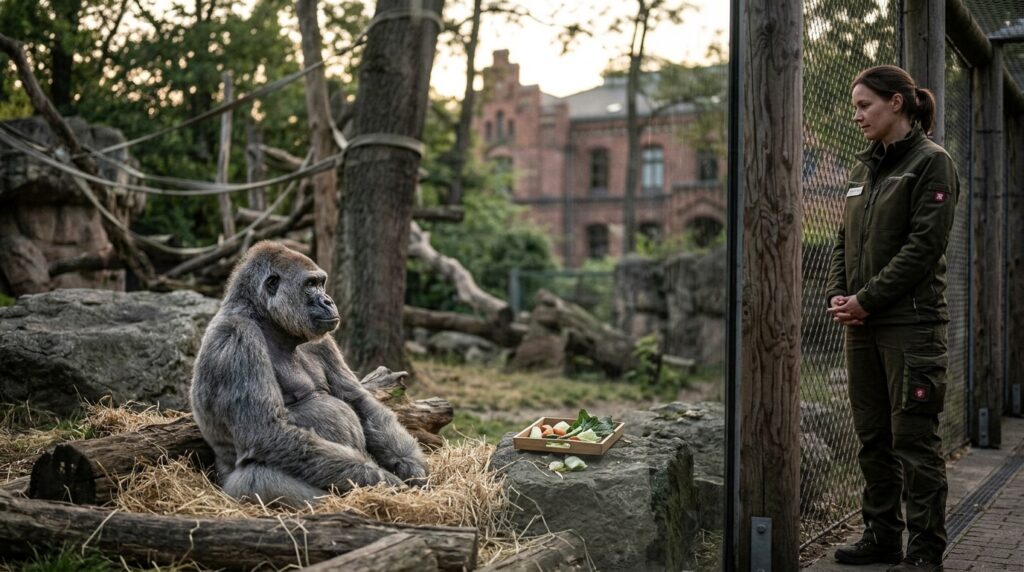
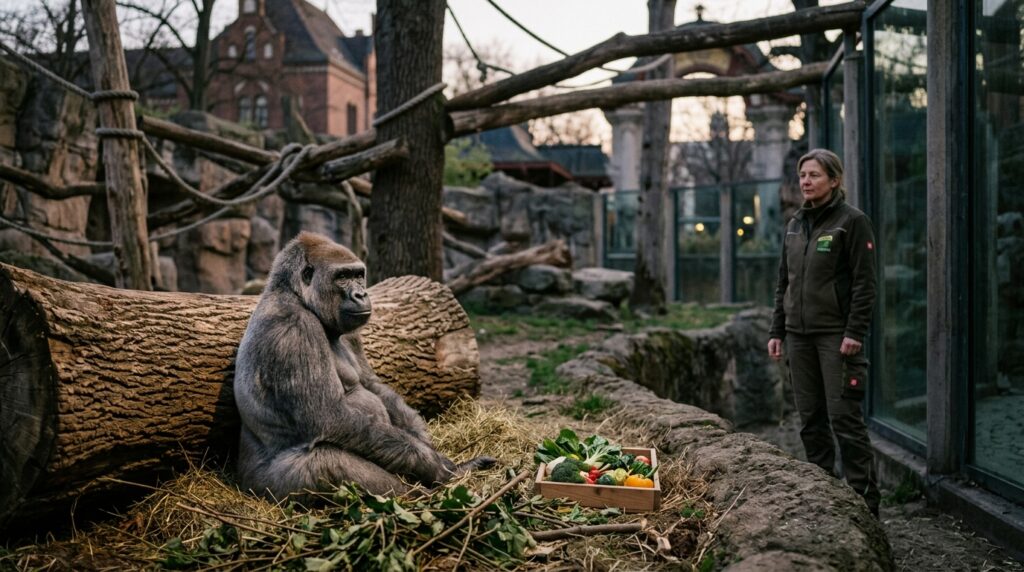
The western lowland gorilla, a resident of the German capital since 1959, marked her milestone birthday with a sugar-free vegetable feast as keepers emphasized individualized care for one of the zoo world’s most remarkable seniors.
BERLIN — Fatou, the world’s oldest gorilla living in captivity, celebrated her 69th birthday at Berlin Zoo with a quiet feast of vegetables, another milestone for an animal whose life spans the Cold War, German reunification and the transformation of modern zoological care.
The western lowland gorilla marked the occasion on April 13, the symbolic birthday assigned by the zoo because her exact birth date is unknown. Instead of a cake, keepers prepared a sugar-free spread of vegetables including cherry tomatoes, beets, leeks and lettuce, reflecting the careful diet now required for an elderly primate whose health is monitored closely by veterinarians, curators and keepers.
For visitors, the scene was both simple and extraordinary: an aging gorilla moving slowly through her enclosure, selecting food from a colorful arrangement, surrounded by the attention that has followed her for decades. For Berlin Zoo, it was a public celebration of longevity, animal care and conservation. For the wider world of zoology, Fatou remains a rare case — a gorilla who has outlived the normal life expectancy of her species by many years and become a living archive of changing human attitudes toward wildlife.
Fatou arrived in what was then West Berlin in 1959, when she was believed to be about two years old. Guinness World Records says she has lived at Berlin Zoo since May of that year and recognizes her as the oldest living gorilla in captivity. The zoo says she is not only its oldest resident but also a distinctive personality whose calm and dignified presence has made her one of its most beloved animals.
Her age is exceptional. Gorillas in the wild typically live around 35 to 40 years, while those in human care can live longer because of regular food supplies, veterinary attention and protection from predators and some environmental pressures. Even by captive standards, however, 69 is extraordinary. Guinness notes that the typical life expectancy for gorillas in captivity is between 40 and 50 years, making Fatou’s survival well beyond the usual range.
The birthday celebration reflected that reality. Fruit, once a familiar treat for zoo animals, has been removed from Fatou’s regular diet because of its sugar content and the risks of obesity and metabolic disease. Zoo Berlin said its Animal Health, Welfare and Research Department has adjusted her feeding plan to provide several small meals across the day, supporting natural foraging behavior while managing her changing nutritional needs.
Age has brought visible challenges. Fatou moves more slowly than she once did, and Berlin Zoo says her daily care has been adapted to her individual condition. AP reported that she has lost her teeth and has some arthritis and hearing loss. She lives in her own enclosure, separate from the more active gorilla group, a decision intended to provide the calm and space appropriate for an animal of her age.
That separation does not mean neglect or isolation in the ordinary sense. Keepers describe Fatou as friendly with staff, though still independent and stubborn. In the world of animal care, those details matter. A senior gorilla’s welfare is not measured only by medical survival but by comfort, choice, appetite, movement and the ability to behave in ways consistent with her needs.
Fatou’s story also carries an uncomfortable history. She is believed to have been born in the wild in western Africa. Guinness World Records says she was brought to Marseille, France, in 1959 by a sailor who reportedly used the young gorilla to settle a bill at a tavern, before she was acquired by a French animal trader and sold to Berlin Zoo. Such capture of wild animals for exhibition is no longer considered acceptable by the modern zoological community, which now relies largely on captive breeding, transfers between institutions and conservation programs.
The contrast between Fatou’s origin and her current status is striking. She began life in a period when the capture and movement of exotic animals were often treated as commerce or spectacle. She now lives in an era when major zoos present themselves as centers of conservation, research, education and animal welfare. Her birthday celebration therefore becomes more than a human-interest story. It is also a reminder of how far zoological ethics have changed, and how complex the legacy of older zoo animals can be.
Berlin Zoo has framed Fatou as an ambassador for western lowland gorillas, a species threatened by habitat loss and poaching. The western lowland gorilla is one of the best-known great apes in public imagination, but its wild populations face severe pressure from deforestation, illegal hunting, disease and human encroachment. Fatou’s calm presence in Berlin cannot solve those threats, but it can draw attention to them in a way that statistics alone rarely do.
The zoo’s director, Andreas Knieriem, has described her as a fascinating and calming presence who has inspired visitors for years. That language reflects a familiar argument made by zoos: that individual animals can create emotional connections that encourage public concern for species and habitats people may never see in the wild. Critics of captivity often challenge that argument, pointing to the moral costs of confining intelligent animals. Fatou’s case sits at the intersection of both views — a life shaped by captivity, but also one that has made millions of people look closely at a threatened species.
Her longevity has also made her part of Berlin’s civic memory. When Fatou arrived, the Berlin Wall had not yet been built. She lived through the division of the city, the wall’s construction in 1961, its fall in 1989 and the decades of reunified Germany that followed. Generations of Berliners have grown up knowing her as a fixture of the zoo. In 2024, after the death of Ingo the flamingo, Fatou became Berlin Zoo’s oldest resident.
There is a human tendency to treat very old animals as symbols, and Fatou has been asked to carry many meanings: resilience, continuity, dignity, survival and the success of long-term care. Yet the most important facts of her present life are practical and immediate. She needs food she can safely eat, an environment she can navigate, medical attention suited to geriatric conditions and keepers who understand her habits.
That is why the absence of birthday cake was not a minor detail. It showed how zoo husbandry has moved away from public spectacle toward individualized welfare. A colorful vegetable spread still gave visitors an image to remember, but the menu was designed around Fatou’s health rather than human expectations of celebration. In that sense, the birthday was both festive and clinical, affectionate and disciplined.
For Berlin Zoo, the milestone also offers a moment to communicate the less visible work behind senior animal care. Caring for a 69-year-old gorilla requires daily observation, diet planning, pain management, mobility assessment and environmental adjustment. It also requires restraint: allowing the animal to move at her own pace, avoiding unnecessary stress and recognizing that old age is not a performance.
Fatou’s birthday did not change the uncertain future facing western lowland gorillas in the wild. It did not erase the troubling circumstances of her arrival in Europe. But it gave the public a rare chance to consider one animal’s long life in full — the historical contradictions, the medical care, the ethical evolution and the quiet persistence of a gorilla who has become older than almost any of her kind.
As Fatou ate her vegetables in Berlin, the celebration was modest by design. There were no sugary treats and no theatrical display. There was simply an elderly gorilla, watched carefully by the people responsible for her care, marking another year in a life that began far from Germany and has become part of the city’s story. At 69, Fatou remains both a record holder and a reminder: longevity in captivity is not just a number, but a responsibility.
“””