
With about two million people drawn to Rio de Janeiro’s most famous beach, the Colombian star’s free show shows how global pop, public planning and destination marketing are reshaping the economics of major cities.
RIO DE JANEIRO — When Shakira stepped onto the stage facing Copacabana Beach, the concert was already larger than a night of music. It was a test of how a city famous for Carnival, New Year’s Eve and postcard scenery could use a free pop spectacle to move hotels, restaurants, transport systems, street commerce and its global image at once.
The Colombian superstar’s free concert on May 2 brought an estimated two million people to one of the world’s best-known waterfronts, according to Rio de Janeiro officials. The show, part of her “Las Mujeres Ya No Lloran” world tour, followed the model of other giant Copacabana performances by international artists, turning the beach into an open-air arena and the city into a temporary capital of Latin pop culture.
For fans, it was a rare chance to see one of the world’s most recognizable performers without buying a ticket. For Rio, it was something more strategic: a publicly backed cultural event designed to fill an economic gap after Carnival and before other high-season festivals, while reinforcing the city’s claim as a global host of mass entertainment.
City Hall and Riotur, the municipal tourism company, estimated before the event that “Todo Mundo no Rio 2026 – Shakira” could move R$776.2 million through Rio’s economy, or roughly US$155 million. The calculation included spending by local residents, domestic travelers and foreign visitors on accommodation, food, drinks, transport, retail and services. Officials projected that among the two million expected spectators, about 278,000 would be Brazilian tourists from outside Rio, 32,000 would be international tourists and around 1.7 million would be residents of Rio and its metropolitan area.
Those numbers explain why a free concert can still be treated as an investment. The revenue is not collected at the gate. It spreads through the city. A visitor who does not pay for a ticket may still pay for a hotel room, a taxi, a restaurant meal, sunscreen, bottled water, a caipirinha, a souvenir shirt or an extra day in Rio. Multiplied by hundreds of thousands of travelers, those small transactions become the financial logic behind a mega-event.
The scene on Copacabana showed that logic in motion. Fans began arriving early, claiming spots on the sand and near the promenade. Street vendors moved through the crowd selling water, snacks and drinks. Hotels and apartments overlooking the beach became premium viewing points. Restaurants, bars and kiosks along the waterfront benefited from a surge of visitors who turned the concert into a weekend itinerary rather than a single-night outing.
The city’s strategy also relies on timing. Carnival and New Year’s Eve are already established pillars of Rio’s tourism calendar. A major free concert in May helps extend the city’s appeal beyond its traditional peaks, giving travel agencies, hotels and airlines another anchor event to market. In that sense, Shakira’s performance was not only an artistic booking but a form of urban programming, aimed at making Rio feel active year-round.
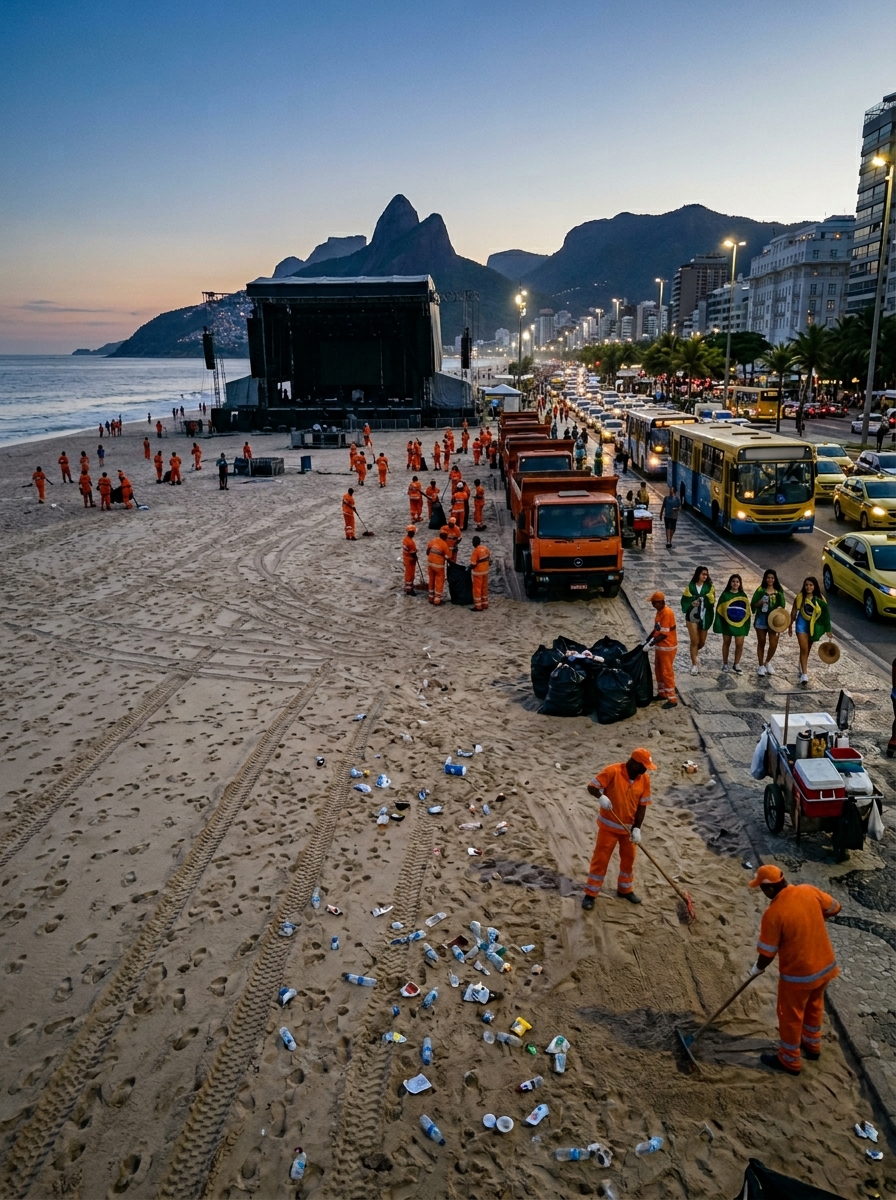
Copacabana is uniquely suited to this kind of spectacle. Few urban beaches can hold such crowds while offering a globally recognizable backdrop of ocean, mountains, hotels and high-rise apartments. The beach itself becomes part of the production value. Images of millions of people gathered beneath stage lights on the Atlantic edge travel quickly across television, social media and news sites, creating a level of destination advertising that would be difficult to purchase directly.
Rio officials have argued that this visibility has its own economic weight. The “Todo Mundo no Rio” series is now embedded in the city’s event calendar, with editions planned through at least 2028. Madonna’s 2024 Copacabana concert and Lady Gaga’s 2025 appearance helped establish the format. Shakira’s show strengthened the idea that the city can repeatedly convert its natural landscape into a mass cultural venue capable of drawing global attention.
But the model depends on heavy public coordination. Rio’s operational plan for the Shakira concert included special transport routes, road closures, municipal guards, medical posts, cleaning crews, social assistance teams and hundreds of monitoring cameras. Metro stations in Copacabana operated around the clock, while bus, BRT and light rail services were adjusted to move crowds into and out of the area. The purpose was not only to deliver entertainment, but to prevent the concentration of two million people from becoming a public safety or mobility crisis.
That scale also raises questions that follow every mega-event: who pays, who benefits and how much pressure is placed on public services and local residents. Free concerts can democratize access to major cultural experiences, especially at a time when global ticket prices often exclude lower-income fans. Yet they also require spending on security, sanitation, transport and crowd control, and they can temporarily disrupt neighborhoods such as Copacabana, where residents must navigate blocked streets, noise and intense foot traffic.
The balance is central to Rio’s argument. Officials say the return is many times larger than the investment, pointing to job creation and increased economic activity across tourism, hospitality, transport and commerce. For small vendors and service workers, the benefits can be immediate. For the city’s brand, the gain is longer term: every aerial shot of Copacabana filled with fans reinforces Rio’s identity as a place where large public celebrations can still feel both dramatic and accessible.
Shakira brought another layer to that identity. As a Colombian artist with deep popularity across Latin America, she connected Brazil to a wider regional cultural map. Her presence on Copacabana was not merely imported pop glamour from the English-speaking market. It was a Latin American star performing to a Brazilian audience, with songs that have crossed languages, borders and generations. That matters in a region where culture often travels faster than politics and where music can express a shared identity more easily than official diplomacy.
Her performance also reflected the changing economics of live music. Around the world, artists and cities are looking beyond traditional arenas and stadiums. Large public concerts can serve as media events, tourism campaigns and civic rituals. The audience may be physically present on the sand, but the wider reach comes through livestreams, short videos, drone images and news coverage. For a city, the concert becomes content. For an artist, it becomes proof of scale.
In Rio, that scale carries history. Copacabana has hosted some of the largest crowds ever assembled for music, religious events and public celebrations. What is changing is the deliberate use of that capacity as a tourism policy. The beach is no longer simply a beautiful place where crowds gather; it is being managed as a recurring global stage.
The success of Shakira’s concert will likely encourage other cities to study the model. Not every destination has Copacabana’s geography, symbolism or experience with crowd logistics. But many are searching for ways to turn cultural events into economic engines without relying only on ticketed venues. Rio’s lesson is that free access does not mean free economics. The money moves elsewhere, through the urban ecosystem.
For visitors, the memory may be simpler: a night on the sand, a global star under the lights, and a city that felt briefly like it belonged to everyone. For Rio de Janeiro, the calculation is more complex but no less emotional. In a city where celebration is part of civic identity, music is not only entertainment. It is infrastructure, advertisement, employment, soft power and invitation.
As the last fans left Copacabana and workers began returning the beach to its ordinary rhythm, the larger message remained visible. Rio had not just hosted a concert. It had turned a shoreline into a tourism platform, a pop star into an economic catalyst and a free public gathering into a statement about how cities compete for attention in the global experience economy.
