
As artificial intelligence moves from chatbots into robots, vehicles, science and industry, the technology behind it is becoming less like ordinary computing and more like a vast industrial system built from GPUs, data centers, models, energy and software.
SAN JOSE, California — To most people, artificial intelligence appears as a box on a screen. A user types a question, uploads an image, asks for a summary or requests a line of code, and the answer arrives almost instantly. The experience can feel light, invisible and effortless. But behind that simple exchange is one of the most demanding computing systems ever built.
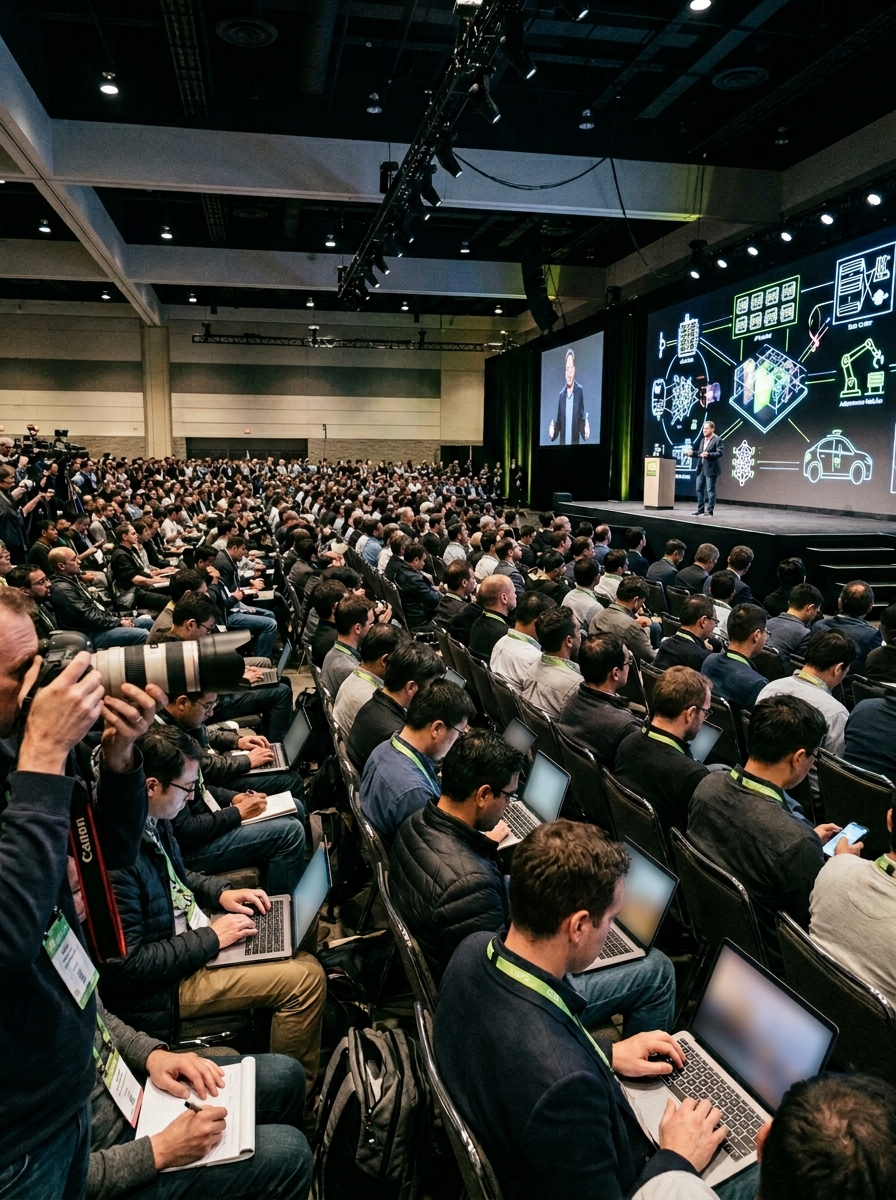
That hidden machinery is the central theme of NVIDIA GTC, the company’s global conference for developers, researchers, engineers and industry leaders working on AI infrastructure. GTC is not only a showcase for new chips. It is a meeting place for the people building the physical and digital foundation of modern artificial intelligence: graphics processors, networking systems, data centers, robotics platforms, autonomous vehicle computers, simulation tools, AI models and software that turns all of them into usable services.
The easiest way to understand why AI needs so much infrastructure is to begin with the difference between a CPU and a GPU. A central processing unit, or CPU, is like a highly skilled office manager. It is flexible, precise and good at handling many different tasks in sequence. It runs operating systems, controls programs and makes decisions across a computer. A graphics processing unit, or GPU, was originally designed for a different problem: drawing images by performing many small calculations at the same time.
That difference became crucial for AI. Modern AI models are built on mathematics that can be repeated millions or billions of times in parallel. When a model learns from text, images, video, speech or sensor data, it performs enormous numbers of matrix operations. These are not mysterious acts of intelligence in the human sense. They are calculations at a scale too large for ordinary machines to handle efficiently. GPUs are valuable because they can process many of those calculations simultaneously.
A single GPU is powerful, but today’s largest AI systems require far more than one chip. They require thousands or tens of thousands of processors linked together so tightly that they behave like one giant computer. That is where the data center enters the story. An AI data center is not simply a warehouse filled with servers. It is an engineered environment where power, cooling, networking, storage and software must work together with extreme precision.
Training an AI model is the first major task. During training, a model studies huge amounts of data and adjusts internal numerical settings known as parameters. The process can take weeks or months, depending on the model, the data and the computing system. The model is not memorizing in a simple way. It is learning statistical relationships: how words relate to other words, how pixels form objects, how sounds become speech, how code is structured, how a robot movement affects the physical world.
Once a model has been trained, another stage begins: inference. Inference is what happens when a user asks a model to do something. Every answer, image, translation, recommendation or robot command requires fresh computation. In the early years of generative AI, much attention focused on training ever-larger models. Now, as AI tools are used by millions of people and businesses, inference has become just as important. A model that is impressive in a laboratory must also be fast, affordable and reliable in daily use.
This is why NVIDIA uses the phrase “AI factory.” The metaphor is simple but powerful. A traditional factory takes raw materials and energy, then produces cars, electronics, food or steel. An AI factory takes data, electricity, chips and software, then produces intelligence in the form of tokens, predictions, decisions or actions. A token may be a piece of a word in a chatbot response, but the idea is broader. It represents the measurable output of AI work.
The factory metaphor also explains why energy efficiency matters. AI is not free. Every answer has a cost in electricity, cooling, hardware wear, network capacity and engineering. If demand for AI continues to grow, the industry cannot rely only on building larger facilities. It must also make each unit of computation more efficient. That is why chip design, networking speed, power delivery and cooling systems are now part of the AI conversation.
At GTC, the data center is presented as a system, not a collection of separate machines. GPUs must communicate with CPUs. Memory must move data fast enough to keep processors busy. Networking equipment must connect racks of servers with low delay. Storage must feed training data into the system. Cooling must remove heat from dense clusters of chips. Software must schedule workloads, recover from failures and protect data. If any layer is weak, the whole system slows down.
This system-level thinking is one reason AI infrastructure is becoming an industrial race. Cloud providers, governments, research institutions and major companies are all trying to secure computing capacity. In the past, a company might compete by owning better software. In the AI era, it may also compete by owning or renting enough compute to train models, run services and improve them continuously.
The same infrastructure is expanding beyond chatbots. Robotics is one of the most important examples. A robot needs to understand the world through cameras, lidar, touch sensors or other inputs. It must plan movements, avoid obstacles and adapt to objects that are never in exactly the same place twice. Training such systems in the real world is slow, expensive and sometimes dangerous. That is why simulation has become essential.
In simulation, robots can practice inside virtual factories, warehouses, kitchens, hospitals or streets before they operate in the real world. Synthetic data can help expose them to rare situations, such as a dropped object, an unexpected human movement or a difficult lighting condition. The goal is not to replace reality, but to prepare machines more safely and at greater scale. This is part of what NVIDIA and others call physical AI: artificial intelligence that does not only generate text or images, but acts in the physical world.
Self-driving vehicles face a similar challenge. A car must interpret lanes, signs, pedestrians, cyclists, rain, glare, construction zones and the unpredictable behavior of other drivers. It must make decisions quickly because a delay measured in fractions of a second can matter. That requires AI models, in-vehicle computing, sensor fusion and enormous data pipelines that collect, label, simulate and test driving scenarios. The vehicle on the road is only the visible endpoint. Behind it is a factory of data and computation.
AI chips are also becoming more specialized. GPUs remain central, but they are increasingly surrounded by other processors built for networking, security, storage, inference and low-power edge devices. In an AI factory, the question is not only how fast one chip can run. The question is how efficiently the entire system can move data, generate responses, train new models and serve users at scale.
For developers and researchers, this infrastructure changes what is possible. A scientist can use AI to search for new materials, model proteins, analyze climate data or simulate physical processes. A hospital can use AI to help interpret scans or organize records. A manufacturer can inspect products, optimize supply chains or program robots. A media company can translate, edit and personalize content. Each application looks different, but many depend on the same foundation: accelerated computing and large-scale AI systems.
The risks are equally real. Building AI infrastructure requires huge capital investment and large amounts of energy. Access to advanced chips is uneven across countries and companies. The concentration of compute can increase the power of a small number of technology firms. AI models can produce errors, reflect bias, threaten privacy or be misused. A smarter data center does not automatically create a wiser society. Governance, transparency and accountability remain necessary.
That is why the AI factory should be understood not as a magic machine, but as a new kind of public and economic infrastructure. Railways shaped industrial economies. Power grids shaped modern cities. The internet reshaped communication and commerce. AI infrastructure may now shape how knowledge work, automation, science and physical machines evolve.
NVIDIA GTC shows this transition with unusual clarity because it brings together the whole stack. The chip is there, but so is the robot. The data center is there, but so is the doctor, the carmaker, the researcher and the software developer. The keynote may focus on new hardware, but the deeper message is that AI has become an infrastructure problem as much as an algorithmic one.
For ordinary users, the future may still feel simple. They will ask better assistants for help, ride in smarter vehicles, use more capable phones, see robots in factories and receive faster digital services. Most will never see the GPUs, cooling systems, fiber links and scheduling software behind those experiences. But the quality of the experience will depend on them.
The age of AI is often described as a revolution in intelligence. It is also a revolution in machinery. The intelligence that appears on a screen is manufactured somewhere, by systems that consume power, move data and perform calculations at immense scale. GTC’s central lesson is that the future of AI will not be built by models alone. It will be built by factories of computation capable of turning data into useful action, again and again, for a world that is only beginning to understand how much intelligence it wants.
