
From smarter cameras and bigger batteries to foldable screens, thinner designs and custom chips, the annual phone reveal remains one of technology’s most powerful media rituals.
SAN FRANCISCO — Every year, the smartphone is declared mature. Every year, analysts ask whether the next model can still matter. And every year, millions of people watch keynote stages, livestreams, hands-on videos and social media leaks to see what Apple, Samsung, Google, Xiaomi, Oppo, Honor and other manufacturers will place inside the glass rectangle that already sits in their pockets.
The answer is not only about technology. A smartphone launch is now a cultural event because the phone is no longer just a device. It is a camera, wallet, map, gaming console, television, office, identity card, health tracker, memory archive and personal assistant. When a company announces a new phone, it is effectively announcing how people may photograph their families, navigate cities, talk to friends, work remotely, create content and increasingly interact with artificial intelligence.
That is why the launch still matters, even when the design changes appear small. A slightly better camera may affect billions of photos. A more efficient chip may decide whether AI features run privately on the device or must be sent to the cloud. A thinner body may change how a phone feels in the hand. A larger battery may determine whether a commuter trusts the device through a long day. A foldable screen may shift the phone from a pocket display into a small tablet.
The modern smartphone race is no longer defined by one headline specification. It is a competition over experience.
Camera AI has become the clearest example. The old smartphone camera war was fought with megapixels and lenses. The new one is fought with computational photography, generative editing, subject recognition, real-time guidance and image stabilization. Google’s Pixel line has leaned heavily into AI-assisted photography, offering tools that coach users on composition, combine group photos and edit images through natural language. Apple has used AI to improve framing and front-camera behavior. Samsung promotes AI as part of a capture-edit-share workflow, aiming to reduce the technical knowledge required to produce polished images.
This changes the meaning of photography. The phone is no longer simply recording what the sensor sees. It is interpreting the scene, correcting it, enhancing it and sometimes reconstructing it. For everyday users, the benefit is obvious: better portraits, clearer night shots, steadier video and easier editing. For journalists, artists and privacy advocates, the questions are equally obvious: when does improvement become alteration, and how should viewers understand images shaped by AI?
Battery life has become another battleground, though in a quieter way. Consumers may admire a brilliant display or a titanium frame, but they complain most loudly when a phone dies before evening. The rise of on-device AI makes power efficiency more important because advanced models, high-refresh screens, gaming, video capture and constant connectivity all draw energy. Manufacturers are responding with more efficient chips, redesigned internal layouts, faster charging and, in some markets, larger silicon-carbon batteries that promise longer endurance without making devices feel too bulky.
The thin-phone race shows how engineering is also marketing. Apple’s iPhone Air placed design back at the center of the launch conversation by emphasizing a 5.6-millimeter body, light weight, a high-refresh display, a 48-megapixel main camera and all-day battery life. The point was not only that the phone was thinner. The point was that Apple could present thinness as a symbol of progress after years in which many phones had begun to look and feel increasingly similar.
Samsung has taken a different route, combining premium hardware with AI and display innovation. Its Galaxy S26 series was announced as a third-generation AI phone, with Samsung describing the experience as more proactive and adaptive. The S26 Ultra also introduced a built-in privacy display, an example of how manufacturers are trying to connect hardware features with concerns about digital security. In a market where many flagship phones are already fast and sharp, privacy itself can become a feature.
Foldables remain the industry’s most visible attempt to change the shape of the smartphone. They have not yet replaced slab phones, but they have moved from novelty to strategic category. Book-style foldables promise productivity and entertainment on a larger display. Flip phones offer portability, nostalgia and fashion. Tri-fold concepts and ultra-thin folding designs show that manufacturers still believe the future phone may not be a single flat panel.
The challenge is trust. Foldables must convince buyers that hinges will last, screens will resist damage, software will use the larger canvas well and prices will fall enough for broader adoption. Forecasts suggest foldables will grow faster than the overall smartphone market in 2026, but the category still depends on solving practical concerns. Consumers do not only ask whether a foldable looks futuristic. They ask whether it can survive everyday life.
Chips are the hidden engine of the launch spectacle. Qualcomm, MediaTek, Apple, Samsung and Google now compete not only on speed, but on AI processing, thermal control, graphics, camera pipelines and power efficiency. Qualcomm’s Snapdragon 8 Elite Gen 5 was promoted around on-device AI, faster CPU and GPU performance and advanced video capabilities. MediaTek’s Dimensity 9500 emphasizes power efficiency and sustained performance. These chips matter because they decide what the phone can do without delay, heat or battery anxiety.
The arrival of on-device AI makes chip strategy even more important. A phone that can summarize messages, identify objects, edit photos, translate speech, screen calls or recommend actions locally may feel faster and more private than one that relies entirely on cloud servers. But it also raises expectations. Users will not tolerate AI that drains the battery, overheats the phone or produces unreliable suggestions. The next generation of smartphones will be judged as much by restraint as by intelligence.
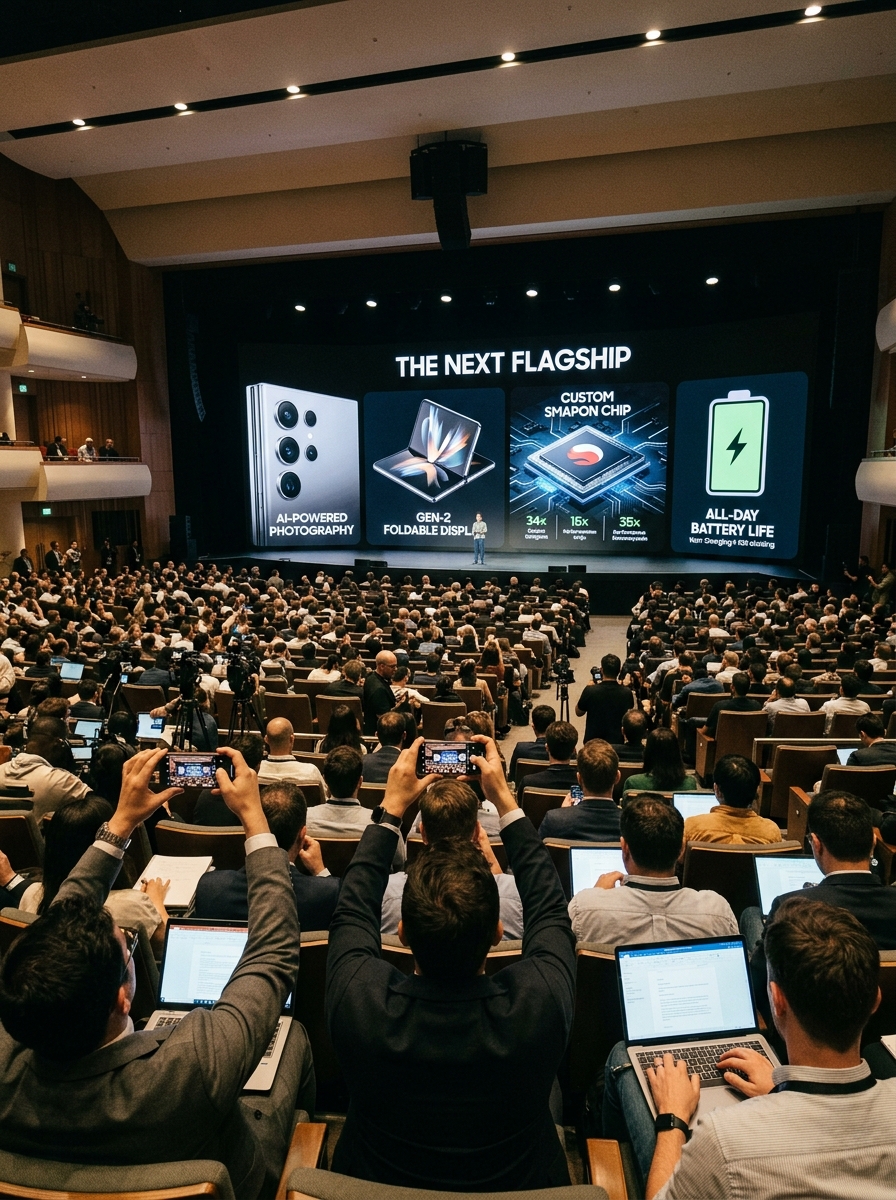
The annual launch event is how companies turn these technical changes into emotion. Apple’s keynotes use controlled storytelling, polished videos and design language to make engineering feel inevitable. Samsung uses large global events to frame its phones as part of a connected AI ecosystem. Google presents Pixel devices as practical demonstrations of its software and AI strength. Chinese manufacturers often compete through speed, charging, camera hardware, foldable experimentation and rapid product cycles.
Leaks, teasers and influencer previews are now part of the launch architecture. The event begins long before the official livestream. Supply-chain rumors set expectations. Rendered images circulate. Tech creators speculate on camera bumps, battery sizes and chip names. By the time the company executive walks on stage, the audience often knows much of what is coming — but still watches to see how the story is told.
That storytelling is essential because smartphone upgrades have become harder to explain. A faster neural processing unit or improved image signal processor does not have the immediate drama of the first touchscreen phone. Manufacturers must translate invisible improvements into daily benefits: fewer missed shots, better video calls, smoother gaming, smarter notifications, longer battery life, safer data and a phone that feels easier to live with.
The global audience is also different. In mature markets, many consumers keep phones longer and upgrade only when there is a clear reason. In emerging markets, affordability, durability, battery life and camera performance may matter more than premium AI features. For content creators, the phone is a production tool. For business users, it is a secure workstation. For teenagers, it is social identity. A successful launch must speak to all of them without sounding generic.
This is why smartphones remain central to technology culture. The industry may talk about smart glasses, mixed reality headsets, wearable AI devices and ambient computing, but the phone is still the device that people carry everywhere. It is personal, intimate and economically massive. It is also the gateway through which many new technologies reach the public.
The future smartphone may become more flexible, more private, more intelligent and less dependent on visible apps. It may fold, translate, edit, anticipate and protect. But the reason people still wait for its launch is simpler: the phone is where the future becomes ordinary.
Each annual reveal asks the same question in a new form. What will the device we touch hundreds of times a day be able to do next? As long as that answer affects how people see, speak, work, remember and connect, the world will keep watching.”””
