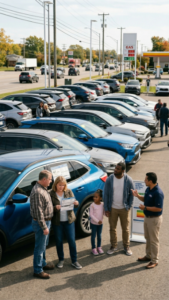
American buyers are turning back to hybrid vehicles as they seek lower fuel bills, familiar refueling habits and fewer compromises than many still associate with fully electric cars.
DETROIT — For years, the future of the American automobile appeared to be arriving with a plug. Automakers poured billions into battery plants, dealers installed chargers, and policymakers promoted electric vehicles as the next great shift in personal transportation. But in showrooms across the United States, many buyers are making a more cautious calculation. They want better fuel economy, but not a charging routine. They want lower emissions, but not range anxiety. They want technology, but not a lifestyle change.
That calculation is pushing hybrids back into the center of the U.S. auto market.
The comeback is not a rejection of electrification. It is a reminder that most consumers do not buy a powertrain as an ideology. They buy a vehicle to commute, take children to school, handle a weekend trip, survive winter weather and fit a monthly budget. For a growing number of Americans, the traditional hybrid — powered by a gasoline engine assisted by an electric motor and battery that does not need to be plugged in — has become the most practical answer.
Deloitte’s latest Global Automotive Consumer Study captured the mood clearly. Its 2026 findings said demand for battery-electric vehicles remains steady but cautious, while hybrid appeal continues to strengthen as consumers weigh affordability, charging access and everyday practicality. A year earlier, Deloitte reported that U.S. intent to purchase a hybrid or plug-in hybrid had risen five percentage points to 26%, while intent to buy an all-battery electric vehicle remained comparatively low at 5%. The firm described hybrids as a “best of both worlds” solution for consumers trying to reduce fuel costs without abandoning familiar driving patterns.
The sales data now tell a similar story. The U.S. Energy Information Administration, citing Omdia estimates, said about 22% of light-duty vehicles sold in the United States in 2025 were hybrid, battery-electric or plug-in hybrid vehicles, up from 20% in 2024. Within that electrified group, hybrids continued to gain market share while battery-electric and plug-in hybrid sales declined. The shift was especially notable after federal EV tax credits expired at the end of September 2025, when battery-electric market share fell sharply in the final months of the year.
This does not mean Americans have abandoned EVs. Cox Automotive said 2025 was still the second-best year on record for U.S. electric vehicle sales, with EVs taking 7.8% of the total market, slightly below 8.1% in 2024. But the quarterly pattern exposed the fragility of incentive-driven demand. EV share peaked in the third quarter, helped by buyers rushing ahead of tax-credit expiration, then dropped to 5.8% in the fourth quarter. Hybrids, by contrast, were not dependent on the same federal purchase credits and benefited from a simpler selling proposition: fewer gallons, no plug.
The practical difference matters. According to the U.S. Department of Energy’s Alternative Fuels Data Center, a hybrid electric vehicle cannot be plugged in to charge its battery. Instead, it uses regenerative braking and the gasoline engine to recharge. The electric motor can help the engine operate more efficiently, reduce idling and improve fuel economy without changing how the driver refuels. For many households, that removes the most intimidating part of EV ownership: installing a home charger or relying on public charging stations.
That concern remains significant. AAA’s 2025 EV survey found that high battery repair costs, purchase price, long-distance travel concerns, lack of convenient public charging stations and fear of running out of charge were among the leading reasons consumers hesitated to go fully electric. AAA also noted that many drivers may find hybrid or plug-in hybrid vehicles more appealing because they combine electric assistance with the familiarity of gasoline power.
In the showroom, that familiarity is powerful. A buyer comparing a hybrid SUV with a fully electric SUV may see two different versions of the same future. The EV promises quiet acceleration, lower fuel costs and fewer moving parts, but may also raise questions about charging access, resale values, road trips and battery replacement. The hybrid promises a more modest improvement, but one that fits neatly into habits Americans already know. Stop at a gas station. Drive hundreds of miles. Let the car manage the battery invisibly.
Toyota has benefited most visibly from that logic. Toyota Motor North America reported 2.52 million U.S. sales in 2025, up 8%, and said electrified vehicles represented 47% of its total volume. The company’s Toyota division said electrified sales were 49% of its volume, with best-ever years for models including the Corolla Hybrid and Camry Hybrid. Toyota’s long-standing bet on hybrids, once criticized by some EV advocates as too conservative, now looks well matched to a market where many consumers want efficiency without uncertainty.
Other automakers have taken notice. Hybrid versions of familiar nameplates are increasingly important not just for sedans but for SUVs, pickups and family vehicles — the segments that dominate American roads. The technology also offers automakers a way to meet customers halfway while battery costs, charging reliability and infrastructure coverage continue to evolve. For manufacturers, hybrids can help lift fleet fuel economy and reduce emissions without requiring the same scale of charging behavior change demanded by EVs.
The economics are equally important. New-vehicle prices and financing costs remain a major burden for buyers. Cox Automotive said U.S. new-vehicle sales reached 16.3 million in 2025, the best result since 2019, but it also warned that high prices and high interest rates continued to keep many consumers out of the market. In that environment, a hybrid’s appeal is not only environmental. It is monthly and practical. Buyers may pay more than for a comparable gasoline model, but many see a clearer path to savings through lower fuel use than they do with an EV that may carry a higher sticker price and require charging arrangements.
The hybrid resurgence also reflects the uneven geography of American transportation. EV ownership is easiest for homeowners with garages, predictable commutes and access to reliable charging. It can be more difficult for apartment dwellers, rural drivers, renters, households with one vehicle, and families that regularly drive long distances. Hybrids do not solve every emissions challenge, but they travel well across those differences. They work in cities, suburbs and small towns. They do not ask landlords, utilities or local governments to move first.
That is why the hybrid comeback should be understood less as a detour from electrification than as a consumer-led correction in its pace. Automakers and policymakers often describe the transition in technological terms: battery chemistry, charging networks, software platforms, emissions rules. Consumers experience it through errands, budgets, parking spots and winter trips to see relatives. When those daily realities collide with ambitious timelines, the middle ground becomes attractive.
There are limits to the hybrid case. Hybrids still burn gasoline and produce tailpipe emissions. They cannot deliver the zero-emission driving of a battery-electric vehicle. Over the long term, better battery technology, cheaper EVs, faster charging and a denser public network could shift the balance again. Many EV owners already find that home charging is convenient and that operating costs are lower than gasoline vehicles. The direction of travel for the industry remains electrified.
But the American market is signaling that the road there may be less linear than expected. The next phase is unlikely to be a simple contest between gasoline and electric power. It will be a mixed landscape in which hybrids, plug-in hybrids and EVs each serve different buyers at different stages of readiness.
For now, hybrids have regained momentum because they answer a question consumers are asking with increasing urgency: What is the most efficient vehicle I can buy without making my life more complicated? In 2026, that answer is often not the most futuristic car on the lot. It is the one that starts every morning, saves fuel in traffic, refuels in five minutes and asks its owner to change almost nothing.