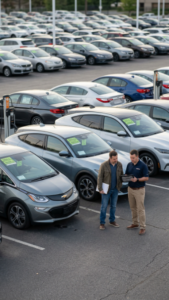
As non-Tesla electric models lose value faster and linger on dealer lots, buyers willing to study batteries, range and charging needs are finding a wider second-hand market.
The used-car market has rarely been kind to shoppers in recent years. Pandemic shortages, high interest rates and tight inventories pushed prices far above old expectations, turning even ordinary family cars into expensive purchases. But one corner of the market is beginning to look different: used electric vehicles, particularly those made by brands other than Tesla.
Across dealer lots and online listings, the second-hand EV market is showing signs of a reset. Data cited by Autoweek and iSeeCars show that while all used EV prices declined 3.0 percent in the first quarter of 2026 from a year earlier, non-Tesla EVs fell far more sharply, dropping 10.3 percent. Tesla values, by comparison, were nearly flat, down only 0.1 percent. Gas-powered cars declined 2.8 percent, and hybrids slipped just 1.4 percent.
The gap is important because it shows that the EV market is no longer moving as one category. Used Teslas still benefit from a strong charging network, broad brand recognition and a large base of buyers already familiar with the technology. Many non-Tesla electric models, however, are being repriced more aggressively as dealers work through growing supplies and consumers compare unfamiliar models with more established alternatives.
For bargain hunters, that divergence is becoming the opportunity. Cars such as the Chevrolet Bolt, Ford Mustang Mach-E, Kia EV6, Hyundai Ioniq 5, Nissan Leaf and Volkswagen ID.4 are increasingly appearing at prices that would have seemed unlikely just two or three years ago. Many are relatively new, often coming off leases, and some still carry portions of their original battery or powertrain warranties.
The discount is not only about price. It is also about time. According to iSeeCars figures reported by Autoweek, non-Tesla EVs are the slowest-selling used vehicles, sitting on dealer lots for an average of 60.1 days. Teslas move much faster, averaging 32.4 days, while the average used vehicle stays on a lot for 58.8 days. When a car sits, dealers often become more flexible. That can give buyers leverage on price, financing, trade-in terms or dealer fees.
The new dynamic comes after years of turbulence. During the early pandemic period, used EV prices rose sharply as new-car shortages pushed buyers into the second-hand market. Tesla price cuts later pulled down used values across the EV segment. Then, the expiration of federal clean-vehicle incentives changed the equation again. The IRS says the previously owned clean vehicle credit is not available for vehicles acquired after Sept. 30, 2025, removing a subsidy that had helped some buyers afford used EVs priced at $25,000 or less.
Normally, higher gasoline prices might be expected to boost demand for battery-powered cars. But the current market suggests many consumers are responding differently. Hybrids, which offer better fuel economy without requiring charging access, have become the safer middle ground for buyers worried about range, infrastructure or battery degradation. That helps explain why hybrid values have held up better than pure EVs.
Still, the used EV market is not collapsing. Cox Automotive reported that used EV sales reached 42,924 units in March 2026, up 27.7 percent from a year earlier and 53.9 percent from February. Used EVs represented 2.5 percent of used-vehicle sales that month. Recurrent, which tracks electric-vehicle pricing and battery data, also reported that total used EV sales in 2025 rose 35 percent from 2024. In other words, buyers are entering the market, but they are doing so with sharper price expectations.
The practical case for a used EV remains strongest for drivers who can charge at home, travel predictable daily distances and understand the vehicle’s real-world range. Electricity is usually cheaper per mile than gasoline, and EVs have fewer routine maintenance items. There are no oil changes, fewer brake replacements because of regenerative braking, and fewer moving parts in the drivetrain. But the savings are not automatic. Public fast charging can be costly, cold weather can reduce range, and insurance or tire costs can vary widely by model.
Battery health remains the biggest psychological barrier. Many buyers still fear that a used EV will require a costly battery replacement shortly after purchase. Industry data and owner experience suggest that severe degradation is less common than many shoppers assume, but battery condition still matters. A used EV should be evaluated differently from a used gasoline car. Buyers should ask for a battery health report, check remaining warranty coverage, compare displayed range with original EPA estimates, review charging history if available, and confirm whether the vehicle has had recall work or software updates completed.
The charging question is equally important. A cheap used EV may not be a bargain for someone who cannot charge reliably at home or at work. Apartment dwellers, renters and long-distance commuters need to calculate charging convenience before being tempted by a low sticker price. A driver with a garage outlet or a Level 2 home charger may see the economics differently from someone dependent on public stations.
Dealers are also adapting. Many traditional retailers were slow to embrace used EVs because sales staff needed to explain range, charging speeds, battery warranties and software features. Now, as more vehicles return from leases, dealers have to become more fluent. Some are adding battery diagnostics, EV-specific inspection sheets and clearer range disclosures. Those that do not may struggle to move inventory, especially when competing with specialist EV retailers and direct-to-consumer platforms.
For automakers, falling used prices are a mixed signal. Lower second-hand values can hurt lease residuals and make new EVs harder to finance attractively. But affordable used EVs can also introduce new buyers to electric driving. A household that would never spend more than $50,000 on a new EV may be willing to try a three-year-old model for half that price. If the experience is positive, that buyer may remain in the electric market.
The non-Tesla discount also reflects a branding challenge. Several rival EVs offer competitive range, faster charging or better interiors than comparable Teslas, but they often lack the same resale confidence. Some use charging standards that are in transition. Some belong to automakers that have changed EV plans or slowed production. Buyers may interpret that uncertainty as risk, even when the cars themselves are capable.
This is why the best deals require careful homework rather than impulse buying. A low price on a used EV should be weighed against range needs, charging access, battery condition, software support, warranty status and local repair options. The right car can deliver quiet performance, low running costs and modern safety features at a price close to, or below, comparable gasoline models. The wrong one can become frustrating if it does not fit the driver’s life.
For now, the market appears to favor informed shoppers. Non-Tesla EVs are cheaper than they were a year ago, many are staying on lots long enough to invite negotiation, and supply is improving as more leased vehicles return. The old assumption that electric cars are always the expensive choice is becoming harder to defend in the used market.
The bargain, however, is not simply the lowest number on the windshield. It is the match between price, battery health, charging reality and daily use. For buyers who can make that match, the second-hand EV market in 2026 may be offering something rare in the car business: a genuine deal.