Electric vehicles promise the lowest running costs for many drivers, hybrids offer the safest middle ground, and gasoline cars still make sense where price, distance and infrastructure matter most.
The question facing car buyers is no longer whether electric vehicles are real cars. They are. The harder question is whether an electric vehicle, a hybrid or a gasoline-powered model is the right car for a particular household, road network and budget.
There is no universal answer. The best choice depends on where a driver lives, how far they travel, whether they can charge at home, how long they plan to keep the vehicle, and how much risk they are willing to accept from changing technology and policy. The same car that saves one family money can become inconvenient for another.
Electric vehicles are the strongest choice for drivers who can charge at home or at work, travel predictable daily distances and plan to keep the vehicle long enough to benefit from lower fuel and maintenance costs. The appeal is simple: fewer moving parts, no oil changes, quiet operation, strong acceleration and zero tailpipe emissions. For commuters with a garage, driveway or reliable workplace charger, an EV can make refueling almost invisible. The car charges overnight, like a phone, and starts each morning with enough range for most daily use.
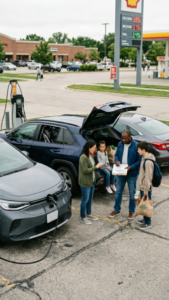
That convenience becomes less certain for people who depend entirely on public charging. Public networks are improving quickly, but the experience varies by country, city, neighborhood and charging provider. A fast charger on a map is not always available, working, affordable or located where a driver wants to wait. Apartment residents, renters and people who park on the street face the biggest barrier. For them, an EV may still be a good choice, but only after checking real charging options, not just advertised range.
Range anxiety has also become more nuanced. Many modern EVs can cover everyday needs easily, and longer-range models have made road trips more practical. But cold weather, high-speed highway driving, heavy loads and towing can reduce range sharply. Drivers who regularly cross rural areas, travel in winter conditions or tow trailers should be especially cautious. An EV can still work, but it requires more planning than a gasoline vehicle.
Hybrids occupy the center of the market, and that is why they are gaining renewed attention. A conventional hybrid does not need to be plugged in. It uses a battery and electric motor to support a gasoline engine, especially in city driving, where stop-and-go traffic allows the system to recover energy. For many households, a hybrid delivers much of the fuel savings people want without asking them to change their habits.
That makes hybrids particularly attractive for buyers without home charging, drivers who split time between cities and highways, and families that want one vehicle for commuting, school runs, holidays and emergencies. Hybrids also avoid the biggest psychological hurdle of EV ownership: the fear of being unable to recharge. They use existing fuel stations, travel long distances easily and usually cost less than comparable EVs before incentives.
Reliability is another reason hybrids deserve attention. Many conventional hybrid systems are now mature, tested over years and widely available in mainstream models. They are more complex than gasoline-only cars, but automakers have refined the technology. For a cautious buyer who wants lower fuel bills but does not want to bet entirely on charging infrastructure, the conventional hybrid is often the most balanced answer.
Plug-in hybrids are more complicated. They can be excellent when used correctly. A driver who charges every night and has a short commute may complete most daily trips on electricity while keeping a gasoline engine for long journeys. But a plug-in hybrid only delivers its best value when it is actually plugged in. Without regular charging, it can become a heavier, more expensive gasoline car carrying unused battery hardware.
Gasoline vehicles remain relevant for practical reasons. They are usually familiar, widely serviced and often cheaper to buy upfront, especially in used markets. They refuel quickly, work well in remote areas and remain the simplest choice for drivers who cover very low annual mileage. If someone drives only occasionally, the fuel savings from an EV or hybrid may not offset a higher purchase price for many years.
Gas vehicles also still make sense for some heavy-duty uses. Long-distance towing, remote work sites, inconsistent electricity supply and limited charging corridors can make internal combustion more convenient. For buyers in regions where EV service networks are thin or electricity prices are high, the financial case for an EV weakens.
The mistake is to judge the three technologies only by sticker price. The real calculation is total cost of ownership: purchase price, financing, insurance, fuel or electricity, maintenance, repairs, taxes, incentives and resale value. EVs often cost more upfront but less to run. Hybrids usually sit in the middle. Gasoline vehicles may be cheaper to buy but more expensive to fuel over time.
Maintenance follows the same pattern. EVs avoid oil changes, exhaust systems and many engine-related repairs, but tires can wear faster because of vehicle weight and instant torque. Battery repairs outside warranty can be expensive, though battery failures are not the same as ordinary degradation. Hybrids still need engine maintenance but often reduce brake wear through regenerative braking. Gasoline cars are mechanically familiar, but their engines, transmissions and emissions systems require more routine service.
Environmental impact is another factor, but it should be understood honestly. EVs have no tailpipe emissions, which is important in polluted cities, and they usually become cleaner as power grids add renewable energy. But battery production carries environmental costs, including mining, processing and manufacturing emissions. Hybrids reduce fuel consumption without requiring large batteries. Gasoline vehicles have the highest tailpipe emissions, but keeping an existing efficient car longer can sometimes be better than replacing it too early, depending on use.
Resale value is harder to predict. EV prices have been volatile because battery costs, incentives, model availability and consumer confidence are changing quickly. Some used EVs have become bargains; others have depreciated faster than expected. Hybrids have often held strong appeal because they offer fuel savings without charging uncertainty. Gasoline models remain liquid in many used markets, especially where charging access is limited.
The best decision starts with a simple personal audit. A driver with private parking, daily mileage under the vehicle’s comfortable range, high fuel costs and a plan to keep the car for several years should strongly consider an EV. A driver without reliable charging, but with frequent city use and a desire for lower fuel bills, should look first at a conventional hybrid. A driver with low mileage, a tight purchase budget, rural routes or heavy towing needs may still be better served by gasoline.
For one-car households, the hybrid may be the least stressful bridge. For two-car households, an EV often works well as the main commuter while a hybrid or gasoline model handles rare long-distance or heavy-use trips. For urban drivers with reliable charging, the EV is increasingly hard to ignore. For rural drivers far from fast chargers, patience may still be the wiser option.
The market is moving toward electrification, but buyers do not have to move at the same speed. A car is not a political statement for most families. It is a tool for work, school, health care, emergencies and daily life. The right answer is the one that reduces cost and stress at the same time.
For now, the cleanest rule is also the most practical: choose an EV if charging is easy, choose a hybrid if charging is uncertain, and choose gasoline if purchase price, remote travel or specialized use still dominate the decision. The future may be electric, but the best car today is the one that fits the driveway, the budget and the road ahead.