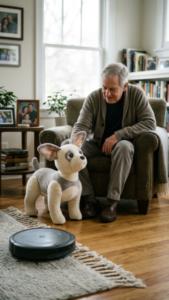
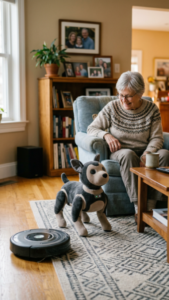
A new generation of domestic machines is moving beyond vacuuming and mopping toward elder support, emotional interaction, household care and AI-driven companionship.
NEW YORK — For more than two decades, the home robot had a familiar shape: round, low to the floor and built to chase dust. The Roomba made domestic robotics practical by solving one narrow problem well enough for millions of households. It did not need to talk, smile or understand loneliness. It only needed to clean.
That era is no longer enough for the robotics industry. The next generation of home robots is being designed not only to perform chores, but to live around people. Companies are experimenting with companion robots, elder-care assistants, mobile home monitors, pet-like machines, social robots for children and devices that promise a warmer emotional presence. The ambition is shifting from automation to relationship.
The clearest symbol of that shift arrived this week from Colin Angle, the iRobot co-founder widely associated with the Roomba. His new company, Familiar Machines & Magic, has introduced a four-legged AI companion robot called Familiar, a plush prototype designed less like an appliance and more like a creature. It is not meant to be a dog or a cat. It is meant to be something else: a domestic presence that learns the rhythms of a home and responds to the people in it.
According to the company, Familiar is part of a broader push toward “emotionally intelligent, physical AI” that can understand social context, read a room and operate safely in human spaces. The company says data is stored on the device and users control whether it is shared with the cloud, a direct response to one of the biggest concerns about putting intelligent machines inside private homes.
The prototype reflects a major change in consumer robotics. Earlier home robots were useful because they stayed in the background. New companion robots must do almost the opposite. They need to be noticed without becoming annoying, expressive without becoming deceptive, helpful without pretending to be human and intelligent without feeling invasive. That is a much harder task than vacuuming a floor.
Familiar is designed to communicate largely without speech. Reports from its debut described a soft, animal-like robot with expressive ears, eyes, body movements and touch-sensitive fur. It uses on-device generative AI to learn from interactions and adapt over time. Instead of answering questions like a smart speaker, it is intended to respond through motion, sound and behavior, creating the impression of companionship rather than conversation.
The target market explains the emotional design. Many older adults want companionship but may not be able to care for a live pet. Others may live alone, face mobility limits or need gentle daily engagement more than another screen. A robot that can greet, respond, remind, notice and comfort could become part of the aging-in-place toolkit, especially as families and health systems look for ways to support independence at home.
Loneliness gives the trend urgency. The U.S. Surgeon General’s 2023 advisory described loneliness and social isolation as serious public health concerns, linked to physical and mental health risks. The National Academies has also warned that social isolation and loneliness among older adults are underappreciated health risks. Robots cannot solve that crisis alone, and they should not be marketed as substitutes for family, friends, caregivers or community. But they may become one layer of support for people who spend long hours alone.
The elder-care use case goes beyond emotional support. Home robots can be designed to remind users to take medication, encourage hydration, guide light exercise, detect routine changes, connect with family members, help with telehealth visits or alert caregivers when something seems wrong. Some may not need arms or humanoid bodies. A moving camera, speaker, sensor array and AI model may be enough for many daily tasks. Others, especially future assistive robots, may need more advanced mobility and manipulation to help with physical chores.
That distinction matters. The home robotics market is not moving toward one universal robot. It is splitting into categories. Cleaning robots still dominate the practical side of the market. Monitoring robots help families check on children, pets or older relatives. Social robots aim to provide engagement. Care robots focus on safety and routines. Future household robots may fold laundry, clear tables, organize rooms or carry objects, but those tasks remain technically difficult because homes are cluttered, unpredictable and full of fragile things.
Artificial intelligence is changing what seems possible. Older robots followed programmed behaviors. Newer systems can use computer vision, voice recognition, generative AI and local sensors to interpret context. A robot can learn that one person likes quiet mornings, another needs medication reminders and a child usually comes home at 4 p.m. The more it understands routine, the more useful it can become.
But usefulness depends on trust. A robot in the home may see bedrooms, hear conversations, track movement and infer health or emotional states. That information is far more sensitive than a shopping preference or search query. Companies that build home robots will need clear privacy rules, strong security and honest explanations of what the robot records, what it processes locally and what it sends elsewhere. A cute design will not be enough if consumers fear surveillance.
There is also an ethical question about emotional machines. A robot can appear affectionate without feeling affection. It can respond to sadness without understanding sadness as a person would. For some users, that may not matter if the interaction provides comfort. For others, the illusion may feel manipulative. The industry will need to avoid promising too much, especially when marketing to older adults, children or people experiencing loneliness.
The history of social robots offers a warning. Several highly publicized companion robots have struggled to move from novelty to daily necessity. Consumers may enjoy a demonstration but lose interest after the first weeks. The robot must earn its place in the home through repeated usefulness, not just charm. It must be easy to maintain, physically safe, affordable, durable and socially acceptable enough that people do not feel embarrassed owning it.
Still, the timing may be better than before. Sensors are cheaper. AI models are more capable. Edge computing allows more processing on the device. Batteries, motors and materials have improved. Consumers are already used to smart speakers, robot vacuums, wearables and AI assistants. The gap between a voice assistant and a physical companion is still large, but it is smaller than it was a decade ago.
The home robot of the future may not look like science fiction. It may not cook dinner, carry a person from bed to chair or hold a complex debate about world events. It may instead do smaller things reliably: notice a fall risk, remind a widower to eat lunch, entertain a child for a few minutes, patrol the house, check on a pet, guide a breathing exercise, or greet someone returning from work with a movement that feels familiar.
That is the deeper meaning of Familiar and similar projects. The industry is no longer asking only what robots can do for the home. It is asking how robots should behave inside the home. Cleaning was the first test because it was practical. Companionship is the next test because it is emotional.
The robot that succeeds will not be the one that pretends to be human. It will be the one that understands the limits of the machine and the needs of the household. It will protect privacy, respect attention, support independence and create comfort without replacing real human connection. After the Roomba, the next great home robot may not be judged by how well it cleans the floor. It may be judged by whether people are glad to see it when it enters the room.