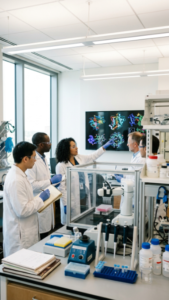
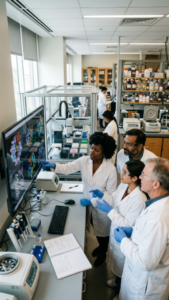
From drug design and protein prediction to materials simulation, energy optimization and biomedical data analysis, artificial intelligence is becoming a research partner — but not a replacement for scientific proof.
NEW YORK — The old image of scientific discovery is a patient researcher at a bench, testing one idea after another. That image is not disappearing. But it is being joined by something faster: algorithms that scan millions of molecules, predict protein structures, simulate materials, search medical records, operate robotic laboratories and suggest experiments humans may not have considered.
Artificial intelligence is moving into the core machinery of science. It is being used to find drug candidates, forecast how proteins fold, design enzymes, model new battery materials, optimize power grids, analyze biomedical data and guide automated labs. The promise is not simply that AI can make science more efficient. It is that it may change the scale of scientific search itself.
In traditional research, scientists often begin with a hypothesis, test it, learn from the result and repeat. AI can widen that loop. A model can evaluate thousands or millions of possible compounds, materials or genetic patterns before a lab team chooses what to test physically. It can identify relationships hidden in data too large for human inspection. It can turn slow trial-and-error into a more directed search.
That shift is most visible in biology. Protein structure prediction, once one of the great unsolved problems in molecular science, has become a symbol of AI’s scientific power. Google DeepMind’s AlphaFold system has predicted structures for more than 200 million proteins, making a vast library of molecular shapes available to researchers. In 2024, the Nobel Prize in Chemistry recognized David Baker for computational protein design and Demis Hassabis and John Jumper for protein structure prediction, confirming that AI-enabled methods had entered the highest level of scientific recognition.
The importance of protein prediction is practical. Proteins do much of the work inside cells, and their shape strongly affects what they can do. When researchers understand a protein’s structure, they can better study disease, design drugs, engineer enzymes and explore biology at atomic scale. AlphaFold did not eliminate laboratory validation, but it gave scientists a powerful map for deciding where to look.
The next phase is more complex. AlphaFold 3 and similar systems are aimed not only at individual proteins but at molecular interactions involving proteins, DNA, RNA, small molecules and other biological components. That matters because drugs work by interacting with living systems, not by binding to isolated textbook diagrams. If AI can help predict those interactions more accurately, it could reduce wasted effort in early drug discovery.
Drug development is the field where expectations are highest and caution is most needed. Pharmaceutical research is slow, expensive and failure-prone. Many compounds that look promising in a computer or animal model never prove safe and effective in people. AI can help identify targets, generate molecules, predict toxicity and match patients to trials, but it cannot repeal biology’s complexity.
Still, the first clinical signals are important. In 2025, Nature Medicine highlighted a randomized Phase 2a trial of an AI-discovered drug and target combination for idiopathic pulmonary fibrosis, reporting safety and signs of efficacy. The study did not prove that AI can reliably produce successful medicines on demand. It did show that AI-enabled discovery is moving beyond software demonstrations and into human clinical testing.
Materials science is another frontier. Batteries, solar cells, semiconductors, catalysts and carbon-capture systems all depend on materials with specific properties. Finding them has historically required years of theory, synthesis and testing. AI is accelerating the search by predicting which crystal structures may be stable and useful before researchers attempt to make them.
Google DeepMind’s GNoME project reported the discovery of 2.2 million new crystal structures, including hundreds of thousands predicted to be stable. At Lawrence Berkeley National Laboratory, the A-Lab combines AI, robotics and automated experimentation to synthesize and test inorganic materials. The direction is clear: the laboratory is becoming a closed loop in which AI proposes, robots test, instruments measure and the system learns from the results.
Energy research is being reshaped in a similar way. AI can forecast demand, optimize building systems, improve grid operations, detect faults in equipment, model battery performance and assist in the development of new chemistries. The International Energy Agency has described AI as both a source of rising electricity demand and a tool that could help optimize energy systems and drive innovation. That dual role is central to the debate. AI may help make energy systems smarter, but the data centers that train and run AI models also consume significant power.
This tension is why “AI for science” is not only a technical story. It is an infrastructure story. Scientific AI needs high-quality datasets, computing capacity, specialized chips, cloud platforms, secure data systems and skilled researchers who understand both algorithms and the scientific domain. A model is only as useful as the data, assumptions and validation process behind it.
McKinsey’s Technology Trends Outlook frames this broader landscape clearly. The firm says frontier technologies are not limited to AI alone. Its 2025 report identifies 13 technology trends, including artificial intelligence, agentic AI, immersive-reality technologies, quantum technologies, robotics, future bioengineering, cloud and edge computing, advanced connectivity, application-specific semiconductors and energy and sustainability technologies. AI stands out as a general-purpose technology, but it also acts as an amplifier of other trends.
That convergence may matter as much as AI itself. A scientist could use AI to design a molecule, robotics to test it, immersive reality to inspect complex data, quantum computing to model difficult chemistry, bioengineering to build a therapy and cloud infrastructure to share results globally. Discovery becomes less a single invention than a network of technologies reinforcing one another.
Biomedical research shows both the opportunity and the governance challenge. The U.S. National Institutes of Health has supported Bridge2AI, a program focused on creating ethically sourced, trustworthy and AI-ready biomedical datasets. That goal sounds technical, but it is fundamental. If biomedical data are biased, incomplete or poorly documented, AI systems may reproduce those weaknesses at scale. In health research, bad data can lead to bad science and, eventually, harm.
Human judgment remains essential. AI can generate hypotheses, but it cannot decide alone which questions society should prioritize. It can detect patterns, but correlation is not causation. It can propose experiments, but results still need replication. It can write code, analyze images and summarize literature, but it can also hallucinate, overfit or produce answers that appear convincing without being true.
The strongest scientists are therefore treating AI less as an oracle than as a collaborator. It is a tireless search engine for possibility, a simulator, a pattern detector and a lab assistant. The human role shifts toward framing the right problem, checking assumptions, designing validation, interpreting meaning and deciding what should be built.
The future of AI in science will not be judged by spectacular demos alone. It will be judged by whether new drugs actually help patients, whether new materials can be manufactured, whether energy systems become cleaner and more reliable, and whether biomedical discoveries benefit broad populations rather than narrow datasets.
AI is speeding up the search for discovery, but science still depends on evidence. The breakthrough era will belong not to machines alone, nor to humans working as before, but to research systems that combine computational scale with experimental discipline. In that partnership, the most important discovery may be a new way of discovering.