As studios, streamers and creators adopt generative tools for trailers, music, virtual characters and personalized media, the industry is confronting a new question: not whether AI can make entertainment, but who controls it.
The next wave of entertainment may not begin on a film set, in a recording studio or inside a writers’ room. It may begin with a prompt, a library of licensed images, a voice model trained under contract, a storyboard generated before a camera is booked, and an algorithm that decides which version of a story a viewer is most likely to finish.
Artificial intelligence, once treated by many entertainment companies as a novelty or a cost-saving experiment, is moving deeper into the machinery of global media. It is being used to generate concept trailers, assist composers, design virtual characters, draft scripts, accelerate visual effects and tailor content recommendations at a level that goes beyond traditional personalization. In 2026, the shift is no longer mainly about dazzling demonstrations. It is about infrastructure, workflow and control.
Deloitte’s 2026 Technology, Media and Telecommunications Predictions framed the change as part of a broader transition across technology, media and telecoms, saying AI is redefining the foundations of hardware, software, telecom and media while driving infrastructure investment and reshaping business models. For entertainment executives, that means AI is becoming less like a special effects plug-in and more like an operating layer: embedded in production schedules, editing systems, marketing tools, distribution platforms and rights-management negotiations.
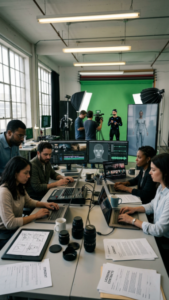
The consequences are already visible. Independent filmmakers are using AI video tools to produce mood reels and speculative trailers that once required teams of editors, stock-footage researchers and motion-graphics artists. Music creators can generate draft compositions, synthetic backing tracks or genre variations in minutes. Studios can use AI-assisted previsualization to test camera angles, lighting styles and action sequences before committing to a shoot. Streaming platforms can sharpen thumbnails, recommendations and advertising messages for specific audience segments. Game companies can prototype non-player characters with generated dialogue and reactive personalities. Virtual influencers and digital idols, already common in parts of Asia, are becoming more technically sophisticated and easier to scale.
The technology’s defenders say this can widen access to production. A filmmaker without a large budget can visualize a science-fiction city. A small music label can test multiple versions of a song for different markets. A children’s animation studio can localize voices and visuals faster. A brand can make a campaign trailer without waiting for a full production cycle. These are not minor changes in an industry where time, labor and upfront capital determine which ideas survive.
McKinsey has described generative AI as a force that could transform every stage of film and television production, from script to screen, while potentially changing who gets to make content. That possibility is central to the optimism around AI entertainment. The tools can compress the distance between imagination and prototype. They can help creators who lack access to Hollywood financing, elite visual effects houses or traditional distribution. They can also create new formats, from interactive fan-directed stories to micro-dramas generated and edited for mobile audiences.
But the same tools that lower barriers can also flood the market. Music offers one of the clearest warnings. Deezer said in September 2025 that it was receiving more than 30,000 fully AI-generated tracks a day, accounting for more than 28 percent of daily delivery to the platform. By April 2026, public reports citing Deezer said the number had risen to nearly 75,000 AI-generated tracks a day, or roughly 44 percent of daily uploads. Spotify, confronting the same pressure, announced stronger rules against unauthorized vocal impersonation, new protections for artists and a music spam filter designed to reduce mass-upload abuse.
For listeners, the problem is not simply whether a song was made by a machine. It is whether synthetic content is being used honestly, whether royalties are being diverted from human artists, and whether recommendation systems are filling playlists with low-cost tracks designed more for algorithmic capture than emotional connection. AI music can be creative, playful and commercially useful. It can also be a form of industrialized filler.
The same tension is emerging in film and video. AI-generated trailers and concept reels can help studios test audience appetite before spending millions. They can also mislead viewers when fan-made or speculative trailers are edited to look official. On platforms such as YouTube, creators are now required to disclose meaningfully altered or synthetically generated content when it appears realistic, including material that makes a real person seem to say or do something they did not do, alters footage of a real event, or generates a realistic scene that never happened.
That distinction matters because entertainment does not exist in a sealed creative space. A realistic AI trailer can influence fan expectations, market behavior and reputational risk. A synthetic actor can revive a deceased performer, replace an extra, imitate a celebrity or create an entirely new character. A voice clone can preserve a performance, localize a film or steal an artist’s identity. The technology is powerful precisely because it works in the emotional territory where audiences form trust.
OpenAI’s Sora 2 release in 2025 underscored the pace of change in video generation, with the company describing a model capable of more realistic and controllable video, synchronized dialogue and sound effects, and social features that allow users to insert themselves into generated scenes after identity verification. Similar tools from other companies are competing to make high-quality synthetic video easier to create, remix and distribute. For entertainment, that means the trailer, the short film, the music video and the social clip are starting to merge into one AI-assisted format.
The labor debate remains unresolved. The 2023 Hollywood strikes placed AI at the center of negotiations over writers’ and actors’ rights. Since then, unions have continued to seek rules around consent, control and compensation. SAG-AFTRA’s 2025 commercials contracts, for example, emphasized mandatory consent before digital replicas are created, informed consent before use, payment when a digital replica generates a performance, and restrictions on using performer data to train AI without union consent. These provisions signal a broader industry principle: AI may be used in entertainment, but performers and creators want enforceable rights over their likeness, voice and labor.
Studios face their own risks. AI can reduce costs, but it can also create legal exposure if training data, likeness rights or music catalogs are not properly licensed. It can accelerate production, but it may weaken a brand if audiences see the result as cheap or deceptive. It can generate thousands of variations, but not necessarily a better story. Entertainment companies are learning that the most valuable AI systems may not be the ones that replace creators, but the ones that help trusted creators work faster, test ideas earlier and manage complex rights more transparently.
The next stage of AI entertainment is likely to be hybrid. Scripts may be developed with AI research assistance, but rewritten by humans. Virtual characters may be designed with generative tools, but voiced by licensed actors. Visual effects teams may use AI for rotoscoping, background generation and previsualization, while reserving final artistic judgment for supervisors. Music producers may use AI drafts as raw material, but build finished songs around human taste, performance and identity. Platforms may personalize trailers, thumbnails and recommendations, but face increasing pressure to label synthetic media clearly.
For audiences, the bargain will depend on transparency. Many viewers may accept AI-generated effects, dubbing or personalization if they know what they are watching and if human creators are credited and paid. They may reject synthetic performances that feel exploitative, especially when involving deceased artists, unauthorized likenesses or deceptive marketing. The emotional contract between entertainment and audience has always depended on suspension of disbelief. AI complicates that contract by making disbelief harder to locate.
The industry is therefore entering a period of practical governance. Contracts, labels, watermarking, rights registries, disclosure tools and platform policies will matter as much as model quality. Companies that treat AI only as a shortcut may produce more content and less culture. Companies that build it into accountable creative workflows may find new forms of storytelling, marketing and audience participation.
In 2026, AI-generated entertainment is not replacing the entertainment business. It is becoming part of the business’s foundation. The central question is shifting from whether machines can generate a trailer, a song, a character or a scene. They can. The more consequential question is whether the industry can build systems in which speed does not erase authorship, scale does not overwhelm quality, and synthetic creativity remains accountable to the human imagination that gives entertainment its value.