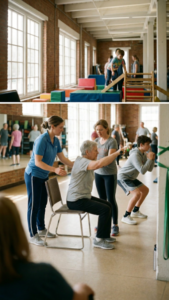
Once treated as a pursuit for athletes and bodybuilders, resistance exercise is increasingly viewed as a basic health practice for children, adults and older people alike.
For decades, strength training carried a narrow public image. It belonged to weight rooms, competitive athletes, military recruits and people chasing visible muscle. Aerobic exercise was the public-health star: walking, running, swimming and cycling were the familiar prescriptions for heart health and longevity. But a broader understanding of health and aging has changed the conversation. Around the world, doctors, exercise scientists and public-health agencies are now emphasizing that building and maintaining strength is not optional decoration. It is a foundation for movement, independence and resilience across the lifespan.
Strength training, also called resistance training, is any activity that makes muscles work against a force. That force can come from dumbbells, machines, resistance bands, kettlebells, weighted backpacks, household objects or a person’s own body weight. A push-up, a squat to a chair, a loaded farmer’s carry, a band row and a slow stair climb can all be strength work when performed with control and enough challenge. The common thread is not the equipment. It is the signal sent to muscle, bone and connective tissue: adapt, preserve capacity and become better prepared for daily demands.
The public-health message is increasingly clear. Adults are commonly advised to perform muscle-strengthening activity at least two days a week, involving major muscle groups. Children and adolescents are encouraged to include activities that strengthen muscle and bone several days a week as part of daily movement. Older adults are advised to combine strength work with balance and aerobic activity, especially when fall risk, frailty or declining mobility become concerns. The details differ by age and health status, but the principle is consistent: every body benefits from some form of resistance.
The case begins early. For children, strength training does not need to resemble adult gym culture. Climbing, jumping, crawling, carrying, gymnastics, martial arts drills, playground games and supervised body-weight exercises can develop coordination, confidence and bone-loading capacity. The old fear that properly supervised strength training is inherently dangerous for young people has been replaced by a more nuanced view. Poor coaching, excessive loads and adult-style pressure can cause harm; age-appropriate movement, good technique and gradual progression can support physical development and reduce injury risk in sports.
For teenagers, resistance training can be especially valuable because adolescence is a period of rapid growth, changing body mechanics and increased sports participation. A well-designed program can improve strength, balance, landing mechanics and body awareness. It can also give young people a healthier relationship with their bodies when the focus is performance, skill and consistency rather than appearance. In an era when social media often turns fitness into comparison, coaches and parents have an important role in keeping the message grounded: strength is a capacity, not a costume.
For working-age adults, strength training is often the missing piece in an otherwise active routine. Many people walk, commute, take occasional fitness classes or play weekend sports, yet spend long hours sitting at desks or in cars. Over time, the gap between cardiovascular fitness and muscular capacity can show up in ordinary tasks: lifting luggage, carrying children, moving furniture, climbing stairs, gardening, or recovering from a minor injury. Resistance training addresses those everyday demands directly. It trains the hips, legs, back, shoulders, arms and trunk to produce and control force.
The benefits extend beyond muscle size. Resistance exercise is associated with better functional capacity, healthier body composition, stronger bones, improved insulin sensitivity and greater ability to maintain activity during aging. It can also support mental health by improving confidence and providing a structured routine. None of that requires elite performance. A person who learns to squat safely, hinge at the hips, push, pull, carry and brace the trunk has built a practical movement toolkit for life.
The need becomes more urgent with age. Muscle mass and strength tend to decline over time, and the loss can accelerate with illness, inactivity or hospitalization. The result is not just a smaller biceps measurement. It can mean slower walking speed, difficulty rising from a chair, reduced balance, higher fall risk and loss of independence. Strength training is one of the most direct interventions against that decline. For older adults, a resistance program may begin with sit-to-stand exercises, wall push-ups, light bands, step-ups, heel raises and supported balance work. Over time, the same person may progress to heavier loads and more complex movements.
This is where the phrase “for everyone” matters. Strength training is not the same program for every person. A healthy 16-year-old basketball player, a pregnant office worker, a 45-year-old with back pain, a 70-year-old recovering confidence after a fall and an 85-year-old living with arthritis all need different starting points. The goal is not uniformity. The goal is appropriate challenge. A movement is useful when it is safe enough to practice, difficult enough to stimulate adaptation and repeatable enough to become part of life.
The most effective programs are often simple. They include movements for the lower body, upper body and core, with gradual progression. A beginner might train twice a week using body weight and bands: chair squats, hip hinges, wall or incline push-ups, rows, step-ups, carries and calf raises. Someone more experienced might use barbells, dumbbells or machines. The program should become harder slowly, through added resistance, more repetitions, better range of motion, improved control or additional sets. Progress does not have to be dramatic to be meaningful.
Technique matters, but perfectionism can become a barrier. Many people avoid strength training because they fear injury or embarrassment. Public gyms can feel intimidating. Instructional videos can be confusing. The solution is not to wait for ideal conditions. A community class, a qualified trainer, a physiotherapist, a school coach, a senior center program or a carefully chosen beginner routine can provide a safer path. For many people, machines are a useful starting point because they offer support and predictable movement. For others, home-based training is more realistic and sustainable.
Medical caution is important but should not be confused with avoidance. People with heart disease, uncontrolled blood pressure, severe osteoporosis, neurological conditions, recent surgery, pregnancy complications or chronic pain may need professional guidance before starting or changing an exercise routine. But in many cases, modified strength training is still possible and beneficial. The modern approach is not to exclude people from resistance exercise because they are older, heavier, disabled or managing disease. It is to adapt the exercise to the person.
The cultural shift is visible in small ways. More women are entering weight rooms. Older adults are joining resistance classes. Runners are adding lifting to prevent injuries. Schools and youth sports programs are teaching movement fundamentals. Office workers are using short strength breaks to counter sedentary days. Even the fitness industry, long focused on transformation imagery, is slowly making room for durability, function and healthy aging.
Still, access remains uneven. Safe places to exercise, knowledgeable instruction, time, money and cultural comfort are not equally distributed. A public-health message that tells everyone to strength train must also make strength training available beyond expensive gyms. Parks, schools, workplaces, clinics and community centers can all play a role. So can low-cost equipment such as resistance bands and adjustable household routines. The most democratic form of strength training begins with the body itself and a few square meters of space.
The future of exercise advice may be less about choosing between cardio and strength and more about integrating both. Walking supports the heart and lungs. Strength training supports the muscles and bones that make walking, climbing, lifting and balance possible. Mobility work preserves usable range. Balance practice helps prevent falls. Together, they form a complete physical-life strategy.
Strength training for everyone does not mean everyone must lift heavy weights or join a gym. It means a child should be allowed to climb and jump, a teenager should learn technique before chasing load, an adult should build capacity for daily life, and an older person should be given the tools to stay independent for as long as possible. The central message is practical and humane: bodies are built to respond to challenge, and strength is one of the clearest ways to keep participating in life.
The most important repetition may be the first one. A person stands from a chair without using their hands. A student learns a proper squat. A parent carries groceries with less strain. A retiree practices stepping up and down with confidence. These ordinary movements rarely look spectacular, but they are the quiet architecture of health. In that sense, strength training has finally outgrown the weight room. It belongs wherever people are trying to live better, move longer and age with dignity