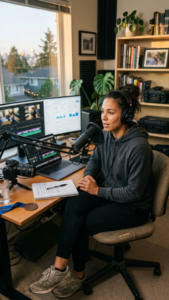
From locker-room vlogs to podcasts, TikTok clips, livestreams and brand collaborations, athletes are building direct communities that may reshape the economics of sport.
The modern athlete is no longer defined only by the scoreboard. A sprinter can leave the track and post a recovery routine before dinner. A basketball player can turn a road trip into a vlog series. A football star can host a podcast that travels further than a postgame interview. A college gymnast, a golfer, a volleyball player or an Olympic hopeful can build an audience large enough to attract brands before winning a major title.
This is the athlete creator economy: a fast-growing corner of sport where performance remains the foundation, but personality, storytelling and direct access create the business. Fans still care about victory, records and rivalries. But many now want something more intimate than the televised match. They want the tunnel walk, the training table, the unfiltered laugh, the setback after injury, the hotel-room routine, the livestream after a win and the human being behind the uniform.
For decades, athletes reached fans mainly through leagues, broadcasters, newspapers, sponsors and press conferences. The athlete’s image was powerful, but distribution belonged to someone else. Social platforms have changed that equation. Instagram, TikTok, YouTube, Twitch, podcast networks and newsletter tools allow athletes to speak directly to audiences without waiting for a camera crew or a sports editor. In that shift, the athlete is not simply a subject of coverage. The athlete becomes a publisher.
The commercial logic is clear. Traditional sponsorships often attached brands to fame after it had already been created by teams, medals or championships. Creator-led sports marketing can begin earlier and operate more personally. A brand does not need only the biggest name in a league. It can work with an athlete whose audience is smaller but more loyal, more niche and more likely to trust the recommendation. For emerging athletes, that can mean income before the richest contracts arrive. For established stars, it can mean control over narrative and a business that lasts beyond retirement.
The college sports market has accelerated the shift. Name, image and likeness rules in the United States allowed student-athletes to earn from endorsements and social content in ways that were once prohibited. The result has been a new marketplace in which athletes are valued not only by playing time or draft potential, but also by engagement, authenticity, demographics and content skill. A backup quarterback with a charismatic YouTube presence, a softball player with a devoted TikTok following or a gymnast whose routines travel well on short video may offer brands something that a box score cannot show.
This does not mean follower count is everything. In the creator economy, attention is not the same as influence. Brands increasingly look at engagement, audience fit, tone, consistency and risk. A polished but distant account may perform worse than a smaller feed that feels honest and interactive. Athletes who share useful, entertaining or emotionally resonant content can build communities that behave less like spectators and more like participants.
Behind-the-scenes content is especially valuable because sport is naturally dramatic. Training is repetitive, painful and visually compelling. Travel is chaotic. Injury recovery creates suspense. Team culture produces humor and conflict. Competition gives every post a larger story arc. Unlike many creators who must invent narratives, athletes live inside one. The season provides episodes. The match provides stakes. The comeback provides tension. The fan already understands why it matters.
Podcasts have become another important format because they let athletes move beyond highlights. Long-form conversation allows them to explain tactics, tell stories, react to controversies and show relationships with teammates, rivals or family members. The tone is often looser than traditional media. That informality can create trust, but it also carries risk. Athletes who speak directly must also manage accuracy, privacy, league rules, sponsor obligations and the possibility that a casual remark becomes a headline.
Livestreaming adds a different kind of intimacy. A livestream after practice or during a gaming session can make fans feel present in real time. The value is not just content but access. For younger audiences raised on interactive platforms, the ability to comment, ask questions, send reactions and feel noticed can be more compelling than a polished advertisement. In this model, community is not an abstract marketing word. It is the product.
Women’s sports show why athlete-led media matters. Many women athletes have built major audiences despite historically receiving less broadcast coverage and smaller media budgets than male counterparts. Social platforms have helped them bypass old visibility barriers, allowing fans to follow individual players even when games are harder to find. In some cases, the athlete’s digital presence becomes the entry point to the sport itself. A fan may first discover a player through a TikTok trend, a fashion partnership or a training video, then become interested in the league.
The same pattern is visible in niche sports. Golf creators, rugby players, fighters, runners, surfers, dancers, skaters and volleyball athletes can now build direct followings without waiting for mainstream networks to treat their competitions as premium rights. New leagues and sports formats increasingly understand this. Many are designed not only as competitions but as content ecosystems, with short clips, player personalities, creator partnerships, livestreams and lifestyle branding built into the model from the start.
For athletes, the opportunity comes with a heavy workload. Creating content requires planning, filming, editing, posting, responding, negotiating, reporting metrics and protecting a public image. It can become a second job layered on top of training, travel, recovery and competition. The pressure to stay visible may collide with the need to rest. A bad performance may still require a public-facing explanation. A private moment may become valuable content, raising questions about boundaries and mental health.
There is also a tension between authenticity and monetization. Fans want athletes to be real, but brand deals can make content feel calculated. The best athlete-creators usually solve this by building from genuine interests: cooking, gaming, fashion, parenting, music, film study, wellness, faith, finance, community work or technical education within the sport. When the content reflects an athlete’s real personality, sponsorship can feel like part of the story rather than an interruption.
Teams and leagues are adjusting. Some once saw athlete-controlled media as a threat to official channels. Many now see it as a growth engine. A player’s vlog may promote a match better than a standard advertisement. A podcast clip can extend a rivalry. A behind-the-scenes video can introduce new fans to a locker room. Still, conflicts remain. Leagues must protect broadcast partners and confidential spaces. Coaches worry about distraction. Agents must negotiate rights. Brands want reliability. Athletes want freedom.
The next stage will be more professional. More athletes will hire editors, producers, community managers and business leads. More agencies will package athletes not only as endorsers but as media properties. More brands will ask for long-term storytelling instead of one-off sponsored posts. More athletes will launch production companies, merchandise lines, paid communities, camps, courses and equity partnerships.
The athlete creator economy is not a replacement for sport. Performance still creates credibility. Winning still changes scale. But the old hierarchy is weakening. An athlete can now own the relationship with fans, not merely borrow it from a team or broadcaster. That is why this shift is powerful. It gives athletes a way to turn attention into independence, personality into enterprise and fandom into community.
In the past, the camera found the athlete. Now the athlete often holds the camera. That change may define the next era of sports business.