The 14-year-old appeared beside Beyoncé and Jay-Z at fashion’s most scrutinized red carpet, drawing attention not only for her white Balenciaga look but for the poise of a teenager stepping into a global spotlight.
NEW YORK, May 6 — Blue Ivy Carter has spent much of her life in public view without often being the central subject of it. At the 2026 Met Gala, that changed. Walking the red carpet at the Metropolitan Museum of Art beside her parents, Beyoncé and Jay-Z, the 14-year-old made a closely watched debut that quickly became one of the most discussed moments of the night across entertainment and fashion media.
The appearance carried the weight of celebrity lineage, fashion symbolism and a rare mother-daughter red carpet narrative. Beyoncé, returning to the Met Gala after a decade away, was not only a guest but one of the evening’s co-chairs, joining Anna Wintour, Nicole Kidman and Venus Williams for an event built around the Costume Institute’s spring exhibition, “Costume Art.” The dress code, “Fashion Is Art,” invited celebrities and designers to treat the body as a canvas. Blue Ivy’s presence gave that idea a generational dimension.
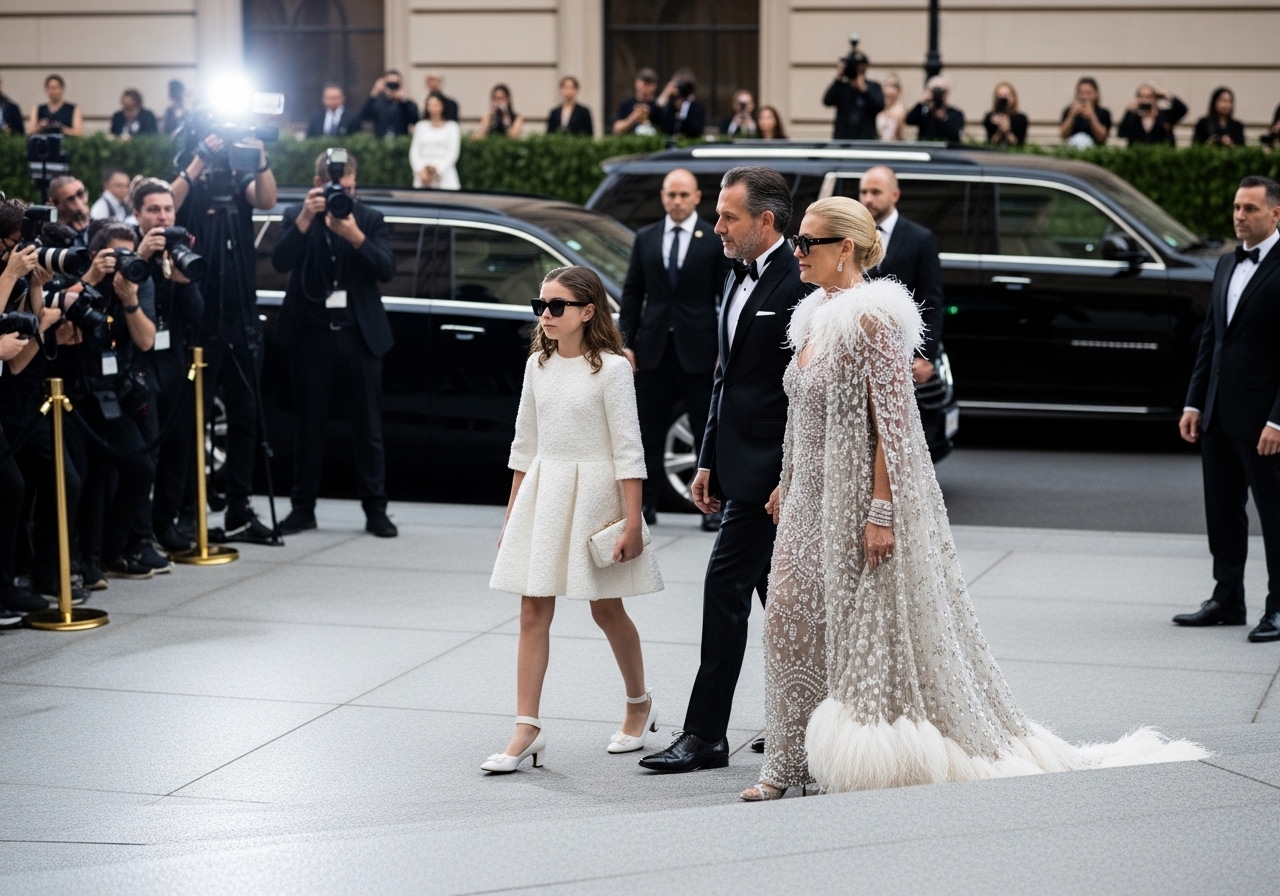
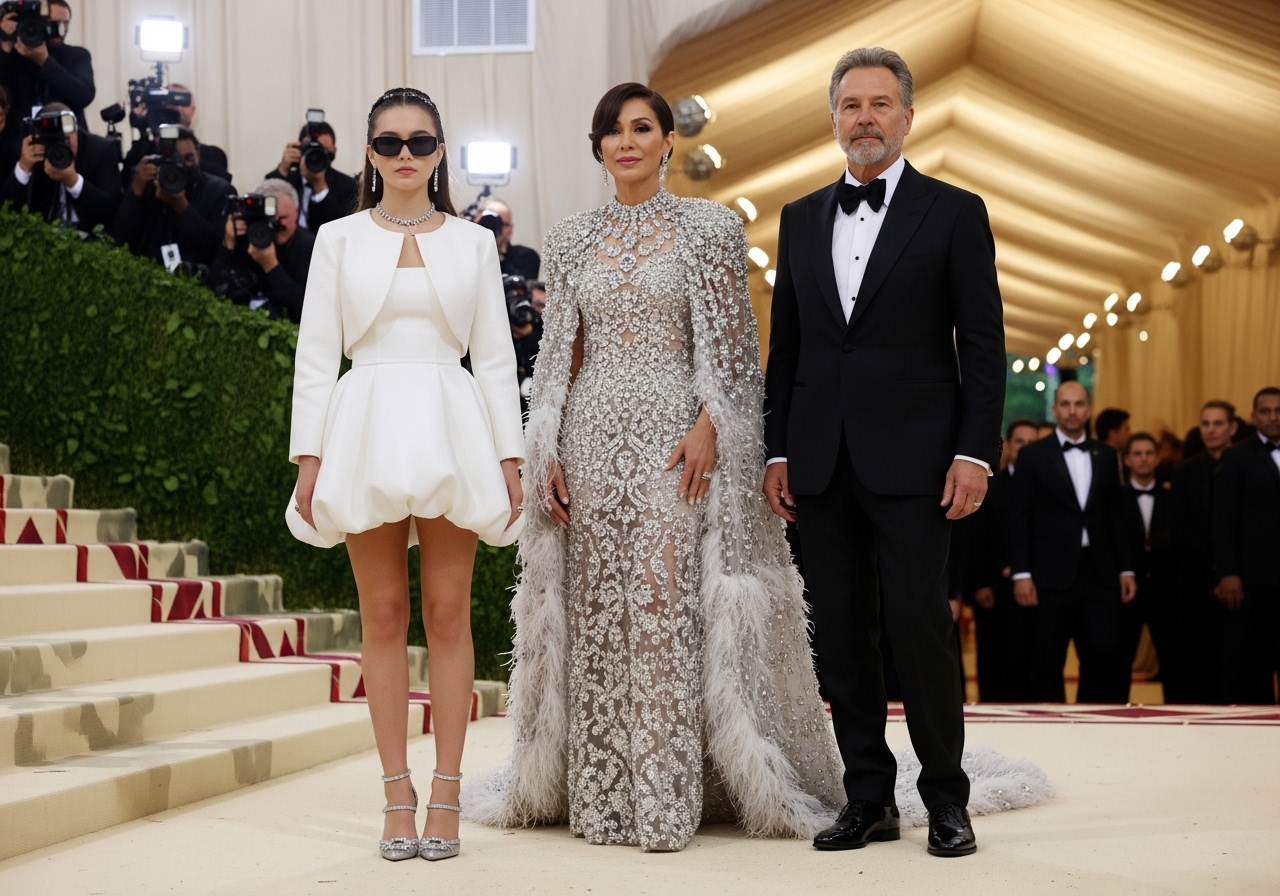
Her look was restrained compared with the theatrical excess often associated with the Met steps. Blue Ivy wore a white Balenciaga dress with a rounded, sculptural silhouette, paired with a matching jacket. The choice stood apart from the darker, more anatomical drama of Beyoncé’s crystal-covered Olivier Rousteing gown, yet the two looks read together as a deliberate visual pairing: mother and daughter, spectacle and composure, legacy and emergence.
Entertainment outlets focused heavily on the details. Teen Vogue highlighted her crystal Jimmy Choo pumps, while Vogue described the appearance as a high-fashion family moment. InStyle and other publications picked up a brief father-daughter exchange in which Blue Ivy appeared to keep her sunglasses on despite encouragement to remove them, a small red carpet moment that quickly spread online because it felt recognizably teenage: composed, self-directed and slightly amused by the machinery around her.
For an event where every gesture is photographed, interpreted and repackaged within minutes, the moment gave Blue Ivy an unusual kind of relatability. She was not presented merely as the child of two of the world’s most famous musicians. She appeared as a young public figure learning how to negotiate attention on her own terms. The sunglasses became less an accessory than a signal of control: a teenager deciding when, and how, to meet the cameras.
Beyoncé’s own comments helped frame the night as personal rather than purely promotional. On the red carpet, she described the experience of attending with her daughter as surreal and meaningful, saying it was incredible to share the moment with her. That sentiment echoed through coverage because Beyoncé’s Met Gala return had already been treated as a major fashion event before Blue Ivy stepped onto the carpet. Once she did, the story expanded from comeback to inheritance.
Tina Knowles, Beyoncé’s mother and Blue Ivy’s grandmother, added another layer when she said seeing Blue Ivy at the gala felt like déjà vu, recalling Beyoncé’s early red carpet years. The comparison was inevitable but delicate. Beyoncé was still a teenager when Destiny’s Child began entering the celebrity-fashion ecosystem, often wearing outfits designed by Knowles herself. Blue Ivy, by contrast, arrives in a media environment far more intense, more digital and more immediate.
That difference matters. The red carpet that Beyoncé entered in the 1990s was powerful, but it was not the same as the one her daughter now faces. Today, a few seconds of body language can become a global clip before the event has ended. Outfits are judged in real time. Age, family dynamics, privilege, styling choices and perceived confidence are all debated by audiences who may never watch the full gala livestream but will encounter edited fragments on TikTok, Instagram, X and entertainment sites.
Blue Ivy is not new to attention. She has appeared with her parents at major public events, joined Beyoncé on stage during the “Renaissance” tour and became a Grammy winner as a child through her credited role in “Brown Skin Girl.” Still, the Met Gala occupies a different space. It is not a concert stage, an awards show seat or a family appearance at a sporting event. It is a symbolic arena where fashion, wealth, celebrity power and institutional art converge under the harshest possible visual scrutiny.
Her debut therefore raised broader questions about youth and celebrity culture, particularly at a gala that has historically been selective about age and access. Several outlets noted that Blue Ivy’s appearance was notable partly because she is 14. The Met Gala is a private benefit with tightly controlled invitations, and underage attendees are unusual. Beyoncé’s position as a co-chair helped explain the family context, but the public reaction showed how quickly curiosity about a young person’s style can turn into a larger conversation about exposure, agency and image-making.
The Carters appeared to manage that balance carefully. Blue Ivy was visible but not overexposed. She posed with her parents, moved through the carpet in a polished but age-appropriate look and did not appear to be pushed into the kind of adult glamour that often draws criticism when applied to teenagers in celebrity spaces. The white dress and jacket were formal, sculptural and fashion-forward, but they avoided obvious provocation. In a setting known for extremes, restraint became its own statement.
That restraint also aligned with the night’s theme. “Costume Art” explored the relationship between clothing, the body and artistic representation. Blue Ivy’s look did not need to shout to participate in that conversation. Its clean shape and monochrome palette made her appear almost like a figure in a gallery composition, placed beside Beyoncé’s more elaborate interpretation of the body as spectacle. Together, they suggested two modes of fashion-as-art: one maximal and performative, the other youthful and controlled.
The online response was swift. Fans praised Blue Ivy’s confidence, her posture and her ability to hold her own beside two globally recognized parents. Entertainment sites framed the sunglasses exchange as charming rather than defiant. Fashion sites examined the styling. Celebrity outlets emphasized the emotional family angle. The coverage reflected a rare convergence: the look, the lineage, the viral moment and Beyoncé’s own long-awaited return all fed the same narrative.
For Beyoncé, the night marked another careful act of image control. Her public appearances are selective, and her Met Gala absence since 2016 had become part of her mythology. Returning as co-chair guaranteed attention; arriving with Blue Ivy changed its emotional center. It allowed the evening to be read not only as a fashion comeback but as a maternal milestone, one in which Beyoncé could re-enter a familiar space while watching her daughter encounter it for the first time.
For Jay-Z, the role was quieter but still visible. His presence beside Blue Ivy during the viral sunglasses moment underscored a family dynamic audiences rarely see in such a formal setting. He was not the focus of the fashion analysis, yet the exchange gave viewers a glimpse of a father navigating an intensely public environment with a teenager who knew exactly what she wanted to do.
The broader significance of Blue Ivy’s debut lies in what it suggests about the next generation of celebrity children. Many are no longer introduced to the public gradually through traditional interviews or controlled magazine profiles. They emerge through moments: a stage appearance, a front-row seat, a livestream clip, a red carpet debut. Those moments can be empowering, but they also carry pressure. Public familiarity can arrive before adulthood.
Blue Ivy’s Met Gala appearance will not by itself define her future. She may choose fashion, music, performance, business or none of the above. But it did mark a shift in how she is publicly perceived. She was no longer simply a child accompanying her parents. She became, for one night, a subject of fashion coverage in her own right.
That is why the moment resonated beyond the dress. The Met Gala thrives on spectacle, but the most memorable images often carry a human subtext. In this case, it was a teenager in white, standing beside a mother returning to a famous staircase after 10 years away, while cameras measured every step. The scene was polished, glamorous and heavily mediated. It was also, beneath the styling and flash photography, a family transition unfolding in public.
By the end of the night, Blue Ivy had done what successful Met Gala appearances often do: she generated conversation without needing to explain herself. Her look was photographed, her gestures were clipped, her confidence was debated and her family’s fashion legacy gained a new chapter. In a room built to turn clothing into cultural memory, her debut became one of the evening’s clearest stories.