
A new Georgia Tech and MIT study shows that mosquitoes are not simply swarming together, but independently following a powerful combination of carbon dioxide and visual cues.
Mosquitoes have long seemed almost supernatural in their ability to find people. They appear in the dark, circle the head, gather around exposed skin and return even after being brushed away. For anyone who has wondered why these insects seem so precise, a new study offers a clearer answer: mosquitoes are not blindly following one another, and they are not guided by a single signal. They are responding to a combination of cues, including invisible chemical traces from human breath and visual contrasts in their surroundings.
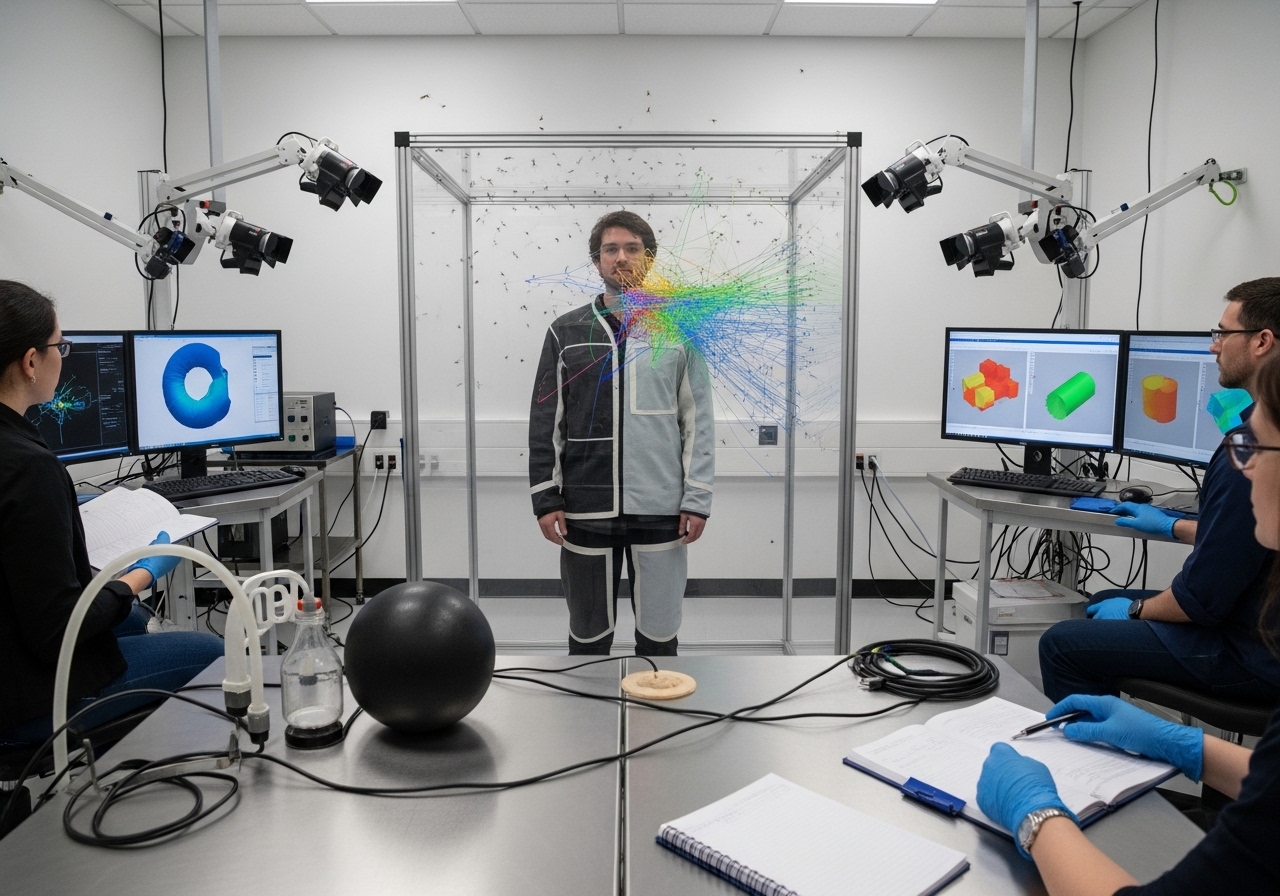
Researchers from the Georgia Institute of Technology and the Massachusetts Institute of Technology have created what they describe as the first detailed three-dimensional visualization and mathematical model of how female mosquitoes fly toward people. By tracking hundreds of mosquitoes and analyzing millions of data points, the team found that the insects independently respond to environmental signals, especially carbon dioxide and dark visual targets. When those signals appear together, mosquitoes become far more likely to swarm, remain near the target and attempt to feed.
The findings, published in Science Advances and summarized by ScienceDaily, help explain a familiar human experience. Mosquitoes often cluster around the head and shoulders, where exhaled carbon dioxide forms a strong plume and where visual contrast can help the insects orient themselves. The study focused on female Aedes aegypti mosquitoes, also known as yellow fever mosquitoes, a species that spreads diseases including dengue, Zika, chikungunya and yellow fever in many parts of the world.
The research matters because mosquitoes are not only an annoyance. They are among the deadliest animals to humans because of the pathogens they transmit. Malaria, dengue, yellow fever, Zika and other mosquito-borne diseases cause enormous health burdens, especially in tropical and subtropical regions. Better understanding how mosquitoes find humans could help improve traps, repellents and other control strategies.
The study began with a deceptively simple question: how does a mosquito decide where to fly? Scientists have known for years that mosquitoes respond to carbon dioxide, body heat, skin odors, humidity and visual cues. But most previous work examined attraction in narrower ways, often focusing on whether mosquitoes landed on a target or moved toward a stimulus in a wind tunnel. What was missing was a detailed map of their full flight paths as they searched.
To build that map, the researchers used 3D infrared cameras to record mosquitoes flying in a controlled chamber. The insects were exposed to different combinations of cues. In some trials, they encountered a dark object. In others, they were given carbon dioxide without a strong visual target. In another set of tests, the researchers combined a dark object with carbon dioxide, mimicking two important signals associated with a human host: a visible silhouette and exhaled breath.
The results showed three distinct patterns. When mosquitoes saw a dark object alone, they often made a brief approach and then moved away. When they detected carbon dioxide without a strong visual target, they slowed down and searched nearby, almost as if reconsidering the area. But when both a dark object and carbon dioxide were present, their behavior changed sharply. They orbited the target, stayed close and appeared ready to land or feed.
That combination is the key insight. Carbon dioxide is invisible to humans, but to a mosquito it is a powerful long-range signal that something alive may be nearby. A dark silhouette or object gives the insect a visual anchor. Alone, each cue is incomplete. Together, they become persuasive. The mosquito does not need to know it has found a person in the human sense. Its nervous system follows a set of rules that make a person increasingly likely to become the target.
The researchers also tested the behavior around a human volunteer wearing different colors, including black, white and mixed clothing. Cameras captured how mosquitoes moved around the person, and the data were used to refine the mathematical model. The largest swarms appeared around the head and shoulders, areas that match both the geometry of human breath and the mosquito’s known attraction points.
One of the most important conclusions is that mosquitoes are not necessarily following each other when they swarm. To an observer, a cloud of mosquitoes around a person may look coordinated, almost like a collective attack. The new data suggest something different. Each mosquito is independently reading the same environmental signals. Because many insects receive similar cues at the same time, they end up in the same place, producing the appearance of a swarm.
That distinction could influence mosquito-control technology. Many traps rely on carbon dioxide, light, heat or odor to attract insects. But if mosquitoes remain engaged only when multiple signals are calibrated together, then traps may need to be redesigned. A device that emits carbon dioxide without the right visual or thermal context may attract attention briefly but fail to hold the insect long enough to capture it. A trap that combines cues in the right sequence could be more effective.
The study also provides a new way to think about personal protection. It does not mean that dark clothing alone guarantees mosquito bites, or that white clothing makes someone invisible. Mosquito attraction is complex and also involves skin chemistry, body temperature, sweat compounds, microbiome differences and local mosquito species. But the findings reinforce the idea that mosquitoes use layered information. Reducing one signal may help, but the strongest attraction may occur when several signals align.
For public health experts, that layered behavior is both a challenge and an opportunity. It makes mosquitoes difficult to fool because they do not rely on one sense alone. At the same time, it provides several possible points of intervention. Repellents may interfere with odor detection. Fans may disrupt carbon dioxide plumes and flight stability. Clothing choices may change visual contrast. Traps may be improved by using intermittent signals or combining cues more precisely.
The Georgia Tech and MIT team also developed a public interactive website that allows users to explore mosquito movement patterns under different cue conditions. That tool reflects a broader shift in biology toward quantitative, data-rich models of animal behavior. Rather than describing mosquito attraction only in general terms, the researchers attempted to predict where the insects would fly, when they would turn, how they would slow down and how long they would remain near a target.
This type of modeling could become increasingly important as climate change expands the range of some mosquito species. Warmer temperatures, urbanization, changing rainfall patterns and global travel are altering the geography of mosquito-borne disease risk. Understanding how mosquitoes detect and approach humans may help communities develop more targeted interventions before outbreaks occur.
The study does not solve the problem of mosquito-borne disease by itself. It does not produce a new vaccine, a new insecticide or a universal repellent. But it gives researchers a sharper picture of the moment before a bite, when a mosquito turns environmental information into action. That moment is crucial. Preventing disease often begins before contact, by stopping the insect from finding or landing on a human host.
The findings also help demystify a common experience. Mosquitoes are not choosing victims through instinct alone, nor are they acting with the coordination of a swarm intelligence. They are small flying sensors, integrating invisible chemical signals with visible shapes and contrasts. Human breath, especially carbon dioxide, tells them that life is nearby. A dark target gives them a place to investigate. Together, those cues can turn a passing insect into a persistent attacker.
For people trying to avoid bites, the practical message is not that one trick will make them disappear. It is that mosquitoes succeed because they combine signals. The more those signals can be disrupted, diluted or separated, the harder the insect’s search becomes. For scientists, the message is equally clear: the future of mosquito control may depend not only on killing mosquitoes, but on confusing the rules they use to find us.