
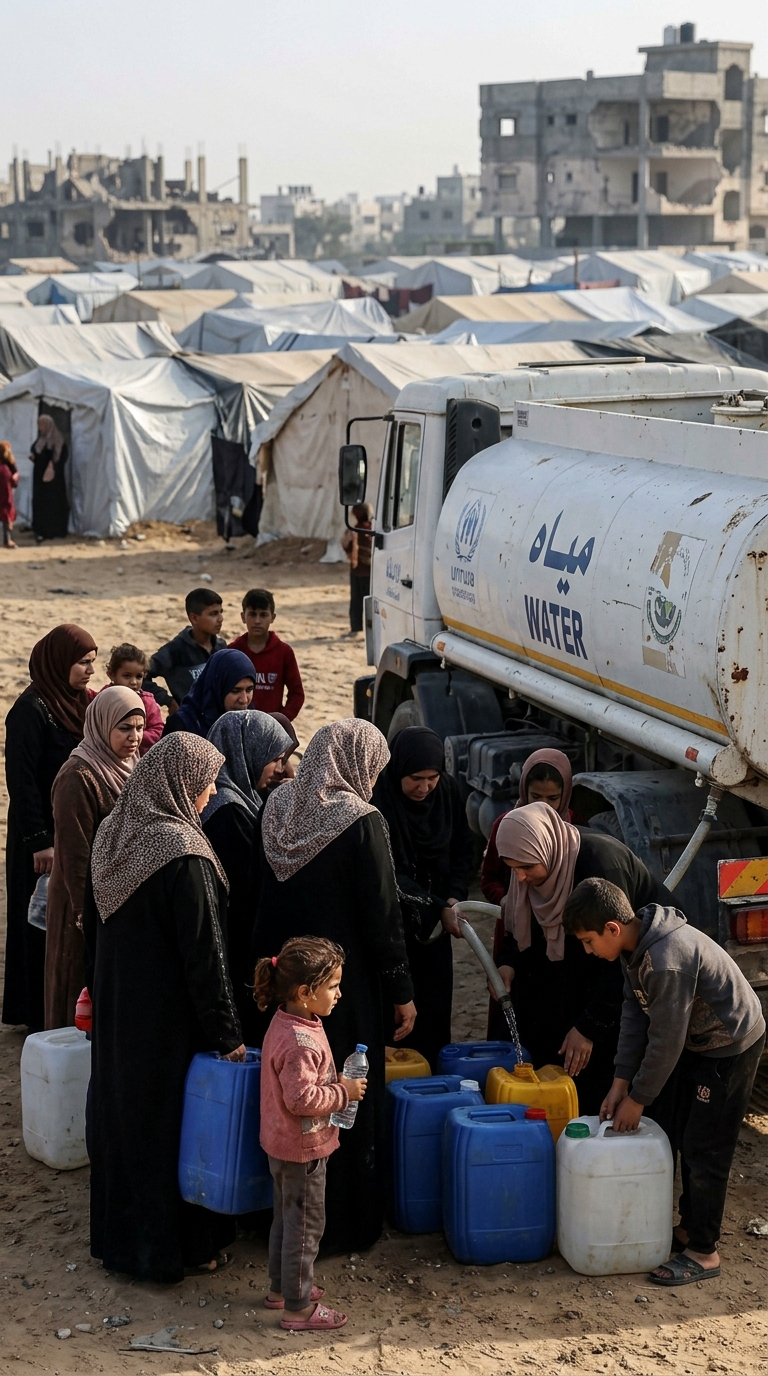
Months after the guns quieted, families in Gaza still chase water trucks through camps where destroyed infrastructure has turned survival into a daily race.
A ceasefire can stop many forms of violence, but it cannot instantly restore water.
Across Gaza, families continue to wait for trucks, carry plastic containers and ration every liter in camps and damaged neighborhoods where basic infrastructure remains shattered. The crisis has become one of the clearest signs that the humanitarian emergency did not end when large-scale fighting eased.
Water systems are among the hardest public services to rebuild after war. Pipes, pumps, wells, desalination units and sewage treatment plants require spare parts, electricity, trained technicians and secure access. When those systems collapse together, recovery becomes slow even under stable conditions. Gaza has neither stability nor full reconstruction capacity.
Residents describe a life organized around uncertainty. A family may spend hours waiting for a delivery that arrives late, runs out quickly or triggers chaotic crowds. Bottled water is too expensive for many. Underground supplies are often unsafe. Children are sent to collect water instead of studying. Parents choose between washing, cooking and drinking.
Aid groups warn that poor water access does not create only thirst. It spreads disease, weakens hygiene, worsens skin infections and increases risk for children, older people and those with chronic illness. In crowded camps, a broken water system quickly becomes a public health emergency.
Israel says it allows water imports and provides basic supply through pipelines. Humanitarian organizations argue that restrictions on materials considered dual-use have delayed essential repairs. The dispute reflects a larger postwar problem: rebuilding Gaza requires security controls, but excessive restrictions can turn temporary damage into prolonged deprivation.
The water crisis also exposes the limits of humanitarian delivery. Trucks can keep people alive, but they cannot replace functioning infrastructure. Emergency aid is designed to bridge a gap. In Gaza, the bridge has become the system.
The political consequences are significant. A ceasefire that does not produce visible improvements risks losing credibility among civilians. Families judge agreements not by diplomatic language but by whether taps run, hospitals function and children sleep without hunger or thirst.
Reconstruction will require money, access, governance and trust. It will also require decisions about who manages water, who guarantees security and who ensures that repairs are not repeatedly destroyed. Without those answers, Gaza may remain trapped between emergency relief and real recovery.
For now, the scene repeats daily: a truck arrives, people rush forward and containers are lifted in the dust. The war’s loudest phase may have passed, but for Gaza’s residents, the struggle for water proves that peace is not only the absence of bombs. It is the return of ordinary life.
“””
