
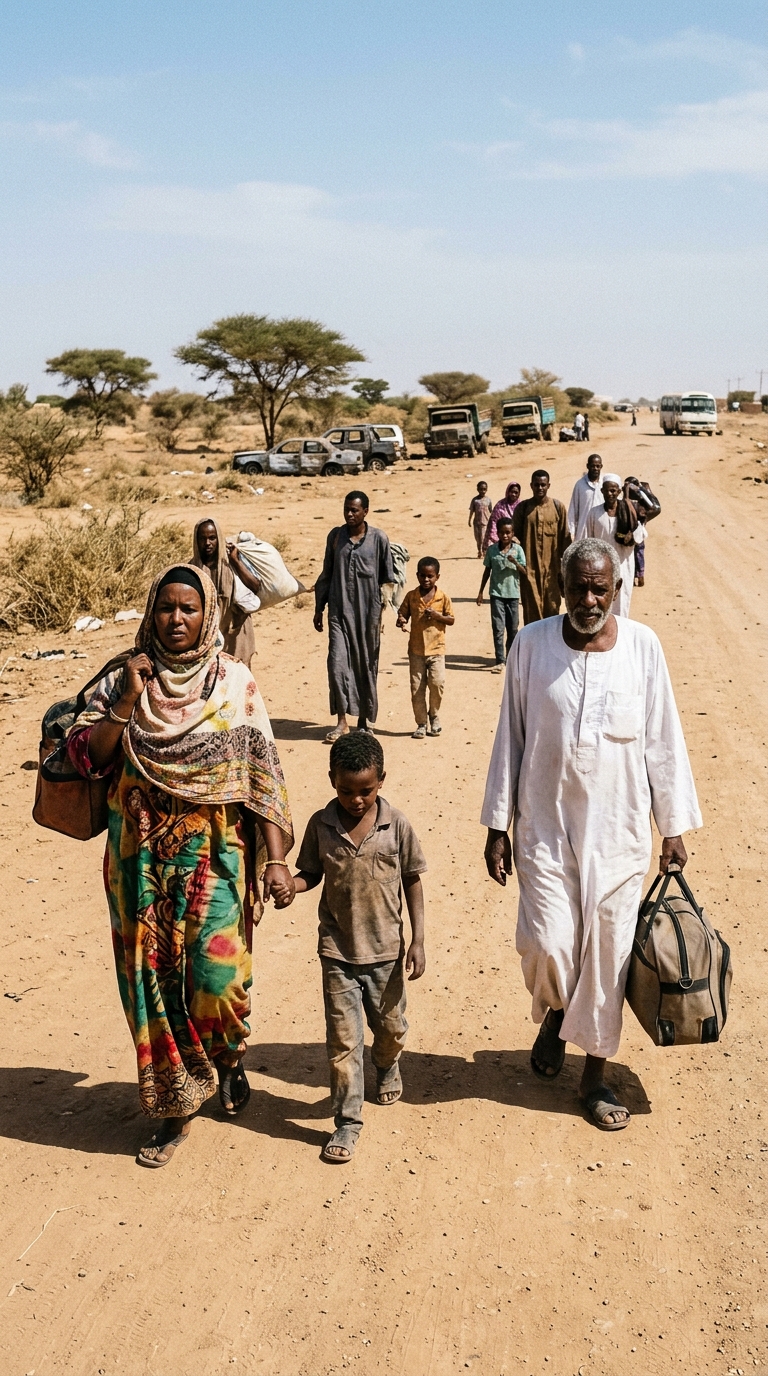
A drone strike near Khartoum underscores how Sudan’s conflict continues to punish civilians even where the battlefield appears to shift.
Sudan’s war has entered a stage in which front lines move, cities change hands and civilians remain exposed.
A recent drone strike near Khartoum, attributed by a rights group to the paramilitary Rapid Support Forces, killed civilians traveling near the capital region. The attack came after months of shifting military control and served as a reminder that the recapture of territory does not automatically restore security.
The conflict between Sudan’s army and the RSF began as a power struggle but has become a national catastrophe. Towns have been emptied, hospitals damaged, markets disrupted and millions pushed from their homes. Aid agencies warn that Sudan now faces one of the world’s gravest hunger and displacement crises.
Civilians are caught in overlapping dangers. In some areas, they face shelling, drone attacks and checkpoints. In others, they face siege conditions, looting, sexual violence, disease and hunger. Humanitarian access remains restricted by insecurity, bureaucracy and deliberate obstruction.
The war has also damaged the state itself. Public services that were fragile before the conflict have collapsed in many places. Teachers, doctors and civil servants have fled or gone unpaid. Local volunteer networks have become lifelines, organizing food, medicine and evacuations under dangerous conditions.
Khartoum carries symbolic weight. The capital’s neighborhoods once represented national political life, commerce and administration. Now they stand as evidence of how quickly state authority can fracture when armed factions turn cities into battlefields.
The humanitarian consequences extend beyond Sudan’s borders. Refugees have crossed into Chad, South Sudan, Egypt and Ethiopia, adding pressure to countries already facing economic and security strains. Families are separated across borders, often without documents, income or certainty about return.
International diplomacy has struggled to keep pace. Ceasefire efforts have repeatedly faltered. External actors have been accused of backing rival sides or failing to apply sufficient pressure. Meanwhile, civilians say the world’s attention remains far below the scale of the disaster.
A durable solution will require more than a battlefield victory. Sudan needs protection for civilians, access for aid, accountability for abuses and a political process that does not simply reward armed power. Without that, any pause in fighting may become preparation for the next round.
For Sudanese families, the immediate demands are simpler: safety, food, water, medicine and a way home. Those needs are urgent, but they are also political. A war that destroys civilian life cannot be treated as a distant military contest.
Sudan’s tragedy is not hidden. It is underreported. The danger is that a country can be torn apart in full view of the world while still failing to command the response its people need.
“””
