
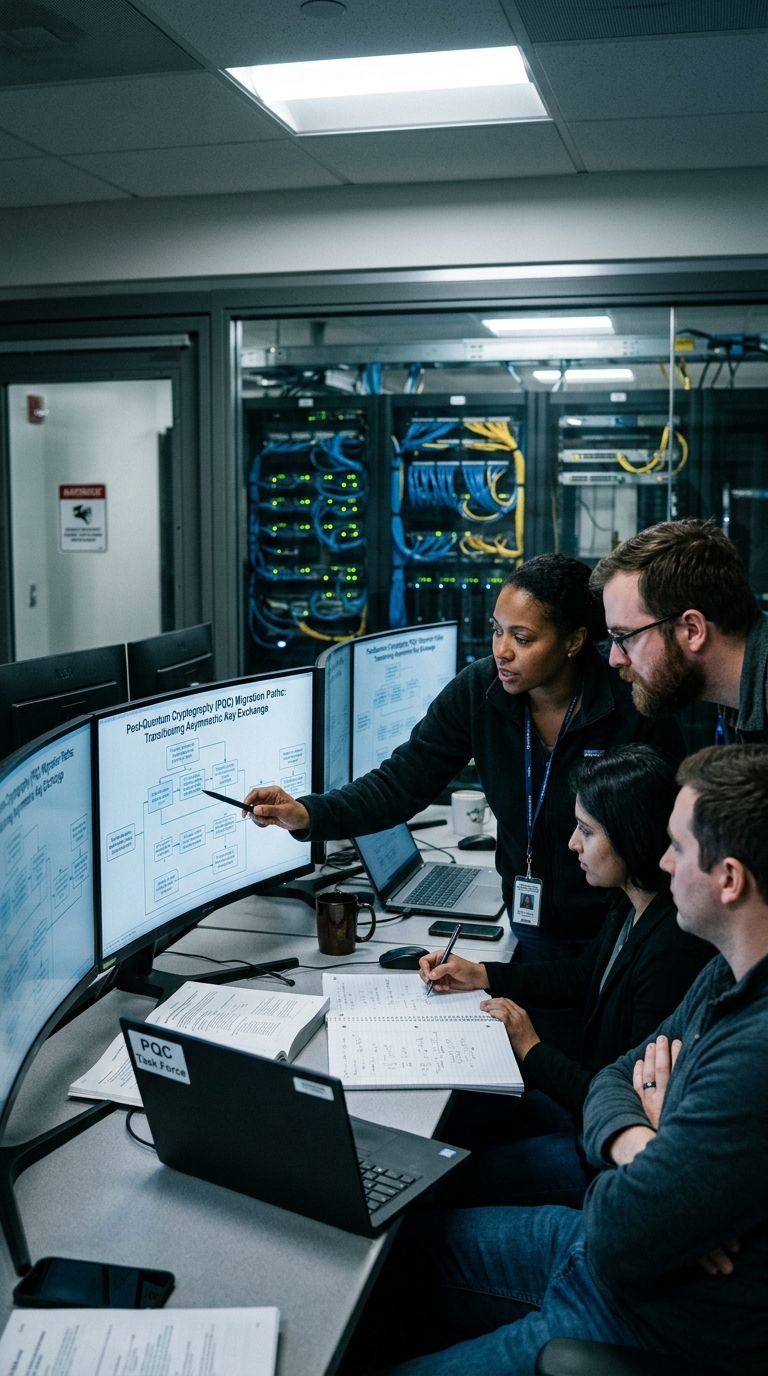
Governments and companies are being urged to replace vulnerable encryption now, long before powerful quantum computers can break today’s digital locks.
The world’s most important security upgrade may happen quietly, inside software libraries, cloud systems, payment networks, government databases and devices most people never see. It is called post-quantum cryptography, and its urgency comes from a future threat that has not fully arrived.
Modern digital life depends on encryption. It protects bank transactions, health records, military communications, messaging apps, software updates, identity systems and e-commerce. Much of that protection relies on mathematical problems that ordinary computers cannot solve efficiently. A sufficiently powerful quantum computer could change that.
Quantum computers use principles of quantum mechanics to process information differently from classical machines. They are not simply faster versions of today’s computers. For certain mathematical problems, they could be dramatically more capable. One of the most important concerns is that future quantum systems may break widely used public-key cryptography, including methods that secure web traffic and digital signatures.
No existing public quantum computer is known to be capable of breaking modern encryption at global scale. But waiting until one exists would be dangerous. Cryptographic transitions take years. Large organizations have countless systems, many undocumented or embedded in old hardware. Some data stolen today may still be sensitive years from now. Attackers can collect encrypted information now and decrypt it later if quantum capability becomes available.
That risk is often called “harvest now, decrypt later.” It is especially serious for government secrets, health records, intellectual property, legal archives and personal data that must remain confidential for decades. The threat is future-oriented, but the defensive work must begin now.
The U.S. National Institute of Standards and Technology has finalized post-quantum encryption standards and encouraged administrators to begin transitioning. The United Kingdom’s National Cyber Security Centre has also advised organizations to prepare migration plans. These signals have turned post-quantum cryptography from a research topic into an operational deadline.
Migration begins with inventory. Organizations need to know where cryptography is used. That sounds simple, but it is often difficult. Encryption may be embedded in applications, databases, virtual private networks, cloud services, hardware devices, industrial systems and third-party products. Many organizations do not have a complete map.
After inventory comes prioritization. Not every system requires immediate replacement. Data with long-term sensitivity should be addressed early. Systems that are hard to update, such as embedded devices, satellites, industrial controls or medical equipment, may require longer planning. Systems that can be updated through software may move faster.
The transition also depends on vendors. Most organizations do not build their own cryptographic tools. They depend on operating systems, browsers, cloud platforms, security appliances and enterprise software. Vendors must implement new algorithms correctly and provide updates. Customers must test them. A mistake in cryptography can create vulnerabilities even when the underlying algorithm is strong.
Performance matters. New algorithms may require larger keys, larger signatures or more processing power. In data centers, that may be manageable. In small devices with limited memory or battery life, it may be harder. Engineers must balance security with practical deployment.
Hybrid approaches are likely during transition. Systems may use both classical and post-quantum algorithms together, reducing risk while standards mature and interoperability improves. But hybrid systems add complexity. Complexity can create misconfiguration, and misconfiguration can become insecurity.
The supply-chain challenge is significant. A bank may update its own systems but still depend on payment processors, authentication vendors and customer devices. A government agency may modernize core infrastructure but still exchange data with local offices using older systems. Cryptography is only as strong as the communication path.
The post-quantum transition also raises geopolitical questions. Countries that move early may protect sensitive information better. Countries that delay may expose government and industrial secrets. Standards adopted by major economies may shape global technology markets, because products need to interoperate across borders.
There is a risk of panic marketing. Security vendors may exaggerate quantum threats to sell products before organizations are ready. Experts generally argue for measured urgency: do not assume disaster is imminent, but do not postpone planning. The responsible approach is disciplined migration.
Public communication is difficult. Encryption is invisible when it works. People notice security only when it fails. A successful post-quantum transition may produce no dramatic headline because the point is to prevent a future crisis. That makes funding and executive attention harder to secure.
The transition should also be an opportunity to improve basic cybersecurity. Organizations that inventory cryptography may also discover outdated systems, weak certificates, poor key management and unpatched software. Post-quantum planning can become part of a broader modernization effort.
Financial institutions are likely to be among the early movers because trust and long-term confidentiality are central to their business. Government agencies, defense contractors, cloud providers and telecommunications networks also face pressure. Health systems may move more slowly because of legacy equipment and budget constraints, even though their data is highly sensitive.
Consumer technology will change gradually. People may not know when their browser, phone or messaging app begins using post-quantum protections. That invisibility is normal. The best security upgrades often happen in the background.
Quantum computing itself remains a field of uncertainty. Researchers continue to improve qubits, error correction and architectures, but timelines vary. Some experts expect useful quantum machines for specialized scientific tasks before cryptographically relevant machines. Others warn that breakthroughs could shorten assumptions. Security planning must deal with uncertainty rather than wait for certainty.
The larger lesson is that digital infrastructure has long memory. Decisions made today can protect or expose information decades later. The encryption that secures a legal settlement, diplomatic cable or genetic database today may need to remain strong in 2040.
Post-quantum cryptography is not a single product that can be installed overnight. It is a migration of trust. It asks organizations to find their hidden dependencies, replace old assumptions and prepare for a future adversary that may not yet exist.
The race has begun not because quantum computers have already broken the internet, but because the internet is too important to wait until they can.
“””
