
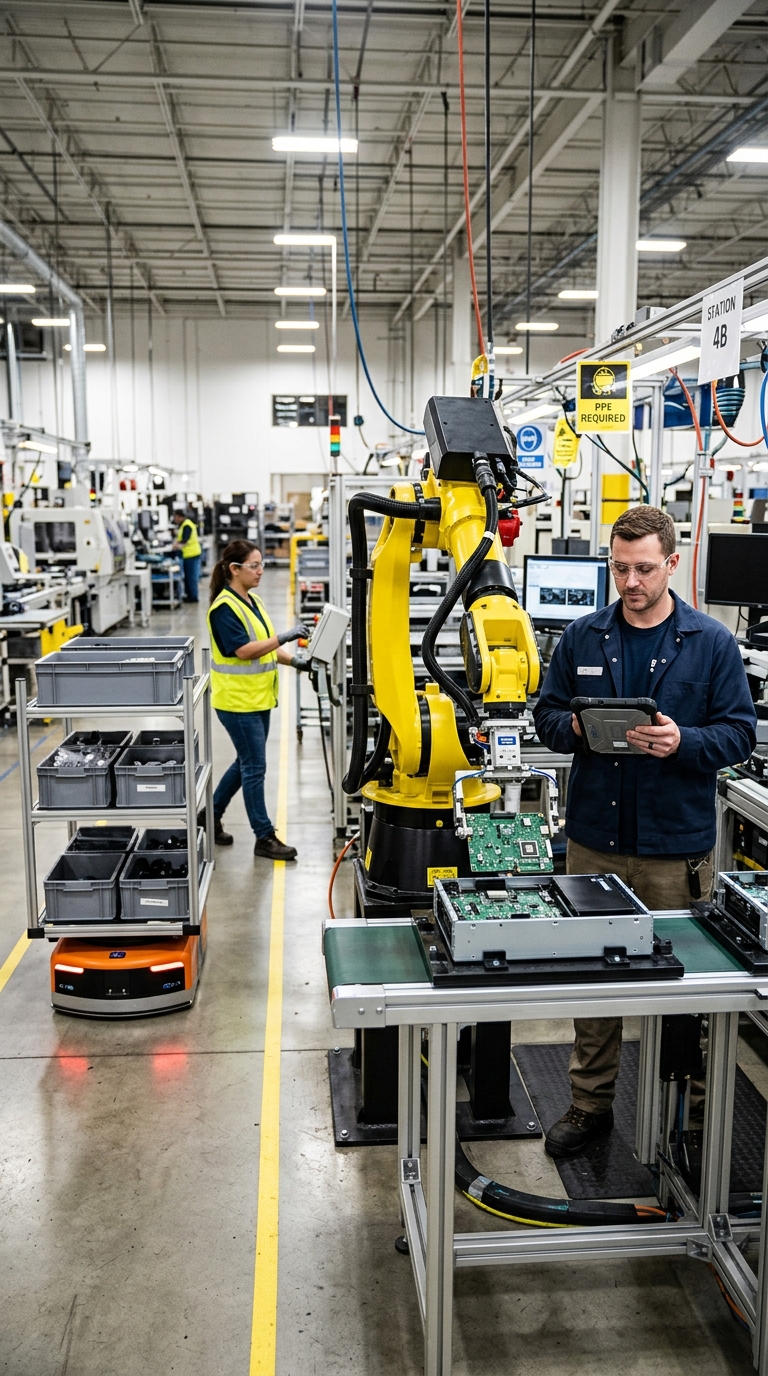
Automation is moving beyond isolated factory arms toward AI-powered machines that can work in warehouses, hospitals, farms and service industries, raising hopes for productivity and fears about labor disruption.
Robots have long occupied two very different places in the public imagination. In factories, they are familiar industrial tools, bolted to floors and programmed to repeat precise tasks. In popular culture, they are humanoid machines that walk, talk and replace people. The reality of 2026 sits between those images.
The International Federation of Robotics reported that global demand for industrial robots has more than doubled over a decade, with annual installations remaining above half a million units. China is the largest market by far, and its latest industrial strategy places AI-powered robots at the center of modernization. The robotics race is no longer only about automation. It is about turning artificial intelligence into physical capability.
Industrial robots remain the backbone of the sector. They weld cars, move parts, assemble electronics, package goods and handle dangerous materials. Their value is clear: precision, speed, repeatability and endurance. They do not call in sick, and they can operate in conditions that are unsafe or unpleasant for humans.
What is changing is flexibility. Traditional robots needed controlled environments and highly specific programming. Newer systems combine computer vision, sensors, machine learning and improved grippers to handle more varied tasks. Warehouses use mobile robots to move goods. Hospitals test robots for logistics and disinfection. Farms use autonomous systems for weeding, spraying and harvesting. Construction companies experiment with robotic layout, inspection and bricklaying.
Humanoid robots have captured attention because they promise compatibility with human-built environments. A machine with arms, legs and hands could theoretically use stairs, tools and workspaces designed for people. That appeal is powerful, especially in societies facing labor shortages and aging populations. But humanoids remain technically difficult. Balance, dexterity, safety, battery life and cost are major constraints.
The more immediate future may belong to task-specific robots rather than general-purpose humanoids. A warehouse robot does not need to look human to be useful. A surgical robot, delivery robot or agricultural machine can be designed around its function. The human form is not always the most efficient engineering choice.
AI has made robotics more ambitious. Large models can help machines interpret language, plan sequences and adapt to unfamiliar objects. A worker might eventually instruct a robot by saying, “Move these boxes to the loading area and avoid the damaged pallet.” That is different from programming every motion. But connecting language understanding to safe physical action is hard. A wrong answer from a chatbot can be corrected. A wrong movement by a robot can injure someone.
Safety is therefore central. Robots operating near people need reliable perception, emergency stops, predictable behavior and clear standards. Collaborative robots, or cobots, are designed to work alongside humans, but collaboration requires trust. Workers must understand what machines will do and how to intervene.
Labor concerns are unavoidable. Automation can increase productivity and reduce exposure to dangerous work. It can also displace workers or change jobs faster than training systems can respond. The impact varies by sector. In manufacturing, robots may reduce some repetitive roles while creating demand for technicians and engineers. In warehouses, they may intensify monitoring and pace. In elder care, robots may assist with lifting or reminders but cannot replace human compassion.
The political debate often treats robots as job killers or saviors. Reality is messier. Countries with high robot adoption can also have strong manufacturing employment if automation keeps industries competitive. But individual workers can still be harmed when tasks disappear or wages decline. The benefits of robotics depend on education, labor bargaining power and social policy.
Small businesses face a different challenge. Large manufacturers can invest in robotics teams and integration. Smaller firms may lack capital and expertise. The robotics industry is trying to respond with easier programming, leasing models and robots-as-a-service. If automation becomes accessible only to large companies, it could widen productivity gaps.
Supply chains are another factor. Robots require motors, sensors, chips, batteries, rare earth materials and precision components. Geopolitical tension can affect availability and cost. As robots become strategic, countries may seek domestic capacity in key components.
China’s robotics push is especially significant because it combines scale, industrial demand and state planning. China already deploys more industrial robots than any other country, and its emphasis on AI-powered machines could accelerate adoption in factories and logistics. Other economies will watch closely, both as competitors and as customers.
Europe has strong robotics engineering and industrial automation firms, particularly in automotive and machinery. Japan has deep expertise and an aging population that creates demand for assistive technologies. The United States leads in AI software and venture capital but has a mixed manufacturing base. The global robotics landscape will depend on how these strengths combine.
Robots are also entering public spaces, where acceptance is less predictable. Delivery robots on sidewalks, security robots in malls and service robots in hotels can create novelty, irritation or concern. People may object to machines collecting video, blocking paths or replacing human interaction. Design and governance matter as much as technical ability.
In health care, robotics offers promise but requires caution. Surgical robots can improve precision in certain procedures, but they are expensive and require training. Rehabilitation robots can support therapy. Logistics robots can move supplies. Care robots may help with reminders or companionship, but ethical questions arise when machines are used to address loneliness or understaffing.
Agriculture may be one of the most important frontiers. Labor shortages, climate pressure and pesticide concerns are pushing farms toward automation. Robots that identify weeds, monitor crops or harvest delicate produce could reduce waste and chemical use. But small farmers may struggle to afford them, and rural connectivity may limit deployment.
The environmental effects are mixed. Robots can optimize energy use, reduce material waste and support clean-energy infrastructure. They also require manufacturing, batteries and electronics. Sustainable robotics will need repairability, efficient design and responsible supply chains.
The future workforce will likely include more human-machine teams. Workers may supervise fleets of robots, handle exceptions, maintain systems and focus on tasks requiring judgment, empathy or improvisation. But that future is not automatic. Without training, workers may be moved from skilled craft into lower-paid monitoring roles.
Robots leaving the showroom means society must move beyond fascination. The questions now are practical: who owns them, who benefits from their productivity, who is responsible when they fail, and how workers are prepared for workplaces where machines can see, move and learn.
The robot revolution may not arrive as a sudden wave of humanoids walking through office doors. It may arrive more quietly, one warehouse aisle, hospital corridor and factory line at a time.
“””
