
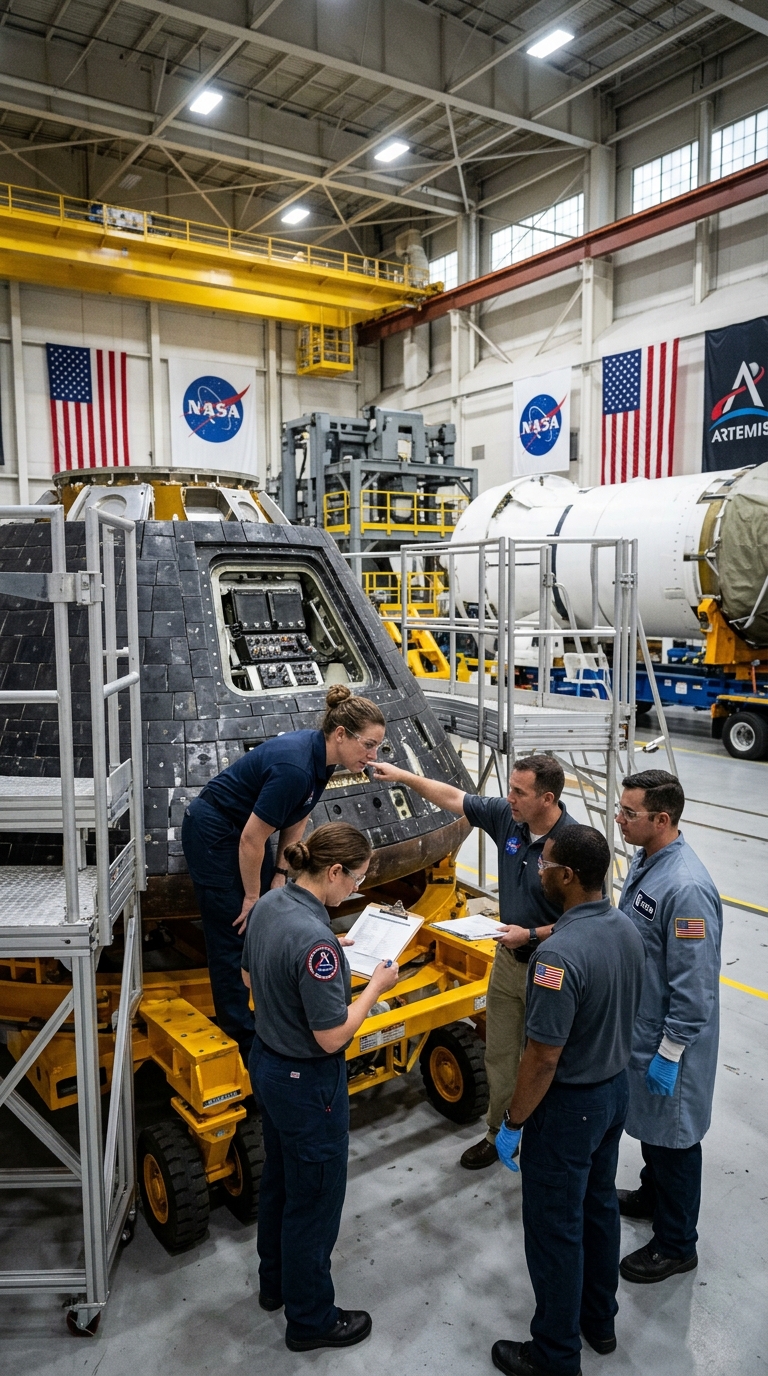
NASA’s Artemis program has revived human lunar exploration, but the path back to the surface depends on technologies far more complex than nostalgia for Apollo.
The return to the Moon is often described in emotional language: humanity going back, footprints returning, a new generation seeing astronauts beyond Earth orbit. But the modern lunar program is not a replay of Apollo. It is a test of a new technological and political model for space exploration.
NASA’s Artemis program combines government spacecraft, commercial launch and landing systems, international partners, new spacesuits, lunar communications, autonomous navigation and long-term plans for operations near the Moon. Its purpose is not only to repeat a landing, but to build experience for sustained lunar activity and eventual missions to Mars.
Artemis II, NASA’s first crewed lunar flyby mission in more than half a century, demonstrated the symbolic power of sending astronauts around the Moon again. It also underscored the complexity of deep-space systems. Orion, the Space Launch System, ground operations, life support, communications and heat-shield performance all matter before any astronaut steps onto lunar soil.
The next challenge is landing. Apollo used a government-built lunar module designed for a specific mission architecture. Artemis relies heavily on commercial human landing systems, including concepts from SpaceX and Blue Origin. That approach reflects a broader change in space policy: NASA increasingly sets goals and requirements while companies develop systems under contract.
The commercial model has advantages. It can bring private investment, accelerate innovation and create competition. It also introduces dependency. If a lander is late, NASA’s schedule moves. If a company must demonstrate orbital refueling, lunar landing, ascent and crew safety, each milestone carries technical risk.
The Moon is unforgiving. A lunar lander must operate in vacuum, extreme temperature swings, abrasive dust and low gravity. It must support astronauts safely and connect with Orion or other systems. Landing near the lunar south pole, a region of scientific and resource interest, adds navigation and lighting challenges.
Orbital refueling is one of the most difficult technologies under discussion. Large landers may require transferring cryogenic propellants in space, something not yet routine at the scale needed. Success would transform spaceflight, enabling heavier payloads and more ambitious missions. Failure or delay would slow the lunar schedule.
The political pressure is intense. Space programs depend on budgets, administrations and public support. Timelines can shift when technical problems arise or political priorities change. NASA must balance ambition with safety, especially after past tragedies taught the cost of schedule pressure.
International competition is also shaping the program. China has advanced its lunar ambitions, including robotic missions and plans for crewed exploration. The United States sees Artemis as a scientific program, a commercial catalyst and a geopolitical signal. The Moon is again a place where technological capability becomes national prestige.
Unlike the Cold War, today’s lunar environment includes more actors. India, Japan, Europe, the United Arab Emirates and private companies all have roles in lunar science or infrastructure. The future Moon may not be dominated by one flag but by a network of missions, contracts and partnerships.
Technology developed for Artemis extends beyond space symbolism. Autonomous landing systems, radiation protection, closed-loop life support, advanced materials, robotics, communications and power systems may have applications in other extreme environments. Space exploration has historically produced spillovers, though they are often unpredictable.
The program also raises legal and ethical questions. The Moon is governed by international space law, but details around resource use, safety zones, heritage sites and commercial activity remain contested. If companies extract water ice or build infrastructure, who regulates access? How are scientific sites protected? How are conflicts prevented?
Public interest tends to focus on astronauts, but robots remain essential. Robotic scouts can map terrain, test technologies, deliver cargo and reduce risk before crews arrive. Human exploration and robotic exploration are not rivals. They are increasingly interdependent.
The economics of the lunar program remain uncertain. Advocates speak of a cislunar economy, including communications, navigation, power, mining, manufacturing and tourism. Skeptics warn that many business cases depend heavily on government demand. The Moon may become commercially important, but not overnight.
SpaceX’s Starship and Blue Origin’s Blue Moon represent two different visions of large-scale lunar transport. Their development paths will shape not only NASA missions but the broader market for heavy payload delivery. A successful reusable deep-space transport system could change assumptions about cost and scale.
Astronaut safety is the irreducible issue. Every new system must be tested, verified and integrated. A lunar landing is not a product launch that can be patched after release. The margin for error is small, and public tolerance for failure involving crews is far lower than for robotic missions.
The Artemis program is also an engineering management challenge. Separate systems built by different organizations must work together precisely. Interfaces, software, communications and operational procedures can create risk even when individual components perform well. Integration is where ambitious space programs often struggle.
The public may grow impatient with delays, but delay is not always failure. In human spaceflight, a slower timeline can be a sign that risks are being addressed. The hardest political task is explaining why caution serves ambition rather than undermines it.
The new Moon race will not be won by planting a flag once. It will be measured by whether humans can return safely, learn scientifically, build useful infrastructure and avoid turning the lunar environment into a geopolitical scramble.
Apollo proved that humans could reach the Moon with extraordinary urgency. Artemis must prove something different: that humanity can go back with systems designed to last.
“””
