
Low Earth orbit networks are expanding internet access to remote areas, yet affordability, regulation and digital skills will decide whether connectivity becomes meaningful.
For decades, the digital divide was often described as a problem of cables. Some places had fiber, towers and reliable networks. Others did not. Satellite broadband is changing that geography by offering a way to reach remote communities without waiting for every road, mountain, island and desert to be wired.
The rise of low Earth orbit satellite constellations has made satellite internet faster and more commercially visible. Unlike traditional geostationary satellites positioned far above Earth, low Earth orbit satellites fly much closer, reducing latency and making broadband service more useful for video calls, cloud applications and real-time communication.
The Broadband Commission’s State of Satellite Broadband 2025 report describes space-based broadband and non-terrestrial networks as technologies reshaping connectivity. The International Telecommunication Union’s Facts and Figures 2025 also shows that while internet use continues to grow, gaps in quality, affordability and skills remain. Together, the reports point to a central truth: satellites can help close access gaps, but access alone is not enough.
Satellite broadband is especially attractive for rural schools, remote clinics, ships, aircraft, disaster zones, farms and isolated households. It can provide backup when terrestrial networks fail. It can support emergency response after earthquakes, floods or conflict damage infrastructure. In regions where laying fiber is too expensive, satellites may be the fastest path to connectivity.
The technology has already changed expectations. People in remote areas increasingly expect video education, telemedicine, digital payments and online government services. A village that once waited for a weak mobile signal may now ask why it cannot have broadband comparable to urban areas.
But the economics are difficult. Satellite service requires user terminals, monthly subscriptions, power supply and sometimes import approvals. Even if the network passes overhead, households may not afford the equipment. Schools or clinics may connect before ordinary families do. Without subsidies or shared-access models, satellite broadband can become a premium service rather than universal infrastructure.
Regulation is another challenge. Governments must approve spectrum use, landing rights, service licenses and security conditions. They must also coordinate with international bodies to avoid interference. The rapid growth of satellite constellations has raised concerns about orbital congestion, space debris and astronomy interference. Connectivity policy is becoming space policy.
Competition may reduce costs over time, but the market is not guaranteed to be evenly served. Companies will focus first on customers who can pay: businesses, governments, aviation, maritime users and wealthier households. Reaching low-income communities may require public funding, universal service programs or partnerships with local operators.
Satellite broadband also raises sovereignty concerns. If a country depends on foreign-owned constellations for critical connectivity, who controls service during a crisis? Can access be restricted? How is user data handled? How are lawful interception and cybersecurity managed? These questions are especially sensitive in conflict zones or politically unstable regions.
Terrestrial networks remain essential. Fiber, mobile towers and Wi-Fi are usually more cost-effective in dense areas. Satellite broadband is not a replacement for all infrastructure. It is one layer in a broader connectivity system. The best strategy may combine fiber backbones, mobile networks, community Wi-Fi and satellites for hard-to-reach locations.
Digital skills are as important as signal strength. A community connected to the internet still needs teachers trained to use digital tools, health workers able to run telemedicine systems, small businesses capable of online commerce and citizens who understand privacy and fraud risks. Without skills, connectivity can be underused or harmful.
Affordability is a persistent barrier. The ITU has emphasized that meaningful connectivity depends on quality, price and relevance. A household technically covered by broadband is not meaningfully connected if service consumes too much income or if devices are unavailable. Policymakers must measure adoption, not only coverage.
Education may be one of the clearest benefits. Satellite broadband can connect rural schools to digital libraries, remote teachers and administrative systems. But technology cannot substitute for teachers, curriculum and local language content. A connected classroom without trained educators may simply add screens to inequality.
Health care is another promising field. Remote clinics can consult specialists, transmit diagnostic data and manage records. During outbreaks or disasters, connectivity can support surveillance and logistics. Yet telemedicine depends on electricity, devices, privacy rules and medical supply chains. A video consultation helps only if treatment is available.
Agriculture can benefit from weather data, market prices, pest alerts and precision tools. Farmers with connectivity may negotiate better prices or reduce losses. But small farmers need services designed for their crops, languages and literacy levels. Generic connectivity does not automatically produce rural development.
Satellite broadband’s environmental footprint is under scrutiny. Launches, satellite manufacturing, orbital debris and atmospheric effects are part of the debate. Operators say modern constellations are designed with deorbiting plans and improved efficiency. Critics warn that thousands of satellites create long-term risks if governance lags behind deployment.
The competition for orbital slots and spectrum may intensify. As more companies and countries enter the market, coordination becomes harder. Space may appear vast, but useful orbits and frequencies are limited. The internet’s next expansion depends on managing a shared orbital environment.
The social meaning of connectivity is also changing. Internet access is no longer a luxury. It affects education, employment, banking, government services, news and social life. Being offline can mean exclusion from modern citizenship. Satellite broadband therefore carries a moral promise: geography should not determine digital opportunity.
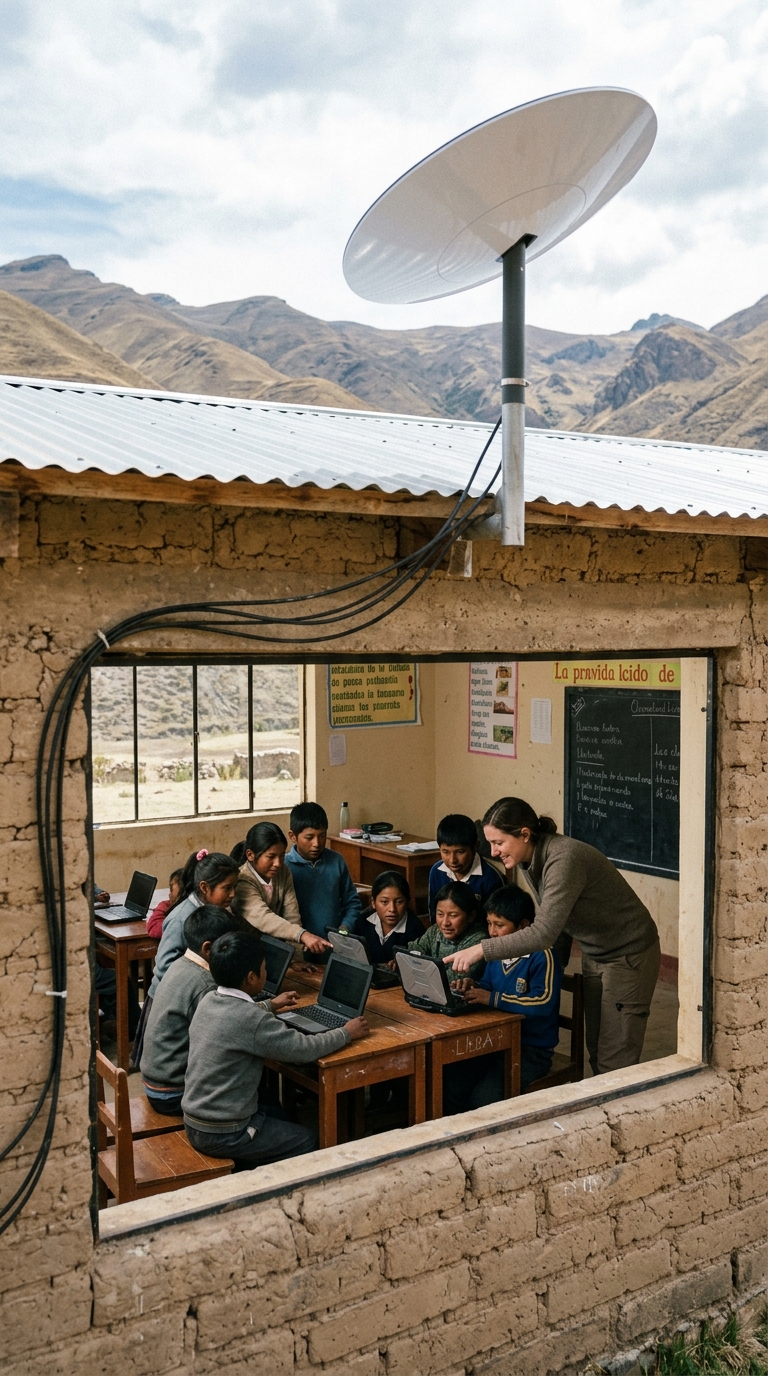
But technology can disappoint when it is oversold. A satellite dish on a school roof makes a powerful image. The harder work is keeping the service paid, training staff, maintaining equipment and ensuring that students benefit. Connectivity projects fail when they stop at installation.
The next phase should be judged by outcomes. Are more children learning? Are clinics functioning better? Are small businesses reaching markets? Are disaster responses faster? Are women, older adults and low-income households included? Those questions matter more than the number of satellites launched.
Satellite broadband has brought the sky into the digital divide debate. It may become one of the most important tools for universal connectivity. But the divide will not be closed from orbit alone. It will close when signal, affordability, skills, content and trust meet on the ground.
“””
