“””
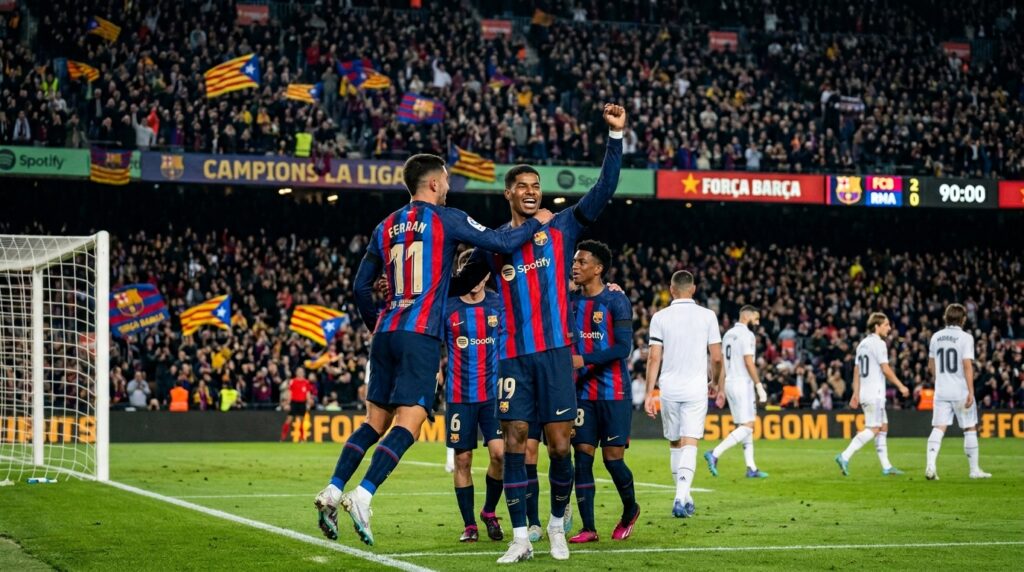
Marcus Rashford and Ferran Torres scored early at Camp Nou as Hansi Flick’s side beat its fiercest rival 2-0 to retain Spain’s league crown with three matches to spare.
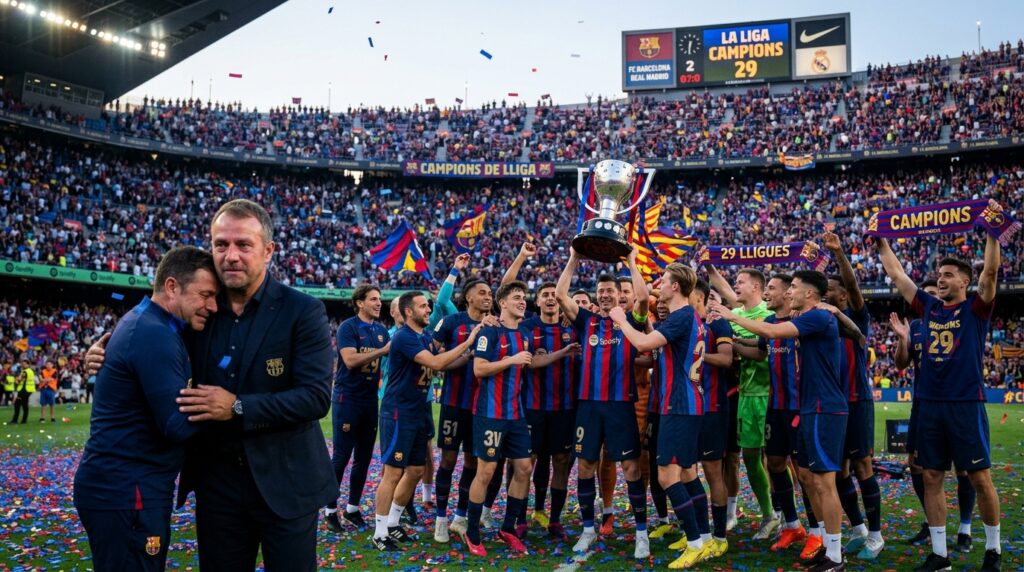
BARCELONA, Spain — Barcelona turned the most charged fixture in Spanish football into a coronation, defeating Real Madrid 2-0 at Camp Nou on Sunday to clinch the club’s 29th La Liga title and deepen a season of frustration for its great rival.
Marcus Rashford opened the scoring in the ninth minute with a curling free kick, and Ferran Torres doubled the lead nine minutes later, giving Barcelona the cushion it needed before a crowd of 62,213 at Spotify Camp Nou. The result left Hansi Flick’s team with an insurmountable advantage at the top of the table with three rounds remaining and confirmed a second consecutive league championship for the Catalan club.
The title was Barcelona’s third league triumph in four seasons, but this one carried a particular emotional force. It was sealed against Real Madrid, under the lights of a rebuilt Camp Nou, and on a night when Flick led his players from the dugout only hours after Barcelona announced the death of his father. Players from both teams wore black armbands before kickoff, and a moment of silence gave the match an atmosphere that was solemn before it became celebratory.
Barcelona needed only a draw to secure the championship. Instead, it delivered the kind of direct, controlled start that made the title feel inevitable long before the final whistle. Rashford, who has become one of the defining figures of Barcelona’s campaign, struck first after a foul outside the penalty area. His free kick cleared the wall and beat Thibaut Courtois, turning the opening minutes into a surge of noise from the stands.
Torres soon made the night even harder for Madrid. Dani Olmo’s touch opened space in the area, and Torres finished from close range to put Barcelona 2-0 ahead before the match had reached its 20th minute. Madrid, already under pressure before kickoff, was forced to chase a game that Barcelona had shaped almost immediately.
The early goals changed the rhythm. Barcelona no longer needed to force the contest. It pressed when necessary, slowed play when useful and trusted the midfield to keep Madrid from building sustained pressure. Real Madrid had moments of possession and flashes of threat, but the visitors lacked the sharpness, cohesion and emotional control required to interrupt a title celebration unfolding in front of them.
For Barcelona, the victory was not only about the final step in the standings. It was a statement about authority. The club entered the season looking to prove that last year’s league success could be sustained, not remembered as a temporary revival. Under Flick, Barcelona found consistency, defensive balance and enough attacking variety to outlast Madrid, Atlético Madrid and the rest of the league.
Rashford’s role in that transformation has been one of the stories of the season. Brought in to add speed, experience and a different attacking profile, the England forward has supplied goals in decisive moments. His free kick against Madrid was not just another contribution; it was the strike that opened the match that delivered the title. In a fixture often defined by icons, his name now sits inside one of Barcelona’s most memorable league nights.
Torres also reinforced his value in a campaign built on depth as much as star power. His movement across the front line, willingness to run behind defenders and ability to finish under pressure have given Flick flexibility. Against Madrid, he turned that reliability into the second goal of a championship-clinching clásico.
The emotional center of the night, however, was Flick. The German coach has restored structure and belief to a club that has spent recent years balancing financial limits, squad transition and enormous expectations. His reaction after the final whistle showed the human weight of the occasion. Barcelona’s players gathered around him, and the stadium’s celebration carried a tone that mixed triumph with sympathy.
In football terms, Flick’s achievement is considerable. Winning La Liga is never routine at Barcelona, even when the club is expected to challenge every year. Doing so while managing a young core, integrating new pieces and maintaining standards across a long season gave this title a different shape from some of the club’s more star-driven eras. Barcelona did not rely on one single figure. It won through a collective rhythm.
That rhythm was visible again against Madrid. The back line handled pressure without panic. The midfield managed tempo. The attack struck early and then chose its moments. It was not a wild clásico. It was not a match of constant comeback drama. It was a controlled performance by the team that had earned the right to celebrate.
For Real Madrid, the defeat confirmed a painful contrast. The club remains the most successful side in Spanish league history, with 36 titles, but this season has ended without a major trophy. Losing the title race at Camp Nou, against Barcelona, gave the failure a sharper edge. Madrid’s squad has enough talent to compete with anyone, but the final weeks have exposed instability, injuries and internal strain.
The absence of Kylian Mbappé, who missed the match through injury, removed one of Madrid’s most dangerous attacking outlets. Without him, the visitors struggled to stretch Barcelona consistently. Jude Bellingham and Vinícius Júnior tried to influence the game, but Barcelona’s shape limited the spaces where Madrid usually does its damage.
The result will intensify scrutiny of Madrid’s direction. El Clásico defeats are never treated as isolated events, especially when they decide a title. Questions over squad balance, coaching authority and dressing-room unity are likely to follow the club into the summer. Madrid has recovered from setbacks before, but the symbolism of watching Barcelona lift the league after a controlled 2-0 win will not fade quickly.
At Camp Nou, the symbolism worked the other way. Barcelona fans had waited for a night when the restored stadium could again feel like the center of Spanish football. As the minutes wound down, the chants of “campeones” grew louder, and the match became less about uncertainty than release. When the final whistle came, players embraced, substitutes raced onto the pitch and the league trophy became the focus of a night built for memory.
The title also strengthens Barcelona’s sporting project at a crucial moment. The club has continued to operate under financial constraints, and every major success carries both emotional and commercial importance. Winning La Liga gives the board, coaching staff and players a platform from which to plan the next phase. It also reinforces the idea that Barcelona’s return to the top is not dependent on nostalgia.
There will be larger tests ahead. Barcelona’s European ambitions remain the benchmark by which the club’s modern era will be judged. Domestic dominance is vital, but Champions League performance continues to define the difference between a strong season and a historic one. Flick’s next challenge will be turning this league-winning side into a team capable of imposing itself beyond Spain.
For now, Barcelona has earned its celebration. It beat Real Madrid when the title was on the line, scored early, defended with discipline and gave its grieving coach a night of collective tribute. The victory did not require chaos or late drama. It came with clarity.
Barcelona’s 29th La Liga title will be remembered for the setting, the opponent and the emotion surrounding Flick. It will also be remembered for the two early goals that settled the country’s biggest match: Rashford bending the first into the top corner, Torres finishing the second, and Camp Nou rising to greet a champion that had made the league its own.
“””