
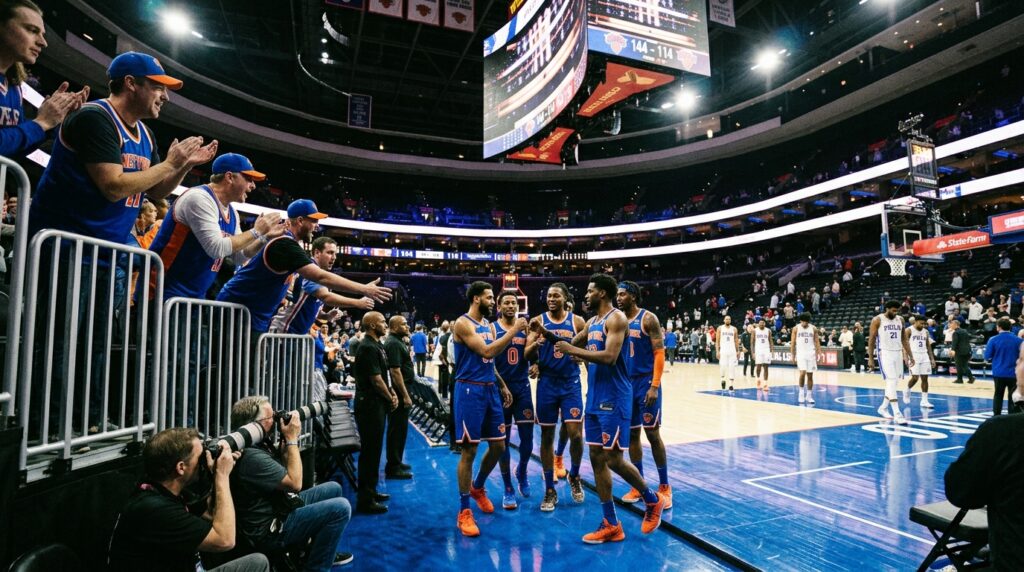
The Knicks swept the Philadelphia 76ers with a 144-114 Game 4 rout, matching an NBA playoff record with 25 made three-pointers and turning a road arena into a celebration of New York’s postseason surge.
PHILADELPHIA — The New York Knicks did not merely close a series Sunday. They turned Game 4 into a declaration that their playoff run is no longer built on grit alone, but on a level of shooting, spacing and confidence that can overwhelm even a talented opponent before halftime.
New York defeated the Philadelphia 76ers 144-114 to complete a four-game sweep in the Eastern Conference semifinals, advancing to the conference finals for the second straight season. The final margin captured only part of the damage. The Knicks tied the NBA playoff record with 25 made three-pointers, including 11 in the first quarter and 18 by halftime, reducing a potential closeout test on the road into one of the most emphatic performances of the postseason.
The Knicks walked into Philadelphia with a 3-0 series lead and played as if they were the team under pressure. They moved the ball quickly, found shooters early and repeatedly punished the 76ers for late rotations. By the end of the first quarter, the game had already taken on a historic shape. Miles McBride, starting in place of injured forward OG Anunoby, hit four three-pointers in the opening period and helped New York build a lead that Philadelphia never seriously threatened.
McBride finished with 25 points and seven made threes, the most striking individual performance in a night defined by collective precision. Jalen Brunson added 22 points and six three-pointers. Josh Hart and Karl-Anthony Towns each scored 17, with Towns adding 10 assists in a reminder that New York’s offense has become more varied than the bruising, isolation-heavy version that often defined earlier Knicks playoff teams.
The sweep sends New York into the Eastern Conference finals with momentum that is difficult to ignore. The Knicks have now won seven straight playoff games, a run that began after they trailed Atlanta 2-1 in the first round. Since then, they have produced a series of lopsided results that have changed the tone around the franchise. What began as a postseason built on survival has become a surge defined by control.
The Knicks’ 144 points were the product of ruthless efficiency from the perimeter and a willingness to trust the extra pass. Philadelphia tried different defensive looks, but the 76ers were repeatedly beaten by early offense, drive-and-kick action and New York’s spacing across the arc. When the Sixers collapsed toward Brunson or Towns, the ball found shooters. When they stayed attached to the perimeter, New York attacked the paint and forced rotations.
The first half told the story. New York led 81-57 at the break, having scored 54 points from three-point range alone. The Knicks’ 18 first-half threes tied a playoff record for a half, and their 11 in the opening quarter tied a playoff record for a quarter. By the time the final record-tying three dropped late in the fourth, the suspense had shifted from the outcome to the history book.
Philadelphia entered the series with enough star power to imagine a competitive battle. Joel Embiid and Tyrese Maxey had helped carry the 76ers through a first-round comeback against Boston, and the franchise hoped a healthy enough Embiid could change the balance of the matchup. Instead, the Sixers were outplayed across the series and overrun in the finale.
Embiid scored 24 points in Game 4 and Maxey had 17, but Philadelphia never found the energy or defensive consistency required to slow New York’s rhythm. The 76ers were chasing shooters almost from the opening tip, and by the second quarter they were also chasing a season that was slipping away. Philadelphia has now gone another year without advancing beyond the second round, extending a painful pattern for a franchise built around high expectations.
For the Knicks, the atmosphere made the night even more memorable. Large numbers of New York fans filled the Philadelphia arena, waving towels, chanting and celebrating as the road team built its lead. By the second half, the building often sounded less like hostile territory and more like a neutral-site coronation. That visual — Knicks fans roaring through a closeout win in Philadelphia — gave the sweep a sharper edge in one of the Eastern Conference’s most charged rivalries.
The performance also marked a significant moment for head coach Mike Brown, who inherited a team with established expectations and has guided it into another conference finals appearance. New York reached the same round last season before falling to Indiana, then made a coaching change that raised questions about whether a new voice could preserve the team’s identity while expanding its ceiling. This postseason run has so far delivered an answer: the Knicks remain physical, but they are now playing faster, passing better and shooting with greater freedom.
Towns has been central to that evolution. His scoring is expected, but his passing in Game 4 allowed New York to operate with unusual flexibility. When he worked from the elbows or the top of the floor, he became a release valve against pressure and a playmaker against mismatches. That dimension helped prevent Philadelphia from loading up entirely on Brunson, whose command of the offense remains the foundation of New York’s late-season rise.
Hart’s contribution was similarly important. He hit four three-pointers, rebounded, defended and brought the emotional force that has become part of the Knicks’ identity. On a night when the three-point shooting will dominate the highlights, New York’s edge still came from its familiar formula: physical wings, aggressive guards, interchangeable lineups and relentless energy.
The 76ers, by contrast, face an offseason of difficult evaluation. Embiid’s health remains the central question around the franchise, even when he is productive. Maxey’s development gives Philadelphia a dynamic guard to build with, but the roster around its stars again fell short of a conference finals berth. The Game 4 defeat was not a narrow loss explained by one cold stretch. It was a comprehensive failure against a team that looked faster, deeper and more connected.
New York will next face the winner of the Cleveland-Detroit series. That matchup will present a different set of problems, but the Knicks have given themselves something valuable before the next round: rest, confidence and evidence that their offense can win in more than one way. A team known for toughness has now shown it can bury an opponent under a storm of threes.
The larger question is whether this shooting display was a singular eruption or a sign of a team peaking at the right time. Playoff history warns against assuming that one historic night will repeat itself. Opponents adjust, percentages cool and the pressure of the conference finals can turn clean looks into harder ones. But New York’s confidence is real, and confidence has a way of reshaping a series before tactics do.
For years, Knicks success was measured against memory — the weight of Madison Square Garden history, the long gaps between deep runs and the constant demand for relevance in the league’s biggest market. This version of the team is beginning to create its own standard. It is not simply happy to be back in the Eastern Conference finals. It arrives there with a seven-game playoff winning streak, a sweep of a division rival and a record-tying shooting performance that will be remembered long after the series fades.
The Knicks left Philadelphia with brooms, a place in the conference finals and a warning to the rest of the East. If their defense holds and their spacing remains this sharp, New York is no longer just a hard team to beat. It is a team capable of ending a playoff series in one breathtaking burst.”””