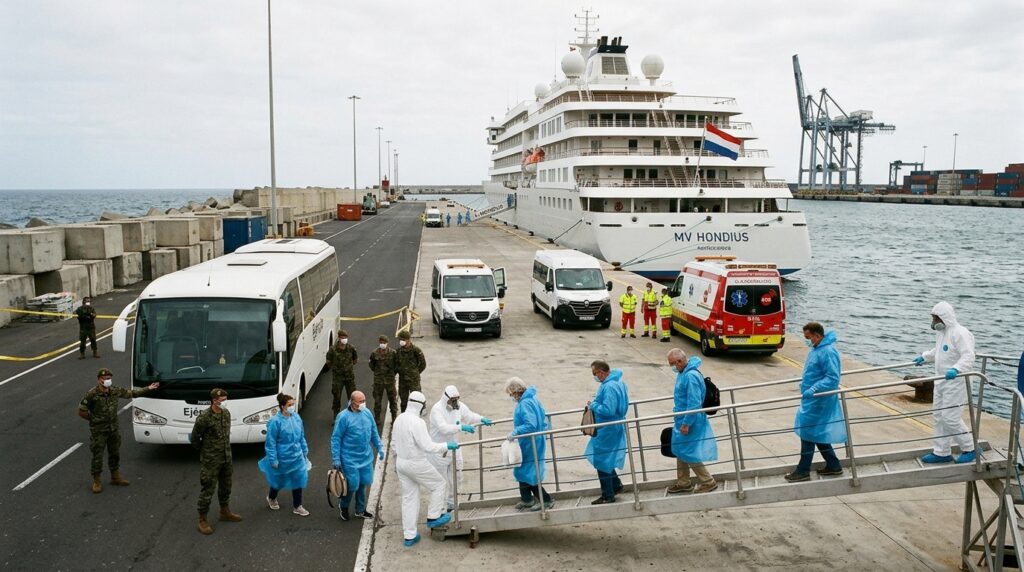
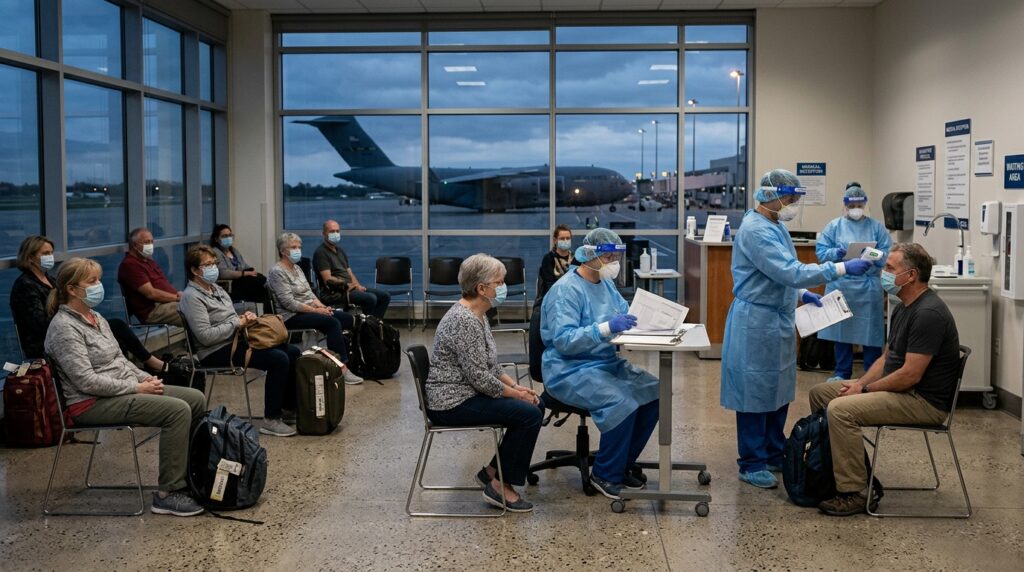
A French woman and a U.S. passenger tested positive after leaving the cruise ship, as governments moved travelers by military and state aircraft into quarantine or medical monitoring.
THE HAGUE, Netherlands — An outbreak of hantavirus linked to the cruise ship MV Hondius has triggered a multinational evacuation and quarantine operation, after passengers were flown from Spain’s Canary Islands on government and military aircraft and health authorities confirmed new infections among evacuees from France and the United States.
The Dutch-flagged vessel, which had been carrying passengers and crew from more than 20 countries, arrived at the port of Granadilla in Tenerife on May 10 after weeks of mounting concern over severe respiratory illness among people connected to the voyage. Officials in protective suits escorted passengers from ship to shore, transferring them by military bus to repatriation flights as Spain, the Netherlands, France, the United States, Britain and other countries coordinated one of the most complex maritime public health responses since the COVID-19 pandemic.
The Associated Press reported Monday that a French woman and an American passenger tested positive for hantavirus after leaving the vessel. The French woman was among five French passengers repatriated to Paris and developed symptoms during or shortly after the flight, according to French officials. Her condition worsened overnight, and she was being treated in a specialized infectious diseases unit. U.S. health officials said one American evacuee who flew to Nebraska tested positive but had no symptoms, while another had mild symptoms. The World Health Organization later said laboratory results for the American case were inconclusive, underscoring the uncertainty surrounding some early test findings.
The outbreak has already been fatal. Three passengers have died since the voyage began, and European health authorities said on May 11 that nine cases had been reported in total, including seven confirmed and two probable cases. The virus involved has been identified as Andes hantavirus, a rare strain associated with severe respiratory disease and, unlike most hantaviruses, limited person-to-person transmission in certain circumstances.
Health officials have emphasized that the risk to the wider public remains low. Hantaviruses are usually acquired through exposure to infected rodents, particularly through urine, droppings or saliva. Most strains do not spread easily between people. Andes virus is an exception, but transmission generally requires close and prolonged contact. That assessment has shaped the response: intensive monitoring of passengers and crew, isolation for higher-risk contacts, and tracing of people who may have encountered infected travelers earlier in the journey.
The MV Hondius left Ushuaia, Argentina, on April 1 for an expedition itinerary across remote parts of the South Atlantic. Its route included Antarctica, South Georgia, Nightingale Island, Tristan da Cunha, Saint Helena and Ascension Island. The source of exposure has not been determined. Investigators are examining whether passengers may have encountered infected rodents or contaminated environments before boarding or during shore excursions, but officials have not publicly identified a definitive origin.
The first known death occurred aboard the ship on April 11. A Dutch woman later became ill and died in South Africa after leaving the vessel. Another passenger died as the ship continued its journey. By early May, the WHO had been notified of a cluster of severe acute respiratory illness involving passengers and crew, including confirmed hantavirus infection, suspected cases, one critically ill patient and deaths.
The ship then became the focus of a diplomatic and medical dilemma as it sailed off West Africa. Cape Verdean authorities did not allow passengers to disembark, while health teams were sent to assist. Several sick people were evacuated for medical care, including a British man who was taken from the vessel and treated in Johannesburg. South African officials said Monday that his condition was gradually improving.
Once the ship reached Tenerife, governments began moving passengers home under controlled conditions. Spanish authorities said passengers underwent health checks and temperature screening. Personnel in full protective gear managed the disembarkation, and passengers were placed on flights arranged by their home governments. France, Britain, the United States and the Netherlands were among the countries receiving evacuees for quarantine, hospital observation or active medical follow-up.
The U.S. government sent a medical repatriation flight to bring American passengers to Nebraska, where they were taken to the University of Nebraska Medical Center. The facility includes a federally supported quarantine center and a biocontainment unit with experience handling high-risk infectious disease cases. U.S. officials said the returning passengers would be assessed individually for exposure risk and monitored for symptoms.
Britain also repatriated passengers, with some placed in isolation and testing programs. France said it was tracing nationals who may have been exposed, including people who traveled on earlier flights after disembarking. Dutch authorities were expected to receive more evacuees, while the ship itself was scheduled to continue toward the Netherlands with remaining crew after disembarkation operations concluded.
WHO officials have recommended active follow-up of passengers by their home countries, including daily health checks either at home or in specialized facilities. Some countries have chosen quarantine periods of up to 42 days, reflecting the possible incubation window for hantavirus illness. Symptoms can include fever, chills, muscle aches, gastrointestinal problems and, in severe cases, rapid progression to pneumonia, respiratory distress and shock.
The outbreak has raised difficult questions for expedition cruising, an industry built around access to remote environments where medical infrastructure is limited and evacuation can be slow. The MV Hondius itinerary moved through some of the world’s most isolated regions, far from large hospitals and laboratory capacity. Once multiple passengers became seriously ill, the ship’s position complicated both diagnosis and response.
Cruise ship outbreaks are not new, but hantavirus is an unusual threat at sea. Norovirus and respiratory infections are far more commonly associated with passenger vessels. A hantavirus cluster on a ship presents different challenges because cases may develop weeks after exposure, symptoms can initially resemble other illnesses, and the source may be difficult to identify once passengers have moved across multiple countries.
Public health authorities are trying to avoid panic while also preventing any secondary spread. WHO Director-General Tedros Adhanom Ghebreyesus said the event should not be compared with COVID-19 and that the risk to the public remains low. Still, the response has been expansive because the consequences for infected individuals can be severe, and because passengers have dispersed across borders.
The captain of the MV Hondius, Jan Dobrogowski, issued a video message praising passengers and crew for their discipline and resilience, while also acknowledging the deaths. His comments reflected the emotional toll of a voyage that began as a remote expedition and ended in quarantine flights, hospital transfers and international contact tracing.
For families of those aboard, the coming weeks will be marked by uncertainty. Some passengers may remain healthy throughout monitoring. Others may develop symptoms after returning home, requiring rapid testing and care. Health officials will continue assessing exposure histories, travel records and close contacts to determine whether the outbreak has been fully contained.
The immediate operation in Tenerife appears designed to reduce risk at every stage: controlled disembarkation, protective equipment, dedicated transport, government aircraft and supervised medical follow-up. That level of coordination reflects both the seriousness of the disease and the lessons learned from previous outbreaks, when delays in tracing and inconsistent messaging allowed fear to spread faster than facts.
For now, officials say the wider public should remain calm. The danger is concentrated among people who were aboard the MV Hondius or had close contact with infected travelers. But the episode is a reminder that rare pathogens can surface in unexpected settings, especially as tourism reaches increasingly remote regions.
The MV Hondius outbreak has become more than a medical emergency aboard one ship. It is now a test of how quickly governments can coordinate across borders, how clearly health agencies can communicate risk, and how prepared the travel industry is for diseases that do not fit the familiar pattern of cruise ship illness.”””