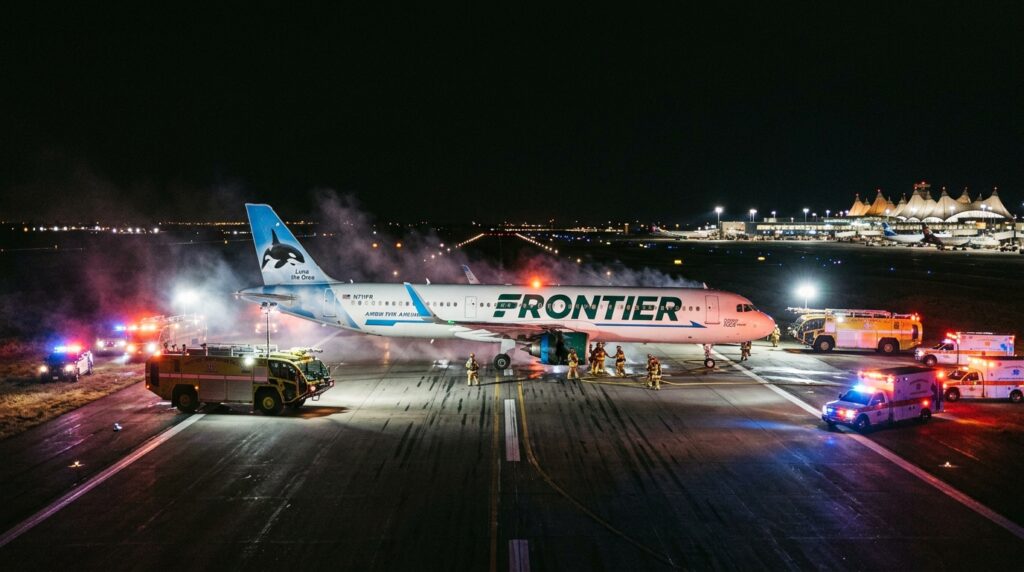
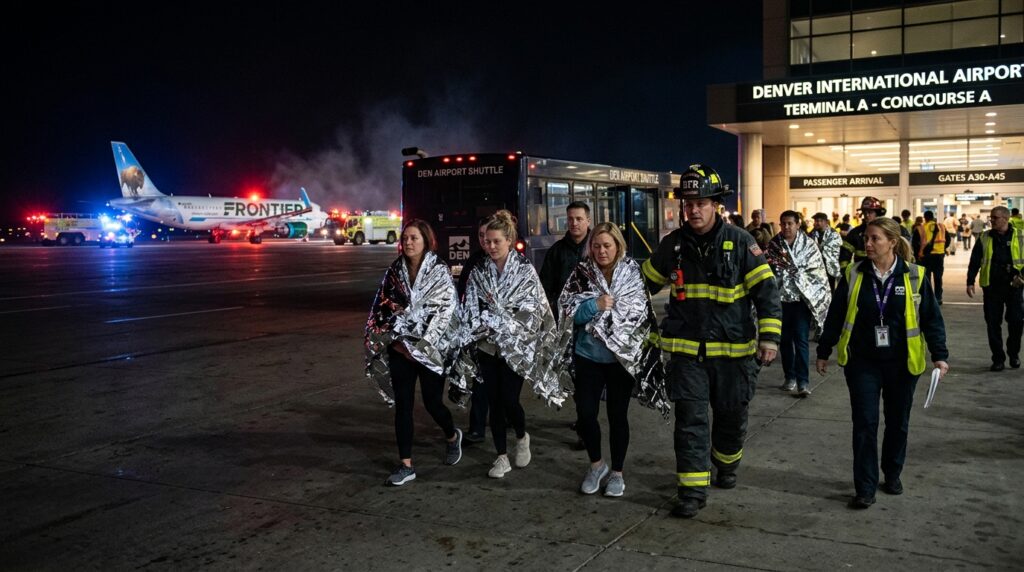
The fatal collision at Denver International Airport triggered an engine fire, a smoke-filled cabin and an emergency evacuation of 231 people as federal investigators examine how the breach occurred.
DENVER — A Frontier Airlines jet bound for Los Angeles struck and killed a person on a runway at Denver International Airport late Friday, triggering an engine fire and forcing an emergency evacuation that left passengers sliding onto the tarmac in the dark as smoke filled the cabin.
Frontier Flight 4345, an Airbus A321neo carrying 224 passengers and seven crew members, was departing Denver for Los Angeles International Airport when it hit a person on Runway 17L at about 11:19 p.m. local time, according to airport officials. The Federal Aviation Administration said the aircraft struck the person during departure and confirmed it is investigating the incident.
Denver airport officials said the person had jumped a perimeter fence and was struck roughly two minutes later while crossing the runway. Authorities have not publicly identified the person, and the Denver Office of the Medical Examiner is expected to confirm the identity and cause of death. Officials said the person was not believed to be an airport employee.
The impact forced the pilots to abort takeoff. Air traffic control audio captured the crew reporting that the aircraft was stopping on the runway after hitting someone and that there was an engine fire. The pilot later reported smoke in the aircraft and said the plane would evacuate on the runway.
Emergency crews responded quickly. The Denver Fire Department extinguished what airport officials described as a brief engine fire, and passengers were evacuated using emergency slides before being bused back to the terminal. Twelve passengers reported minor injuries, and five were taken to hospitals, according to airport officials cited by the Associated Press.
The incident has raised urgent questions about airport perimeter security, runway monitoring and emergency evacuation procedures at one of the busiest airports in the United States. Denver International Airport, a major hub for domestic and international travel, has long runways spread across a vast airfield east of the city, where security depends on fencing, patrols, surveillance and coordination among airport operations, police, air traffic control and federal agencies.
The immediate focus is how a person was able to enter the airfield and reach an active runway as a commercial jet was beginning its takeoff roll. Investigators are expected to examine the fence line, security camera footage, airport response times, air traffic communications and whether any detection systems alerted authorities before the collision. The fact that officials say the person was struck within two minutes of breaching the perimeter suggests an extremely narrow window for intervention.
For the passengers aboard Flight 4345, the sequence unfolded suddenly. The aircraft was accelerating for takeoff when the impact occurred. Passengers later described a loud jolt, sparks or flames near the engine and smoke entering the cabin. In such moments, airline crews must make rapid decisions under intense pressure: stop the aircraft, assess fire or smoke, coordinate with air traffic control, prepare exits and evacuate passengers without allowing panic to overwhelm procedure.
The evacuation itself is now part of the safety review. The National Transportation Safety Board said it was gathering information about the emergency evacuation to determine whether the event meets criteria for a safety investigation. Passenger video reviewed by news organizations showed people using inflatable slides, with some appearing to carry bags despite safety instructions that passengers leave belongings behind during an evacuation.
That detail matters. Aviation safety authorities have repeatedly warned that retrieving luggage during an emergency evacuation can slow movement, damage slides, injure other passengers and block aisles at the moment when seconds count. In a smoke-filled cabin, even a brief delay can increase risk. The NTSB has previously expressed concern about passengers taking carry-ons during evacuations, and the Denver incident is likely to renew debate over whether airlines and regulators need stronger enforcement, clearer passenger briefings or redesigned cabin procedures.
There is no indication that the Frontier crew caused the runway breach. The pilots appear to have stopped the aircraft and alerted controllers after impact, while emergency crews moved to the scene. Still, aviation investigations are intentionally broad. Investigators will not only ask how the person reached the runway, but also whether airport systems detected the breach quickly enough, whether controllers had any warning, how emergency responders were deployed and how passengers were evacuated after the aircraft stopped.
Runway incursions involving unauthorized people are rare but among the most dangerous scenarios in aviation. Modern airports are designed to keep vehicles, workers, aircraft and pedestrians separated through layered procedures. When a person enters an active movement area without authorization, the threat can develop faster than a tower controller, airport vehicle or pilot can respond. At takeoff speed, a commercial aircraft cannot maneuver like a car, and stopping distance depends on speed, weight, runway length, aircraft systems and pilot reaction time.
The human cost of the Denver incident is central. One person died on the runway, and dozens of passengers and crew were exposed to a frightening emergency. Many travelers who boarded expecting a routine late-night flight to Los Angeles instead found themselves escaping down slides onto an active airfield after a collision and fire. Even where physical injuries were minor, the psychological impact may be lasting.
Frontier Airlines said it was investigating the incident and gathering more information in coordination with the airport and other safety authorities. The airline’s immediate operational task was to care for passengers, arrange onward travel and assist investigators. Airport officials said most passengers later departed Denver on another Frontier flight.
The event also places Denver International Airport under scrutiny. Airport CEO Phil Washington said there were still questions to answer and described the incident as a preventable tragedy caused by an apparent trespasser. The airport has said Runway 17L would remain closed while the investigation continues. Any prolonged runway closure at Denver can affect operations, though the airport has multiple runways and is built to handle heavy traffic.
For federal regulators, the incident sits at the intersection of aviation safety and airport security. The FAA’s role will include examining the aircraft operation, runway environment and air traffic elements. Local police and airport authorities will focus on the trespass, the fence breach and the circumstances that brought the person onto the runway. The NTSB may look closely at the evacuation if it determines the response raises safety issues that warrant deeper investigation.
The Transportation Security Administration may also have an interest in perimeter security, although airports themselves typically maintain and police much of their physical airfield boundary under federally approved security programs. Investigators may seek to determine whether the breach exposed a weakness in fencing, surveillance, patrol coverage or response protocols.
The Denver collision is unlikely to be understood through one factor alone. In aviation, serious incidents often reveal a chain of vulnerabilities: an unauthorized entry, limited time to detect it, an active runway, a departing aircraft and an emergency response complicated by smoke and fire. Breaking that chain is the purpose of the investigation.
In the coming days, officials are expected to release more information about the person who died, the condition of injured passengers, the aircraft damage and the timeline of the emergency response. Surveillance footage, cockpit voice data, flight data, airport operations logs and air traffic recordings may all become important to investigators.
For passengers, the questions are more immediate and personal: how someone reached the runway, why the aircraft was not warned sooner, and whether the evacuation was handled as quickly and safely as possible. For airport operators across the country, the incident is a reminder that perimeter security is not a background function. It is a frontline safety system.
Commercial aviation remains extraordinarily safe, and runway collisions involving trespassers are rare. But the Denver incident shows how rapidly an external breach can become a life-threatening emergency for hundreds of people aboard an aircraft. A person crossed a fence, entered an active airfield and, within minutes, a routine departure became a fatal accident, a burning engine and an evacuation under smoke.
The investigation will determine what failed, what worked and what changes may be needed. For now, the facts are stark: one person is dead, several passengers were injured, and 231 people escaped a damaged aircraft after a late-night takeoff from Denver became a crisis on the runway.
“””