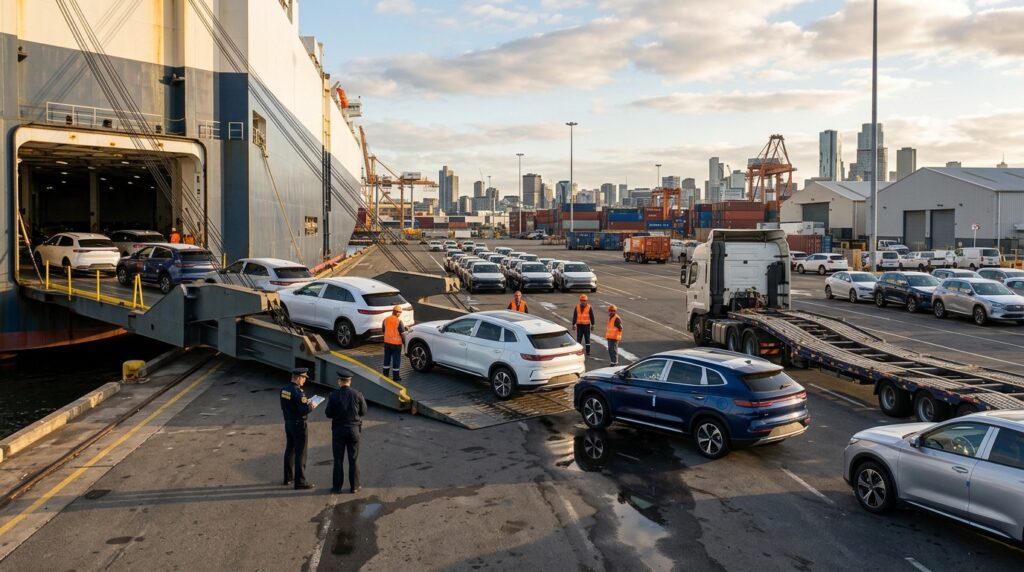
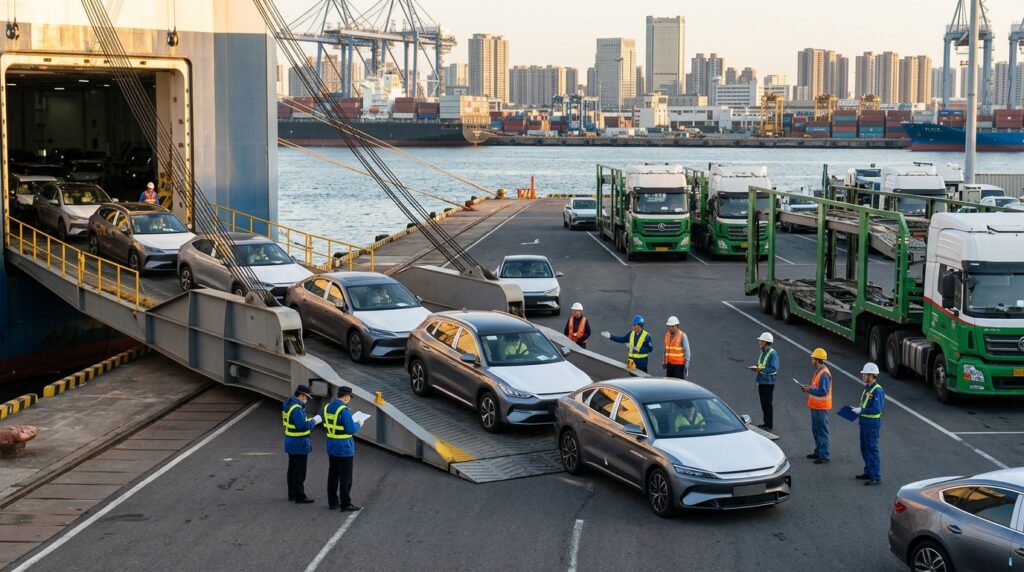
The April surge highlights how Chinese automakers are leaning harder on overseas markets as domestic demand weakens and trade tensions reshape the global car industry.
HONG KONG — China’s passenger car exports surged in April, extending a powerful outward push by the world’s largest auto market as its manufacturers seek growth abroad while facing softer demand at home.
Exports of passenger vehicles from China climbed nearly 85% from a year earlier to about 796,000 units in April, according to data from the China Association of Automobile Manufacturers. The figure was also higher than March’s 748,000 exported vehicles, underscoring the speed at which Chinese automakers are using international markets to absorb production and build global scale.
The sharpest increase came from new energy vehicles, a category that includes battery-electric cars and plug-in hybrids. Exports of those vehicles rose more than 120% from a year earlier to about 420,000 units, making them the strongest symbol of China’s changing role in the global auto trade. Once known mainly as a manufacturing base for foreign brands and a vast consumer market, China is now exporting its own vehicles in volumes that are forcing established automakers, regulators and governments to reassess competitive assumptions.
The April figures point to a clear split in China’s auto sector. Overseas demand is expanding rapidly, but the domestic market is losing momentum. Passenger car sales inside China fell 25.5% from a year earlier to about 1.3 million vehicles, marking another month of weakness in a market long considered the industry’s most important growth engine.
That divergence is reshaping company strategy. Chinese automakers that spent years fighting for share in a crowded home market are now looking overseas not as a side business, but as a core path to survival and profit. Brands such as BYD, Geely, Chery, SAIC and Great Wall Motor have expanded sales networks, shipping routes and factory plans across Southeast Asia, Europe, Latin America, the Middle East and parts of Africa. The goal is no longer simply to export excess vehicles. It is to become global.
China’s rise as a car exporter has been unusually fast. A decade ago, Chinese brands were often viewed abroad as low-cost alternatives with limited recognition. Today, many are competing on electric range, battery technology, digital interiors, driver-assistance features and price. Their advantage comes from a deeply integrated supply chain, fierce domestic competition and years of government support for electric vehicle development.
The surge in new energy vehicle exports shows how those strengths are translating beyond China’s borders. Electric and plug-in hybrid vehicles are no longer a niche export category. They are becoming the central product in China’s automotive trade strategy. In some markets, Chinese EVs appeal to consumers because they offer features associated with higher-priced vehicles at lower costs. In others, they give governments and fleet operators a faster way to expand electric mobility without relying solely on legacy Western, Japanese or Korean brands.
But the export boom is also intensifying political friction. The United States has imposed heavy tariffs on Chinese electric vehicles, effectively keeping most Chinese EV brands out of the American consumer market. The European Union has also moved to apply countervailing duties on Chinese-made battery electric vehicles after investigating state support for the sector. European officials argue that subsidies have given Chinese manufacturers an unfair advantage, while Beijing says such measures are protectionist and harmful to global climate goals.
Those trade barriers have not stopped China’s outward push. Instead, they are encouraging automakers to adjust routes, pricing and production plans. Some companies are investing in overseas assembly plants to reduce tariff exposure and reassure local governments that Chinese expansion can create jobs. BYD has pursued manufacturing plans in Europe, Southeast Asia and Latin America. Other Chinese automakers are using partnerships with local distributors and industrial groups to build brand recognition before committing to deeper investment.
The April numbers also reflect pressure inside China. The domestic auto market remains intensely competitive, with dozens of electric vehicle makers battling through price cuts, fast product cycles and heavy marketing. Consumers have become more cautious amid uncertainty tied to the property sector, employment conditions and uneven household confidence. At the same time, changes in government incentives have reduced some of the support that previously encouraged buyers to switch to new energy vehicles.
That combination has left automakers with a difficult equation. Factories built for rapid growth need high utilization. Battery plants, component suppliers and logistics networks depend on volume. If the home market slows, exports become an essential release valve. For some companies, foreign sales may determine whether they can maintain scale in an industry where margins are under pressure.
The shift has global consequences. In Europe, Chinese brands are challenging automakers already navigating the costly transition from combustion engines to electric platforms. In emerging markets, Chinese vehicles are competing with Japanese and Korean brands that have dominated for years. In Latin America and Southeast Asia, Chinese EVs and hybrids are entering markets where charging infrastructure is still developing but consumer interest is rising.
For buyers, the result can be more choice and lower prices. For local automakers, the challenge can be severe. Chinese companies are arriving with competitive technology, flexible pricing and experience gained from one of the most demanding consumer markets in the world. Their cars often come with large touchscreens, connected services, advanced battery systems and high equipment levels that put pressure on rivals to respond.
The speed of China’s export rise also raises questions about overcapacity. Western officials and some industry analysts argue that China’s manufacturing system is producing more vehicles than the domestic market can absorb, pushing companies to sell abroad at aggressive prices. Chinese officials and manufacturers counter that their success reflects innovation, efficiency and consumer acceptance rather than dumping or unfair trade.
Both arguments are shaping policy. Governments want lower-emission transport and cheaper electric vehicles, but they also want to protect domestic industries and jobs. That tension is likely to define the next stage of the global auto market. The electric vehicle transition is not only a technological shift; it is also an industrial contest over factories, batteries, software, minerals and trade rules.
China’s automakers face their own risks. Export success requires more than shipping cars. Companies must build service networks, supply spare parts, meet local safety and regulatory standards, manage currency risk and support vehicles long after sale. Brand trust is built slowly, especially in markets where consumers are unfamiliar with Chinese names or concerned about resale value and long-term reliability.
There is also the challenge of politics. A market that is open today can become restricted tomorrow if governments face pressure from domestic manufacturers or labor groups. Tariffs, import quotas, local content rules and subsidy restrictions can all alter the business case. Chinese companies that want durable global positions will need to localize not only production, but also compliance, after-sales service and public perception.
Still, the April figures show that China’s auto export machine is gaining force. The rise of new energy vehicle shipments is particularly important because it suggests Chinese automakers are not merely exporting older gasoline models to less competitive markets. They are exporting the products at the center of the industry’s future.
That future is likely to be more fragmented than the past. The United States may remain largely closed to Chinese-branded EVs. Europe may allow growth but under tighter price and regulatory conditions. Southeast Asia, Latin America and the Middle East may become more open battlegrounds, where Chinese companies can expand quickly if they combine price advantages with reliable service.
For now, the message from April is unmistakable. China’s carmakers are moving outward at scale, and electric vehicles are leading the way. Domestic weakness has made exports more urgent, but the global appetite for affordable electrified cars has made the opportunity real.
The world’s auto industry is entering a period in which the old hierarchy is no longer secure. China is not just producing cars for the world. It is competing to define what the next generation of cars will cost, how they will be powered and who will build them.”””