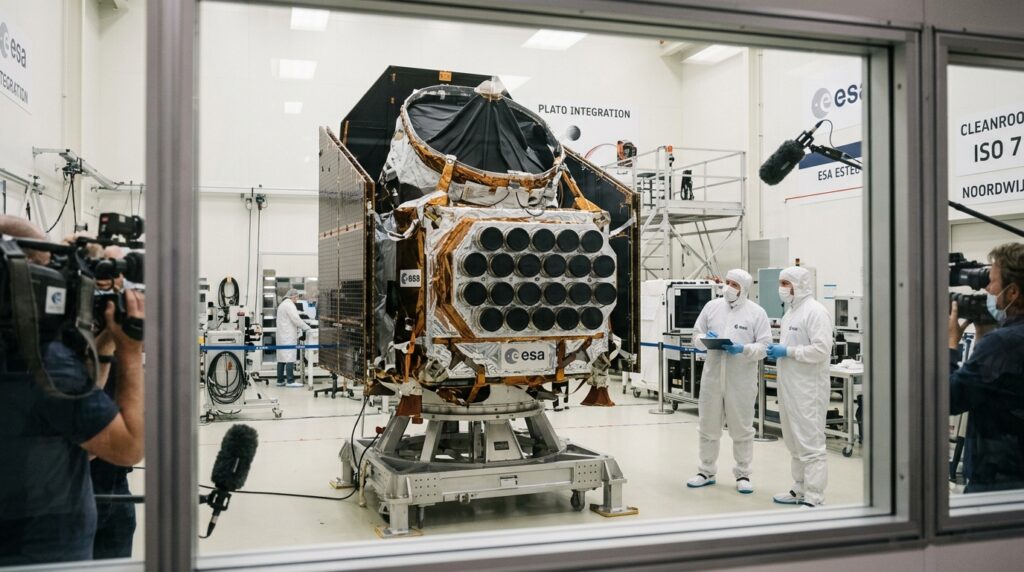
The European Space Agency is inviting journalists to see its completed Plato spacecraft at ESTEC in the Netherlands as final preparations continue for a mission aimed at finding Earth-like worlds around Sun-like stars.
NOORDWIJK, Netherlands — The European Space Agency is preparing to give journalists a final cleanroom look at Plato, Europe’s next major planet-hunting satellite, before the spacecraft moves deeper into the last stage of preparations for a mission designed to search for potentially habitable worlds beyond the Solar System.
The one-off media viewing, scheduled for May 20 at ESA’s European Space Research and Technology Centre in Noordwijk, will place reporters just outside one of the most controlled environments in European space science. Inside the cleanroom will be a spacecraft built to answer a question that has moved from philosophy to measurement over the past three decades: how common are planets like Earth around stars like the Sun?
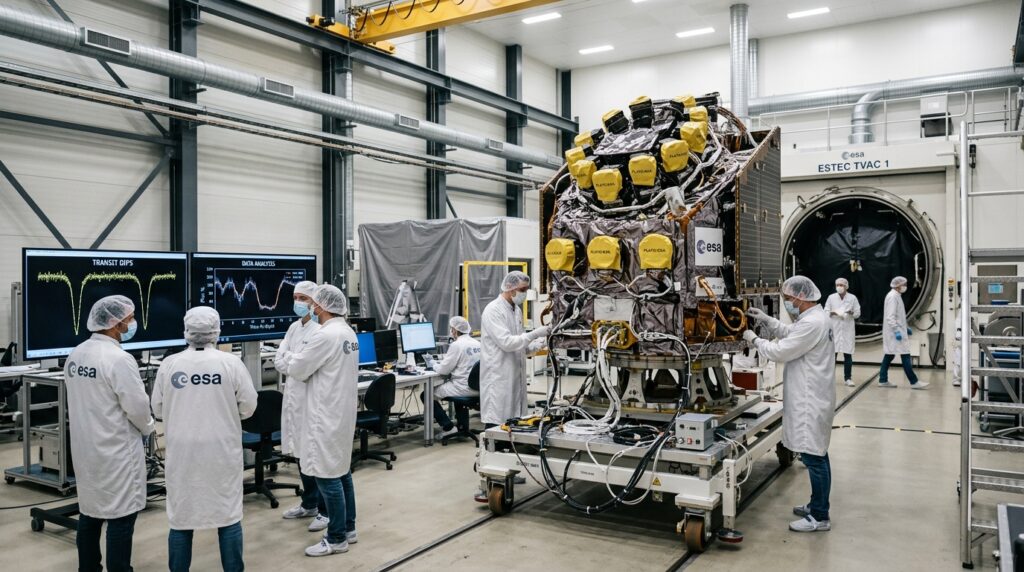
Plato, short for PLAnetary Transits and Oscillations of stars, is not designed to produce dramatic close-up images of distant planets. Its work will be quieter and more precise. The spacecraft will watch large fields of stars, measuring tiny, repeated dips in starlight caused when planets pass in front of their host stars. From those dimmings, scientists can determine a planet’s size, orbit and, with follow-up observations from the ground, clues to its density and composition.
ESA describes the mission as a search for terrestrial exoplanets in orbits up to the habitable zone of bright Sun-like stars. That is the region where temperatures could allow liquid water to exist on a planet’s surface, though the presence of a planet in that zone does not by itself mean the planet is inhabited or even habitable. The mission’s value lies in narrowing the list of targets: identifying worlds that are small enough, temperate enough and well measured enough to merit closer study.
The cleanroom event comes after a demanding test campaign at ESTEC. Plato recently emerged from the Large Space Simulator, Europe’s largest cryo-vacuum chamber, where engineers exposed the spacecraft to conditions intended to mimic the vacuum and thermal extremes it will face in space. Those tests are central to the mission because Plato’s scientific performance depends on stability. Its cameras must detect brightness changes so small that even tiny thermal shifts can matter.
For ESA, the public presentation is also a milestone in a long European effort to move from discovering exoplanets in bulk to characterizing them with enough precision to understand what they are. Since the first confirmed detections of planets around other stars, astronomers have found thousands of exoplanets, many of them through transit surveys. But many of the best-known detections orbit small, cool stars or have properties that remain uncertain. Plato is intended to fill a different part of the map: brighter stars, longer-period planets and systems where the host star itself can be studied in detail.
The spacecraft’s design reflects that ambition. Plato carries 26 cameras, a configuration that gives it a very wide view and allows it to monitor more than 200,000 stars. Most of the cameras will take regular measurements of stellar brightness, while two fast cameras will observe brighter stars at a quicker cadence and help control the spacecraft’s pointing. ESA says each camera has 81.4 megapixels, producing an overall imaging capability on a scale unprecedented for a space mission.
The number of cameras is not a matter of spectacle. It is a solution to a statistical and engineering problem. Earth-sized planets crossing Sun-like stars block only a minute fraction of light. To detect that signal reliably, Plato must collect steady measurements over long periods and separate planetary transits from stellar variability, instrument behavior and noise. The mission’s broad field of view and repeated observations are meant to increase the odds of finding small planets with orbits comparable to those of the inner Solar System.
Plato will also study the stars themselves through asteroseismology, the measurement of subtle brightness variations caused by oscillations inside stars. Those oscillations can reveal a star’s radius, mass and age. That matters because the properties of a planet are only as well known as the properties of the star it orbits. A more accurate stellar radius gives scientists a better planetary radius. A better stellar age helps researchers understand where a planetary system stands in its evolution.
This is one of Plato’s distinguishing promises. The mission is not simply expected to add more names to the exoplanet catalogue. It is expected to produce a better-characterized catalogue of planets, including worlds with known sizes, densities, compositions and ages. Such information could help scientists compare planetary systems more directly with our own and ask whether Earth’s conditions are rare, typical or somewhere in between.
The spacecraft’s route to this point has been complex. Plato was assembled by an industrial team led by OHB System AG, with major contributions from Thales Alenia Space and Beyond Gravity. Its scientific payload was supplied through the Plato Mission Consortium, a collaboration of European institutes and industries led by the German Aerospace Center. The completed spacecraft arrived at ESTEC after its main sections were joined in Germany, and engineers later fitted its combined sunshield and solar array module.
That sunshield and solar array structure is essential. Once in orbit, Plato’s solar panels will generate power while the sunshield keeps its cameras away from direct sunlight and helps maintain the cold, stable environment required for precision measurements. ESA has said the cameras must be kept around very low temperatures to stay in focus and limit noise, making the thermal behavior of the spacecraft one of the mission’s most important technical concerns.
Plato is planned for launch in early 2027 on an Ariane 6 rocket from Europe’s Spaceport in French Guiana. After launch, it will travel to a halo orbit around the Sun-Earth Lagrange point L2, about 1.5 million kilometers from Earth in the direction away from the Sun. That region has become a favored home for major observatories because it allows stable thermal conditions and an unobstructed view away from Earth, advantages that are crucial for long-duration astronomy.
The mission will join a lineage of exoplanet observatories, but it is not a duplicate of earlier efforts. NASA’s Kepler transformed the field by showing that planets are common across the galaxy. TESS expanded the hunt around bright, nearby stars. ESA’s Cheops studies known exoplanets in detail, while the James Webb Space Telescope can probe selected planetary atmospheres. Plato’s role is to identify and characterize a large sample of terrestrial planets, especially around stars bright enough for later ground- and space-based follow-up.
The stakes are scientific, but also strategic. For Europe, Plato is part of a broader push to maintain a leading role in space science after missions such as Gaia, Rosetta, Juice and Euclid. It also comes as Ariane 6 becomes central to Europe’s independent access to space. A successful launch and mission would strengthen ESA’s science program while giving European astronomers a major dataset in one of the most competitive fields in modern astronomy.
The cleanroom viewing will not answer whether Earth-like planets are common. It will show the machine built to ask that question with greater precision. Behind glass, under filtered air and strict contamination controls, Plato will appear less like a telescope in the traditional sense than a carefully arranged array of eyes, electronics, thermal shields and folded wings.
Once it leaves that controlled setting, the mission will enter a harsher sequence: final checks, shipment to the launch site, integration with the rocket and the risks of launch. Only after that will Plato begin the patient work for which it was designed, staring at stars and waiting for the faint shadows of distant worlds.
For scientists, those shadows could become some of the most important measurements in the search for life beyond Earth. For ESA, the cleanroom event is a public glimpse of a spacecraft nearing the end of its construction story and the beginning of its scientific one.
“””