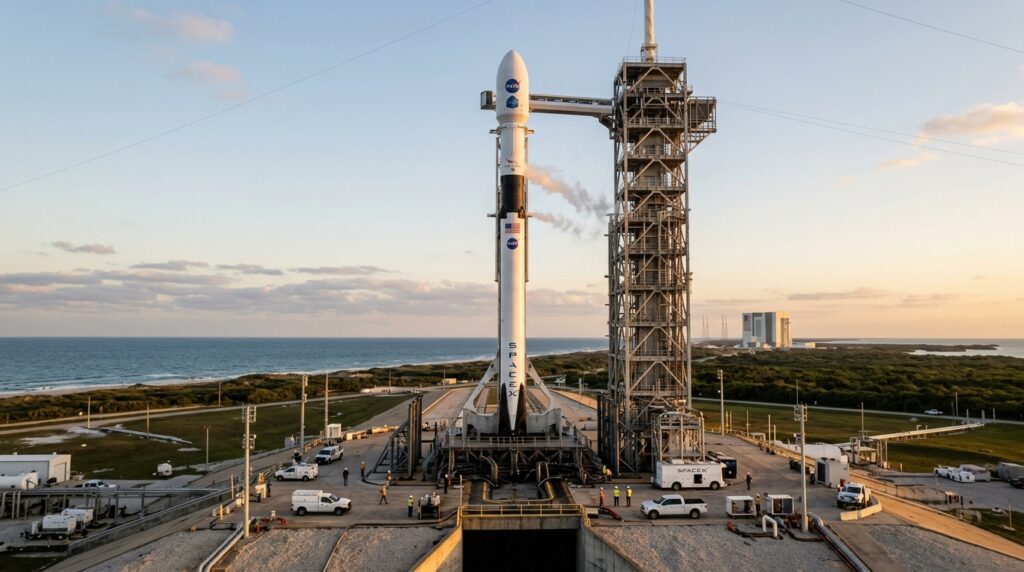
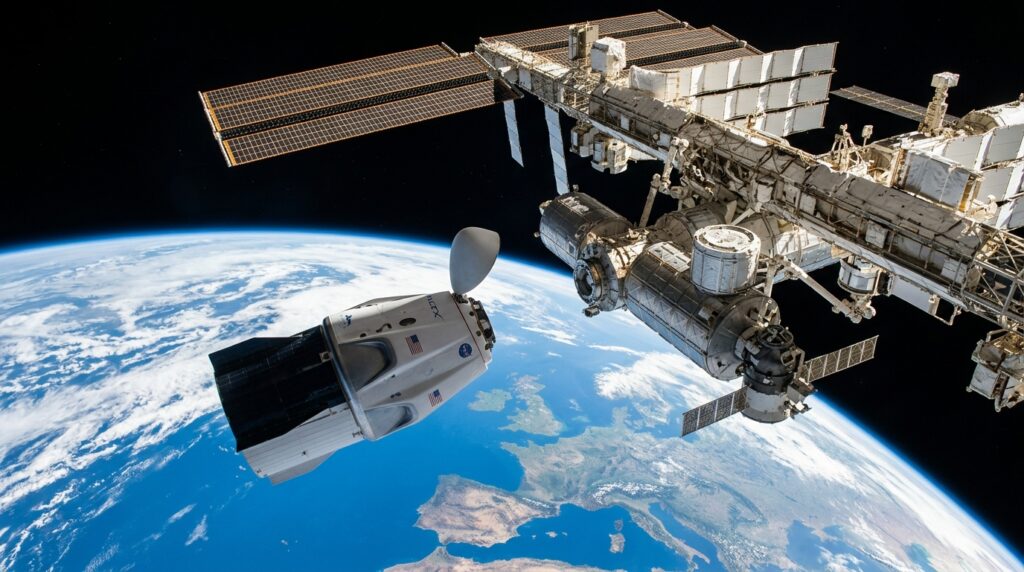
The Falcon 9 launch will send a Dragon spacecraft loaded with science, supplies and critical station hardware to the orbiting laboratory in mid-May.
CAPE CANAVERAL, Florida — NASA and SpaceX are preparing to launch the 34th SpaceX commercial resupply mission to the International Space Station, a mid-May cargo flight that will carry thousands of pounds of science experiments, crew supplies and station hardware to an orbital laboratory now more than a quarter-century into continuous human operation.
The mission, known as CRS-34, is scheduled to lift off at 7:16 p.m. EDT on Tuesday, May 12, from Space Launch Complex 40 at Cape Canaveral Space Force Station in Florida. A Falcon 9 rocket will carry a SpaceX Dragon spacecraft toward low Earth orbit, beginning an approximately 38-hour pursuit of the station. If the schedule holds, Dragon will dock autonomously to the forward port of the Harmony module at about 9:50 a.m. EDT on Thursday, May 14.
For NASA, the flight is another routine-looking but essential link in the logistics chain that keeps the International Space Station operating. For SpaceX, it is a continuation of a long-running cargo service that has made Dragon one of the central vehicles in the station’s supply network. For researchers, it is a delivery route for experiments that can only be conducted in microgravity, where biological systems, fluids, particles and materials behave in ways not easily reproduced on Earth.
NASA says the Dragon spacecraft will carry about 6,500 pounds of cargo, including food, equipment, spare parts and new investigations. The spacecraft is expected to remain attached to the station until mid-June, when it will undock and return to Earth with time-sensitive research and used hardware, splashing down off the coast of California. That return capability remains one of Dragon’s most important roles, allowing experiments and components to be brought back intact for analysis, repair or preservation.
The launch comes as NASA and its international partners continue to balance station operations, crew rotations, cargo arrivals and the growing use of the orbiting laboratory as a test bed for future lunar and Mars missions. More than 4,000 investigations from researchers in more than 110 countries have been conducted aboard the ISS, according to NASA, making the station both an engineering platform and a global research facility.
Among the science heading to orbit is ODYSSEY, an investigation designed to compare bacterial behavior in actual microgravity with results produced by Earth-based microgravity simulators. The work could help scientists understand how well ground laboratories replicate conditions in space, an important question for researchers who must often test ideas on Earth before flight opportunities become available. If the simulators prove reliable for certain kinds of microbial research, they could make future experiment planning more efficient and less costly.
Another payload, STORIE — short for Storm Time O+ Ring current Imaging Evolution — will monitor charged particles around Earth. Those particles respond to space weather, including solar storms, and can affect satellites, communications systems and even power grids. A better understanding of the ring current could help researchers improve models of how Earth’s magnetic environment reacts to disturbances from the Sun.
The CRS-34 cargo also includes Laplace, an investigation focused on the movement and collision of dust particles in microgravity. On Earth, gravity quickly interferes with delicate particle motion, making it harder to observe the early processes that may resemble the formation of planetary material. In orbit, researchers can study how dust aggregates move, collide and evolve, offering clues about the physical steps that contributed to the formation of planets in the solar system and beyond.
A biomedical experiment called Green Bone will study how bone cells grow and develop in space on a scaffold made from wood. The research is aimed at improving understanding of bone formation and could eventually contribute to treatments for fragile bone conditions such as osteoporosis. Microgravity is especially useful for such work because it alters the mechanical forces that cells experience, revealing biological responses that may be difficult to isolate on Earth.
Another investigation, SPARK, will evaluate changes in red blood cells and the spleen during spaceflight. Human health remains one of the central challenges of long-duration exploration. Astronauts living in orbit experience shifts in fluid distribution, changes in vision, muscle loss, bone density reduction and immune system effects. Understanding how blood and immune-related organs respond to spaceflight could help NASA protect crews during future missions that last months or years beyond low Earth orbit.
Dragon will also carry CLARREO Pathfinder, an Earth science instrument designed to make highly accurate measurements of sunlight reflected by Earth and the Moon. The mission is intended to improve the calibration of Earth-observing sensors and help scientists detect changes in the planet’s climate system with greater confidence. By anchoring measurements to rigorous standards, researchers hope to reduce uncertainty in long-term observations of Earth’s energy balance.
Not all the cargo is experimental. Some of it is the less glamorous but indispensable hardware that keeps a spacecraft the size of a football field functioning. NASA lists a replacement power cable for the European Enhanced Exploration Exercise Device, a catalytic reactor component for the Water Recovery and Management System, and universal pretreat concentrate tanks for the station’s waste and hygiene systems among the items launching on CRS-34.
The catalytic reactor is part of the station’s life-support infrastructure, helping process wastewater by oxidizing volatile organic compounds. The pretreat tanks support urine and waste collection systems, while other cargo includes an ultrasonic inspection tool, a remote sensor unit for vibration monitoring, flexible repair patches for pressure-hull sealing, water-processing hardware for oxygen generation and a nitrogen recharge tank assembly for station gas reserves.
Those items underline a basic reality of station operations: science depends on maintenance. The ISS is an aging orbital complex exposed to vacuum, radiation, temperature swings and constant mechanical stress. Every experiment requires power, air, cooling, data links and crew time. Every crew member depends on water recovery, oxygen production, waste management, exercise systems and environmental controls. Cargo missions are therefore both research flights and maintenance calls.
NASA astronaut Jack Hathaway and European Space Agency astronaut Sophie Adenot are expected to monitor Dragon’s arrival from the station. Because Cargo Dragon docks autonomously, the crew does not need to capture it with the station’s robotic arm, but astronauts still oversee the approach and remain ready to respond if mission controllers require intervention. Once Dragon is secured, the crew will begin unloading supplies and preparing cold-stowage items and scientific samples for transfer.
The flight also reflects the maturation of commercial space logistics. NASA’s Commercial Resupply Services program was created to shift routine cargo delivery to private American companies, freeing the agency to focus on exploration, science and deep-space development. SpaceX’s Dragon fleet has since become a regular visitor to the station, delivering cargo and returning research in a reusable capsule architecture that distinguishes it from vehicles designed to burn up in the atmosphere after departure.
SpaceX said the Dragon spacecraft assigned to CRS-34 is flying for the sixth time, having previously supported CRS-22, CRS-24, CRS-27, CRS-30 and CRS-32. Reuse has become a defining feature of SpaceX operations, from Falcon 9 boosters to Dragon capsules. For NASA, repeated flights of certified vehicles can help sustain a predictable station schedule, though each launch and docking remains subject to technical reviews, weather, range availability and real-time mission conditions.
The CRS-34 launch also fits into a crowded 2026 station traffic plan. NASA and its partners are coordinating U.S., Russian and commercial vehicles while preparing future crew rotations and cargo missions. Maintaining that cadence is critical as the ISS supports scientific research, commercial technology demonstrations and preparations for NASA’s Artemis campaign, which aims to return astronauts to the Moon and build systems needed for eventual human missions to Mars.
Even after more than two decades, the station continues to serve as a proving ground for exploration. Exercise hardware helps researchers understand how crews can preserve muscle and bone health. Water recovery systems test closed-loop life support. Biomedical studies reveal how the human body adapts to space. Materials and particle experiments take advantage of an environment that cannot be sustained on Earth for long periods.
That is the broader significance of CRS-34. The public may see a familiar rocket launch from Florida, followed by a capsule docking two days later. Inside the pressurized spacecraft, however, are tools for climate measurement, planetary science, microbiology, human health, maintenance and survival. Each package is a small part of a larger system that links orbital operations today with exploration goals beyond Earth tomorrow.
If Falcon 9 lifts off on schedule, Dragon will streak northeast over the Atlantic, separate from the rocket’s second stage and begin a carefully choreographed approach to the station. Within two days, it should arrive at a laboratory traveling about 250 miles above Earth at roughly 17,500 miles per hour. The cargo inside will then become part of the daily rhythm of orbital life: unpacked, installed, tested, sampled, repaired and eventually, in some cases, returned home.
CRS-34 is not designed to make history in the way a first launch or crewed moon mission does. Its importance lies in repetition, reliability and the accumulation of science. The International Space Station survives through such flights, and its research advances one cargo bag, one experiment and one spare part at a time.”””