
Lower charging and maintenance costs make electric vehicles increasingly practical, but range, charging access and daily habits still determine whether the switch is financially sensible.
The question of whether to buy an electric vehicle now no longer has a simple yes-or-no answer. For many drivers, especially those with predictable commutes, access to home charging and moderate daily mileage, the case for an EV has become stronger than at any point in the past decade. For others, particularly people who live in apartments without reliable charging, travel frequently on rural routes or cannot tolerate delays during long-distance trips, a hybrid or efficient gasoline vehicle may still be the more practical choice.
The electric car market has moved from early adoption into a more mature phase. Battery ranges have improved, prices in some segments have become more competitive, and public charging networks are expanding. The International Energy Agency has said global electric car sales in 2025 were expected to exceed 20 million units, representing more than one-quarter of cars sold worldwide. In Southeast Asia, the shift is also accelerating, with Vietnam becoming one of the region’s more active EV markets as domestic brands, charging operators and government policies push the transition forward.
The strongest financial argument for an EV is energy cost. Electricity is usually cheaper per kilometer than gasoline, particularly when the driver can charge at home overnight. A typical modern electric car may consume about 15 to 20 kilowatt-hours per 100 kilometers, depending on vehicle size, speed, traffic, climate control use and driving style. At Vietnam’s public V-Green rate of 3,858 dong per kilowatt-hour, that would translate roughly into 58,000 to 77,000 dong for 100 kilometers before considering charging losses. A gasoline car using 6 to 8 liters per 100 kilometers at a fuel price near 23,000 to 24,000 dong per liter would cost far more over the same distance. The exact savings vary, but the direction is clear: drivers who cover many kilometers each month stand to benefit most.
The calculation is even better for those who can charge at home under residential electricity pricing, especially during off-peak hours where available. Home charging also changes the psychology of car ownership. Instead of visiting a fuel station, the driver plugs in at night and starts the next morning with a replenished battery. For commuters who travel 30 to 80 kilometers a day, this is one of the strongest advantages of an EV. The car does not need to be fully charged every day; it only needs enough energy for the next day’s use, plus a reserve.
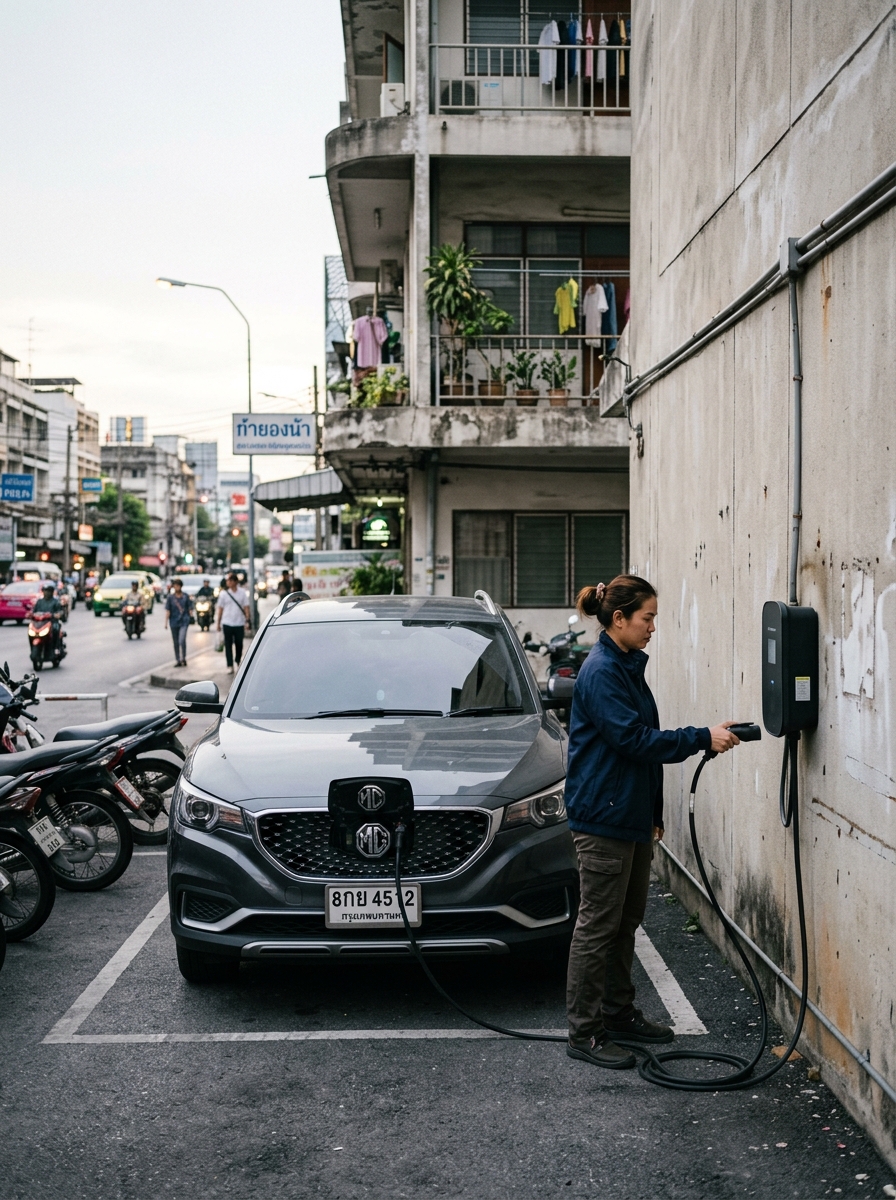
Public charging is improving, but it remains the main uncertainty. Globally, the public charging network has grown quickly, with the IEA reporting more than 5 million public charging points by the end of 2024. But drivers do not experience infrastructure as a global average. They experience it on the roads they actually use: the apartment basement, the office parking area, the shopping mall, the highway rest stop and the route to their hometown. In Vietnam, the charging network has expanded rapidly, but much of the most visible infrastructure is linked to VinFast and V-Green. VinFast states that its charging stations currently serve VinFast vehicles only, which means buyers of other brands must examine charging access more carefully.
This matters because public charging is not only about the number of plugs. It is about location, reliability, speed, payment, waiting time and compatibility. A slow charger at a mall may be useful during a two-hour stop but inconvenient on a long journey. A fast charger can restore a battery much more quickly, but queues during holidays or peak travel periods can turn charging into a planning exercise. Drivers who frequently travel between cities should check not just whether chargers exist along the route, but whether they are fast enough, available to their vehicle brand and located near food, restrooms or safe waiting areas.
Range anxiety has declined, but it has not disappeared. Many modern EVs can comfortably handle daily city driving and short regional trips. Some models can exceed 300 or 400 kilometers on a charge under favorable conditions. But real-world range depends heavily on speed, temperature, terrain, tire pressure, passenger load and air-conditioning use. Highway driving consumes more energy than urban stop-and-go traffic because electric cars recover energy through regenerative braking in the city but face higher aerodynamic drag at speed. In hot climates, constant air-conditioning can reduce range; in cold climates, heating can have an even larger effect.
For Vietnam and much of Southeast Asia, heat, traffic and mixed road quality are more relevant than winter range loss. An EV used mainly in Hanoi, Ho Chi Minh City, Da Nang or other urban areas may spend much of its time in congestion, where electric drivetrains are efficient and quiet. However, drivers who regularly travel on expressways at high speed, climb mountain routes or carry heavy loads should apply a safety margin. A car advertised with a certain laboratory range may deliver less in real use. A practical buyer should ask whether the vehicle can complete the longest regular trip with at least 20 percent battery remaining, or whether a reliable charging stop is available.
Maintenance is another strong point for electric vehicles. A battery-electric car has no engine oil changes, no spark plugs, no exhaust system, no fuel injectors and fewer moving parts than a gasoline vehicle. Regenerative braking also reduces wear on brake pads and discs. The U.S. Department of Energy’s Alternative Fuels Data Center notes that all-electric vehicles generally require less maintenance because their batteries, motors and electronics need little regular service, there are fewer fluids, and brake wear is reduced. This does not mean EVs are maintenance-free. Tires, suspension components, cabin filters, coolant systems, brake fluid and software updates still matter. Because EVs are often heavier and deliver instant torque, tire wear can be significant if the driver accelerates aggressively.
Battery life remains a key concern for buyers. Modern EV batteries are designed to last many years, and many manufacturers provide long battery warranties, often around eight years or 100,000 miles in major markets. Still, replacement outside warranty can be expensive. The best protection is to buy from a brand with a clear warranty, reliable service network and transparent battery health policy. Used EV buyers should pay special attention to battery condition, charging history and remaining warranty. A cheap used EV can be a bargain if the battery is healthy, but a risk if battery degradation is unclear.
The total cost of ownership should also include purchase price, insurance, registration, financing, resale value and repair access. EVs can be cheaper to operate but more expensive to buy in some segments. Insurance and body repairs may cost more for models with expensive sensors, battery structures or limited parts availability. Resale values are still evolving as battery technology improves quickly and new models enter the market. A buyer who plans to keep the car for seven to ten years may benefit more from lower operating costs than someone who changes cars every two or three years.
Driving habits may be the deciding factor. The ideal EV owner has a regular parking space, can charge at home or work, drives predictable distances and rarely needs unplanned long-distance travel. For this person, an EV can be quieter, cheaper to run and more convenient than a gasoline car. A less suitable buyer lives in a building without charging, parks on the street, drives long routes at short notice, or relies on remote highways with uncertain charging coverage. For that person, the EV may still work, but it requires planning and patience.
There is also a middle path: plug-in hybrids and conventional hybrids. A plug-in hybrid can cover short daily trips on electricity while keeping a gasoline engine for long journeys, but it only makes sense if the owner actually charges it. A conventional hybrid does not need charging and can reduce fuel use, making it attractive for drivers who want lower operating costs without depending on charging infrastructure. In markets where EV incentives are shrinking or charging access is uneven, hybrids remain a practical bridge.
So, should drivers buy an electric car now? For urban and suburban users with dependable charging, the answer is increasingly yes. The economics are favorable, the driving experience is refined, and maintenance needs are lower. For buyers without charging access or with frequent long-distance demands, the answer is more cautious: not yet, unless the chosen model and charging network match their routes. The smartest decision is not based on trend or technology alone. It is based on a simple audit of daily life: where the car sleeps, how far it travels, how often it leaves the city, how much waiting the driver can accept, and whether the savings over time justify the higher planning burden. Electric cars are ready for many people now, but they are not yet equally ready for every driver.
“””
