
From anti-lock brakes to automatic emergency braking, today’s vehicles are increasingly designed not only to protect people in a crash, but to help prevent one before it happens.
Modern cars are no longer judged only by engine power, fuel economy or interior comfort. Increasingly, their value is measured by how well they can help drivers avoid danger. Safety technology that was once limited to luxury models has moved into family sedans, compact SUVs, pickup trucks and even entry-level vehicles. The shift has changed the way millions of people drive, adding sensors, cameras, computers and automated responses to situations that used to depend entirely on human reaction.
The most familiar of these systems is the anti-lock braking system, widely known as ABS. Its purpose is straightforward but critical: when a driver brakes hard, ABS helps prevent the wheels from locking. A locked wheel can slide across the road surface, reducing steering control at the very moment a driver may need to avoid an obstacle. ABS rapidly adjusts brake pressure many times per second, allowing the tires to keep rotating while still applying strong braking force. In practical terms, the system helps the driver continue steering during emergency braking.
ABS is not a guarantee that a car will stop in a shorter distance in every condition. Loose gravel, snow or poor tires can still make stopping unpredictable. But on many paved surfaces, especially wet roads, the system improves stability and helps prevent the vehicle from skidding out of control. Drivers are often advised to press the brake pedal firmly and steadily in an emergency rather than pumping the brakes, because the system is designed to do that work automatically.
Electronic stability control, often called ESC, builds on the foundation of ABS. While ABS focuses on braking control, ESC helps prevent a vehicle from spinning out or sliding away from the driver’s intended path. Using sensors that monitor steering angle, wheel speed and vehicle movement, ESC can detect when the car is beginning to understeer or oversteer. It can then reduce engine power or apply braking to individual wheels to help bring the vehicle back under control.
The importance of ESC is most obvious during sudden evasive maneuvers, sharp curves, wet pavement or slippery roads. A driver may turn the wheel to avoid a hazard, but the vehicle’s body may not follow exactly as intended. ESC works in the background, often before the driver fully realizes the car is losing stability. For many safety experts, it is one of the most important crash-avoidance technologies introduced in the past several decades.
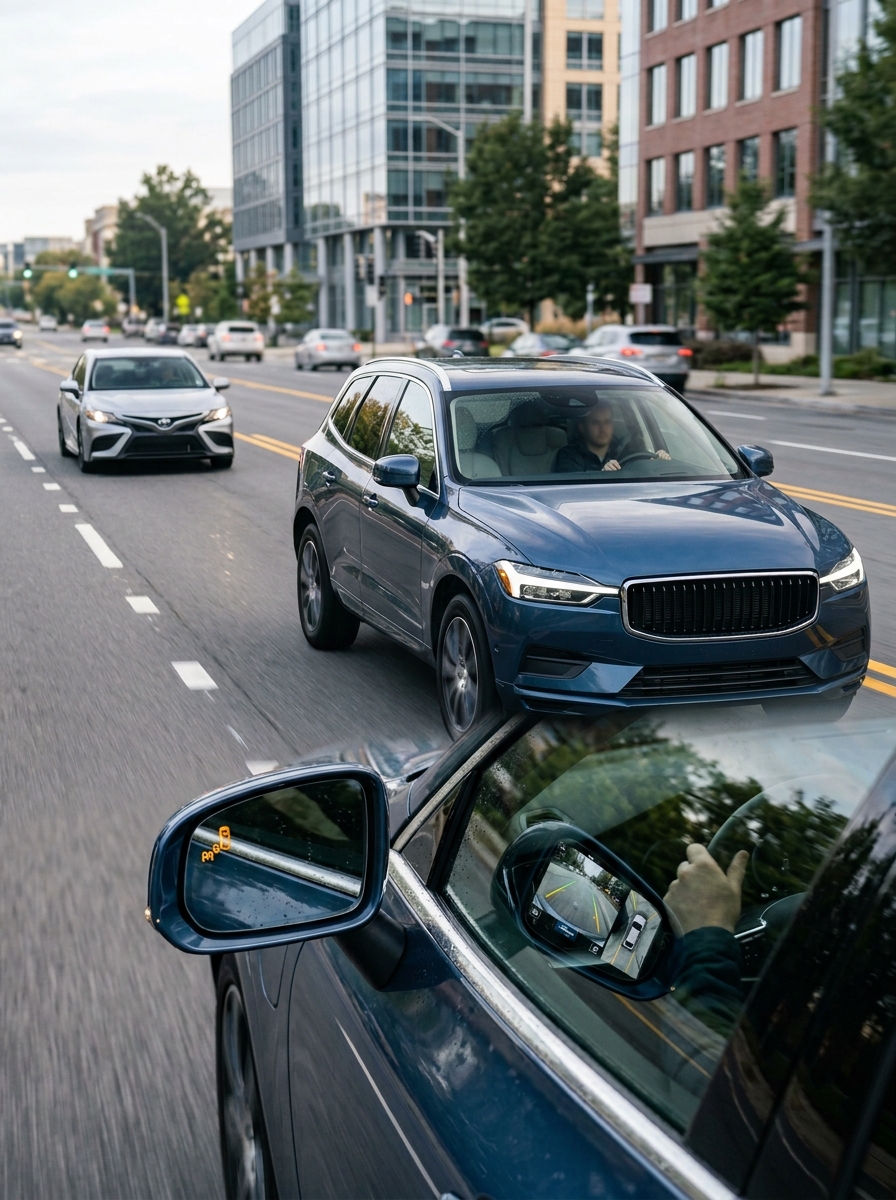
Newer driver-assistance systems go beyond vehicle stability and begin to monitor the surrounding road environment. Blind spot warning is one of the most common examples. The system uses radar, ultrasonic sensors or cameras to detect vehicles traveling in areas that are difficult for the driver to see in mirrors. When another vehicle is in the blind spot, a warning light usually appears near the side mirror. If the driver signals a lane change, the system may add a sound, steering-wheel vibration or stronger visual warning.
More advanced versions can intervene if the driver continues to move toward an occupied lane. Some systems apply gentle steering correction or braking pressure to discourage the lane change. This does not remove responsibility from the driver, but it adds a valuable second layer of awareness, especially in heavy traffic, on multi-lane highways and in urban areas where motorcycles and smaller vehicles can disappear from view quickly.
Camera systems have also changed everyday driving. A rearview camera is now familiar to many drivers, but the 360-degree camera system has expanded the concept. By combining images from cameras placed around the vehicle, usually at the front, rear and side mirrors, the system creates a simulated overhead view on the dashboard display. This helps drivers judge distance from curbs, walls, pedestrians, bicycles and other vehicles at low speeds.
The 360-degree camera is particularly useful when parking in tight spaces or maneuvering a large SUV or pickup in a crowded area. It can reduce minor collisions, scraped bumpers and accidents involving objects that are too low or too close to appear clearly in mirrors. Still, the image on the screen can be distorted by camera angle, dirt, rain or poor lighting. Drivers must continue checking mirrors and surroundings rather than relying only on the display.
Lane departure warning and lane keeping assistance are another major step in modern safety. Lane departure warning alerts the driver when the vehicle begins to drift out of its lane without a turn signal. Lane keeping assistance goes further by applying steering input or braking to help guide the vehicle back toward the lane. These systems generally use forward-facing cameras to read road markings.
The benefit is clear on long highway drives, where fatigue and distraction can cause small steering errors. A brief lapse of attention can move a car toward the shoulder or into another lane. Lane keeping assistance may help correct that movement before it becomes dangerous. But it depends heavily on visible lane markings. Faded paint, construction zones, heavy rain, snow, glare and sharp curves can limit performance. Drivers who treat lane keeping as self-driving technology misunderstand its purpose.
Automatic emergency braking, or AEB, is among the most significant technologies now spreading through the market. AEB uses cameras, radar or other sensors to detect when a collision with a vehicle, pedestrian or other obstacle may be imminent. If the driver does not respond in time, the system can apply the brakes automatically. In some cases, it may avoid the crash entirely. In others, it may reduce impact speed and lower the severity of injuries and damage.
Many AEB systems work together with forward collision warning, which first alerts the driver through sound, visual messages or vibration. The best systems are designed to operate in a range of daylight and night conditions, though performance varies by vehicle and situation. Pedestrian detection is especially important in cities, school zones and residential neighborhoods, where people may enter the road suddenly. Cyclist detection is also becoming more common, though not all systems identify cyclists with equal reliability.
These technologies reflect a broader change in automotive safety philosophy. For decades, much of vehicle safety focused on surviving a crash through seat belts, airbags, crumple zones and stronger passenger compartments. Those protections remain essential. But the newer generation of technology focuses increasingly on avoiding the crash in the first place. The car is becoming a platform that observes, warns and sometimes acts.
The trend has regulatory and industry momentum. Safety agencies and insurance researchers have reported real-world crash reductions linked to systems such as automatic emergency braking, blind spot detection, rear automatic braking and lane departure prevention. Regulators in some markets are also moving to require or encourage wider adoption of advanced driver-assistance systems. Automakers, meanwhile, are packaging safety features as standard equipment to meet consumer expectations and improve crash-test ratings.
There are limits. Sensors can be blocked by mud, ice, stickers, damaged bumpers or cracked windshields. Cameras may struggle with low sun, heavy rain or unclear road markings. Radar can detect objects differently depending on speed, angle and distance. After a collision, windshield replacement, bumper repair or suspension work, some systems may need calibration to function properly. A warning light on the dashboard should not be ignored, because a disabled safety system may leave the driver without protection they assume is active.
Another challenge is driver behavior. Safety technology can create confidence, but overconfidence can be dangerous. A car with lane keeping assistance is not a self-driving car. A vehicle with blind spot warning still requires mirror checks and shoulder checks. A 360-degree camera does not replace looking around before reversing. Automatic braking may not recognize every hazard, and it may not stop the vehicle in time at high speed or in poor weather.
The most effective use of modern safety technology comes when drivers understand both its strengths and its boundaries. ABS helps maintain steering under hard braking, but it cannot overcome bald tires. ESC can reduce the chance of a skid, but it cannot cancel the laws of physics. Blind spot systems can warn of hidden vehicles, but they do not replace judgment. Cameras can reveal obstacles, but they can be obscured. AEB can react quickly, but it is not a license to follow too closely.
For buyers, the safest approach is to compare vehicles not only by the number of features listed, but by how well those features work. A system that is easy to understand, difficult to switch off accidentally and consistent in real traffic is more valuable than one that looks impressive in advertising but performs unevenly. Test drives should include checking camera clarity, warning sounds, dashboard messages and whether the driver can adjust sensitivity without confusion.
Modern automotive safety is moving toward a layered model. The driver remains the central decision-maker, but technology adds backup in the moments when human attention, reaction time or visibility may fall short. The best outcome is not a car that takes responsibility away from the person behind the wheel, but one that helps the driver make fewer mistakes and recover more quickly from danger.
As roads become more crowded and vehicles become more complex, safety technology will continue to expand. ABS and ESC have become basic expectations. Blind spot warning, 360-degree cameras, lane keeping assistance and automatic emergency braking are rapidly becoming normal parts of the driving experience. Their promise is significant: fewer crashes, fewer injuries and more informed drivers. Their condition is equally clear: they work best when treated as assistance, not as a substitute for attention, caution and skill.”””
