
Mandatory liability coverage protects victims and keeps drivers compliant with the law, while voluntary physical-damage insurance can shield owners from repair bills that may exceed months of income.
Car insurance is often treated as an administrative requirement, something purchased quickly when registering a vehicle or renewing documents. In reality, it is one of the most important financial protections a car owner can have. A collision can happen in seconds, but the consequences can last for months or years: medical bills, vehicle repairs, compensation claims, disputes with other road users, lost working time and legal exposure. Insurance does not prevent accidents, but it can prevent one accident from becoming a financial crisis.
The first layer is compulsory civil liability insurance for motor vehicle owners. In Vietnam, this insurance is required for vehicles participating in traffic. Its purpose is not to repair the policyholder’s own car. It is designed to protect third parties and passengers when a vehicle causes harm. If a driver injures another person, damages another vehicle, hits public property or causes losses to passengers, compulsory liability insurance provides a regulated source of compensation within legal limits. This matters because road accidents rarely affect only the driver at fault. They affect pedestrians, motorcyclists, passengers, families and other vehicle owners who may have no ability to absorb sudden costs.
Under current Vietnamese rules, compulsory motor vehicle liability insurance provides a limit of 150 million dong for health and life damage for each person in one accident. For property damage caused by cars, tractors, trailers or semi-trailers pulled by cars or tractors, the limit is 100 million dong in one accident. Those amounts may not cover every serious loss, particularly when several people are injured or expensive vehicles are damaged, but they create a basic legal and financial safety net. Without such coverage, the driver or vehicle owner may have to pay directly from personal savings, income or assets.
Compulsory insurance also protects social order after crashes. When an accident happens, emotions are high and parties may disagree about fault, medical costs or repair expenses. A valid insurance policy gives victims a formal channel for compensation and gives vehicle owners a process to follow. It does not remove responsibility from the driver, but it helps move the matter from roadside argument to documented claim handling. In a country with dense urban traffic and a large mix of cars, motorcycles, buses and delivery vehicles, that function is essential.
The cost of compulsory insurance is modest compared with the risks it addresses. For a non-commercial car with fewer than six seats, the current basic premium is 437,000 dong per year before value-added tax. For non-commercial cars with six to eleven seats, the basic premium is 794,000 dong. Pickup and minivan classifications have their own rates. Insurers may adjust the premium up or down within regulated limits based on claims history or accident history, but the compulsory product remains one of the least expensive parts of owning a car. It is also cheaper than the penalty for failing to comply and far cheaper than paying compensation after an uninsured accident.
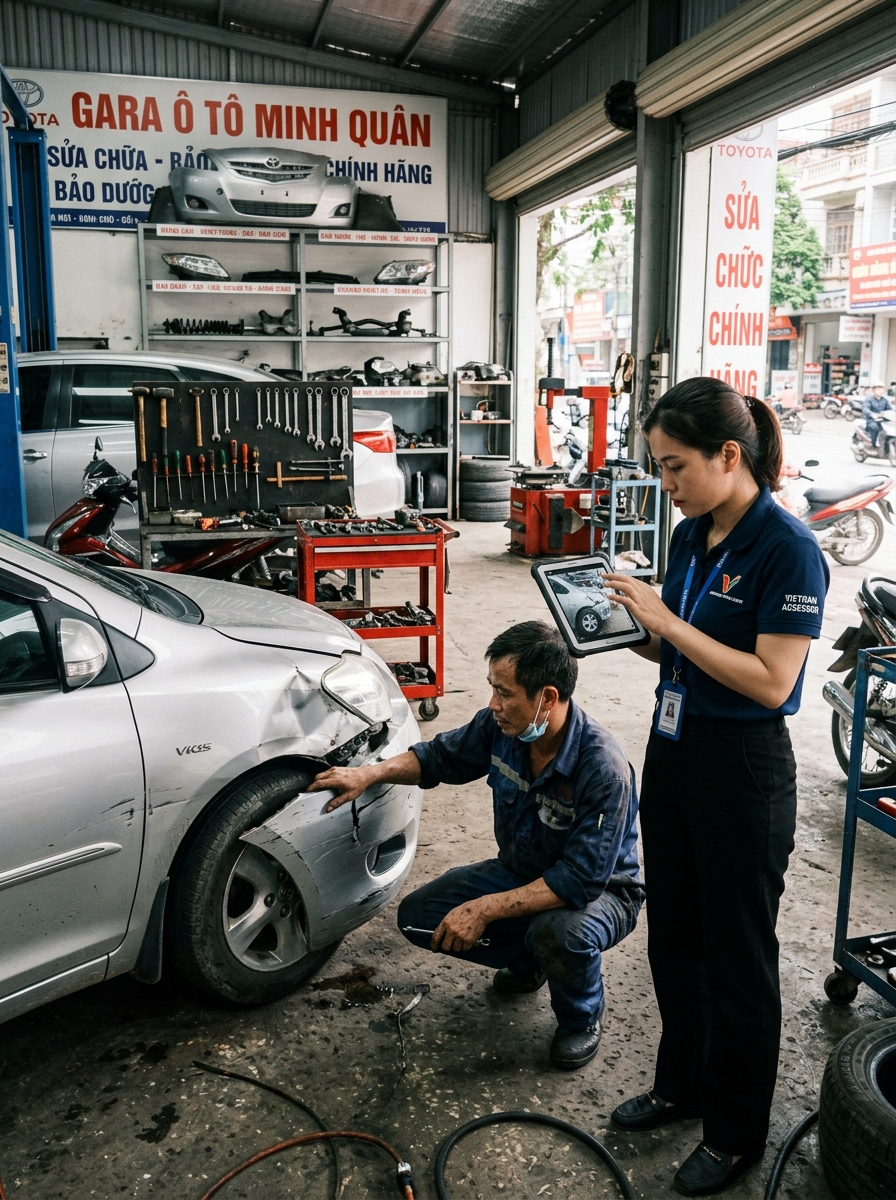
Still, compulsory insurance has a major limitation: it does not protect the owner’s own vehicle. If a driver reverses into a wall, floods the engine, hits a divider, loses a mirror to theft, or suffers damage from falling objects, the compulsory policy is not intended to pay for repairs to that car. This is where voluntary physical-damage insurance, commonly called body insurance or comprehensive vehicle insurance, becomes important.
Physical-damage insurance is not mandatory for most private owners, but it is often the policy that drivers feel most directly after an incident. It can cover repair or replacement costs when the insured vehicle is damaged by collision, overturning, fire, explosion, natural disasters, falling objects or theft, depending on the contract. In serious cases, it may cover total loss if the vehicle is stolen or damaged beyond an economic repair threshold. For new vehicles, expensive cars, cars bought with bank loans, commercial vehicles and cars used daily in crowded cities, this coverage can be the difference between a manageable deductible and a repair bill that disrupts household finances.
The value of physical-damage insurance has increased as cars have become more technologically complex. A minor front-end collision today may damage sensors, cameras, radar units, LED lighting, parking systems and electronic control modules, not just metal panels. Repairs at authorized workshops can be expensive, and imported parts may take time to arrive. Paint, calibration, replacement bumpers and windshield-mounted driver-assistance systems can turn what appears to be a small accident into a large claim. Owners of newer cars should therefore look beyond the visible bodywork and consider the full repair ecosystem.
The cost of voluntary physical-damage insurance varies much more than compulsory coverage. It is usually calculated as a percentage of the insured value of the vehicle, adjusted for age, model, use purpose, claim history, deductible, selected garage network and optional extensions. In the Vietnamese market, many quotations for physical-damage or body insurance commonly fall around 1.2 percent to 2.0 percent of vehicle value, though actual prices differ by insurer and package. A car valued at 800 million dong could therefore cost roughly 9.6 million to 16 million dong per year for this layer of protection, before considering add-ons or discounts.
That cost may appear high to careful drivers, but risk is not based only on personal skill. A parked vehicle can be hit by another driver. Floodwater can enter an underground garage. A motorbike can scratch a door in traffic. A stone can crack a windshield on the highway. A driver can make one tired mistake after years of safe driving. Insurance is valuable precisely because large losses are unpredictable. The owner pays a known annual cost to avoid an unknown repair bill.
When buying voluntary insurance, drivers should pay close attention to exclusions and optional benefits. Flood and water damage, often called hydrolock or engine water damage, may require a specific extension. Repair at an official dealership may cost extra. Theft of parts, replacement car service, rescue towing, glass damage, and no-deductible options may also be separate. A cheaper policy is not automatically worse, but a cheaper policy with a narrow scope may disappoint the owner after a claim. The practical question is not only “How much is the premium?” but “What exactly will be paid, where will the car be repaired, and how much will I still have to pay?”
Drivers should also understand deductibles. A deductible is the amount the owner pays for each claim before the insurer pays the rest. A higher deductible can reduce the premium and discourage small claims, but it can also make minor repairs uneconomical to claim. For experienced drivers with safe parking and a low-risk routine, choosing a reasonable deductible may be a good way to control cost. For new drivers or owners in high-traffic areas, broader coverage may be more appropriate.
Another important issue is claim procedure. After an accident, the driver should prioritize safety, contact emergency services when needed, preserve evidence, notify the insurer quickly and avoid unauthorized repairs before inspection unless urgent action is necessary to prevent further damage. Photos, video, location details, police records where required, driver’s license, registration, inspection certificate and insurance certificate can all become important. Many disputes arise not because the policy is invalid, but because the owner fails to follow reporting requirements or cannot prove the cause and timing of damage.
Drivers should compare insurers not only by price but by service quality. A useful policy is backed by a responsive hotline, clear claim instructions, a broad garage network, transparent assessment, reasonable repair approval time and a reputation for fair settlement. The cheapest insurer may not be the best choice if claims are slow or communication is poor. Owners should read customer feedback carefully, but they should also read the contract itself, because online reviews cannot replace policy wording.
Car insurance is ultimately about responsibility. The compulsory policy protects other people and keeps the driver legally compliant. The voluntary physical-damage policy protects the owner’s asset. Additional products, such as voluntary liability extensions, passenger accident coverage or roadside assistance, may be worth considering for families, business users and frequent travelers. The right package depends on vehicle value, driving frequency, road conditions, parking environment, loan obligations and the owner’s ability to absorb sudden costs.
For most car owners, the sensible approach is simple: never drive without valid compulsory insurance, and seriously consider physical-damage insurance if the car is new, expensive, financed, used daily or parked in exposed conditions. Insurance is not merely paperwork. It is a financial seat belt. Drivers hope never to need it, but when the unexpected happens, its value becomes immediate.
“””
