
A HOUSEKEEPER’S DISCOVERY REOPENS A FAMILY SECRET INSIDE A WEALTHY ESTATE
After taking a job in a secluded mansion, a young woman finds her late mother’s photograph in her employer’s private room, uncovering a buried connection between two families separated by class, silence and grief.
When 23-year-old Elena Marquez accepted work as a live-in housekeeper at the Whitmore estate, she expected long hours, polished marble floors and the quiet discipline of serving a family whose wealth had long shaped the city from behind iron gates. She did not expect to find her mother’s face hidden in a silver frame inside the private study of the man who owned the house.
The discovery came on her fourth evening at the mansion, a sprawling stone residence set back from the road behind cypress trees and security cameras. Elena had been assigned to dust the second-floor corridor while the owner, 68-year-old Richard Whitmore, was away at a charity board meeting. One door, left slightly open, led to a room staff members had been told to avoid unless specifically instructed.
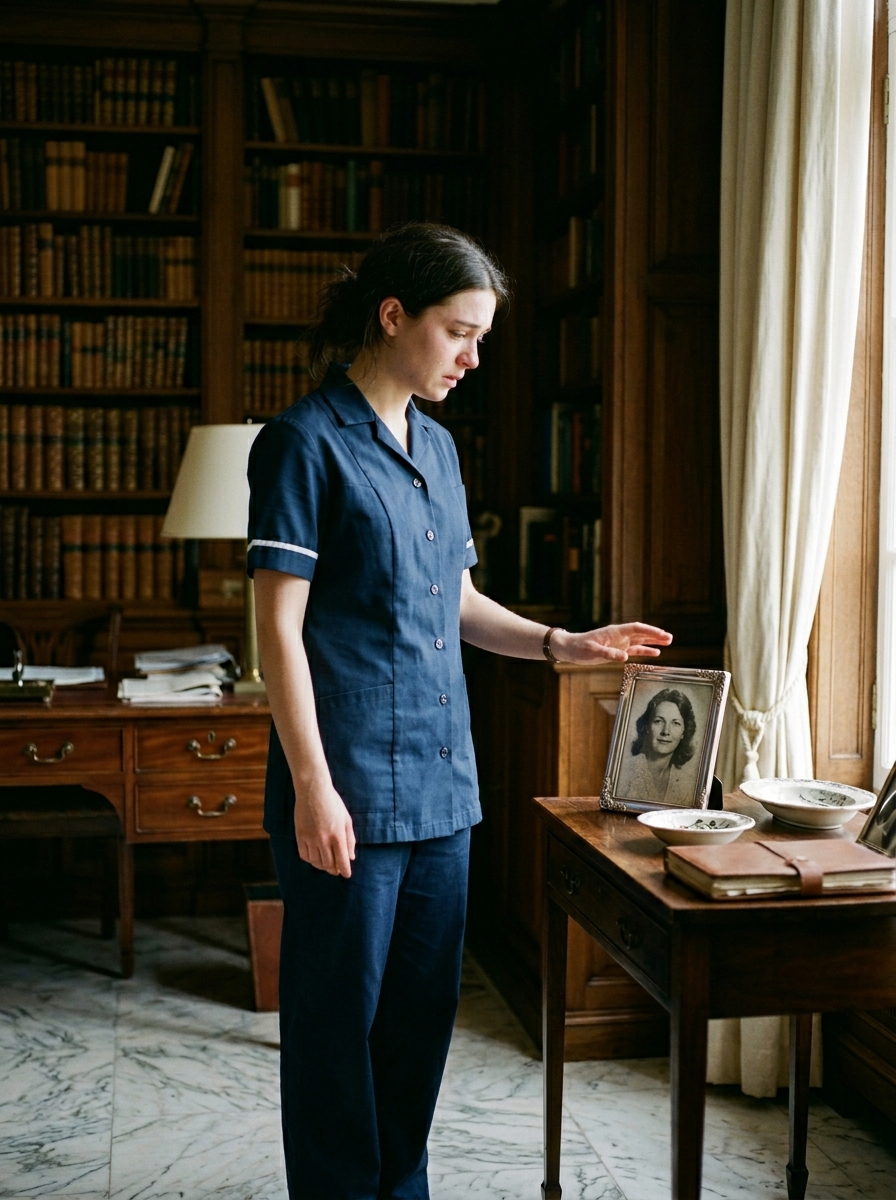
Inside, Elena saw shelves of leather-bound books, framed awards, and photographs of business leaders and politicians. On a side table near the window sat an older picture: a young woman in a pale dress standing by a garden fountain, her hair pinned back, her expression half-smiling and uncertain.
Elena recognized the face immediately. It was her mother, Isabel.
At home, Isabel’s few surviving photographs had been kept in a cardboard box under Elena’s bed. She had died when Elena was 12, leaving behind almost no records, no relatives willing to speak clearly about the past, and no explanation for why she had once carried herself like someone accustomed to rooms far grander than the small apartment where she raised her daughter.
For years, Elena had known only fragments. Her mother had worked as a seamstress. She had avoided certain neighborhoods. She became anxious whenever the Whitmore name appeared in the newspaper. When Elena asked questions, Isabel would touch her daughter’s hair and say only that some doors were safer closed.
But in the Whitmore mansion, one of those doors had opened.
Elena did not take the photograph. She returned it to its place, finished her work, and spent the night awake in the small staff room overlooking the service courtyard. By morning, she had begun asking questions carefully, knowing that employment in a house like that depended as much on silence as skill.
The oldest member of the household staff, Mrs. Caldwell, had worked for the family for nearly four decades. At first, she dismissed Elena’s questions. Then, after hearing Isabel’s full name, she went pale.
“She was here,” Mrs. Caldwell said, according to Elena’s later account. “A long time ago. Before you were born.”
What followed was a slow reconstruction of a past that the Whitmore family had tried to seal away. Isabel Marquez, it emerged, had not merely passed through the estate as a temporary employee. She had lived there for several years in her early twenties, first as a dressmaker’s assistant hired to help prepare gowns for Richard Whitmore’s younger sister, Margaret, and later as a trusted companion within the household.
At the time, the Whitmores were among the city’s most influential families. Their shipping company, investments and philanthropic foundations gave them a public image of discipline, refinement and generosity. But inside the house, according to former staff and family correspondence later shown to Elena, relationships were strained by inheritance disputes, social expectations and the rigid boundaries of class.
Isabel became close to Margaret, who was fragile, artistic and often isolated by illness. She also became acquainted with Richard, then a young executive being prepared to inherit the family business. The nature of Richard and Isabel’s relationship remains difficult to define. Some former staff described it as affectionate but restrained. Others suggested it was deeper, a bond the family would never have permitted to become public.
The questions grew sharper when Elena found a second clue: a bundle of letters tucked into the back of an unused linen cabinet. The letters, written by Margaret, referred to Isabel as “the only honest person left in this house” and mentioned “the child who must never be punished for our cowardice.” None of the letters named Elena directly, but the dates aligned with the months before her birth.
Elena confronted Richard Whitmore two weeks after finding the photograph.
According to two people familiar with the conversation, Richard did not deny knowing Isabel. He asked Elena to sit down, poured a glass of water he never drank, and told her that her mother had been “braver than all of us.” He admitted that Isabel had left the estate abruptly after a scandal involving missing family documents, a threatened engagement and accusations that she had tried to manipulate Margaret for money.
The accusations, Elena later learned, had been false.
Margaret Whitmore had planned to leave part of her personal trust to Isabel, not as payment, but as protection. She believed Isabel was pregnant and feared the family would cast her out. When Richard’s father discovered the plan, Isabel was accused of theft and dismissed without references. Margaret died less than a year later. The official obituary described a long illness. Former staff say her decline accelerated after Isabel’s departure.
Richard told Elena he had tried to find Isabel years later but claimed she refused contact. Whether that is true remains unclear. Elena’s mother left no diary. Neighbors from her old apartment remember only that she worked constantly, avoided visitors and never accepted charity.
For Elena, the revelation was less a single answer than the beginning of a painful inheritance. She had entered the mansion to clean rooms owned by strangers. She now understood that the house had shaped her life before she was born.
The Whitmore family has declined to make a public statement. A spokesperson for the family foundation said only that “private family matters from many years ago should be treated with dignity and care.” Richard Whitmore has not disputed the existence of the photograph or the letters but has resisted calls from Elena’s attorney to provide full access to archived household records.
Elena has since left her job at the estate. With help from a legal clinic, she is seeking documents related to Isabel’s employment, Margaret’s trust and any correspondence that may explain whether Isabel was denied money or recognition she was meant to receive. She says the effort is not about revenge.
“I grew up thinking my mother had no one,” Elena said. “Now I know she was surrounded by powerful people who knew her name, knew her situation and still let her disappear.”
The story has drawn attention in the city not because it involves a wealthy family, but because it exposes a familiar imbalance: how easily poor women can be erased from the histories of rich households, even when their lives are woven into them. Domestic workers, caregivers, seamstresses and companions often witness the most intimate truths of elite families while leaving behind few records of their own.
For Elena, the photograph remains the clearest evidence. Her mother was not imagined into that world after death. She had stood in its garden, worn its light, and been seen by someone who cared enough to preserve her image.
Late last month, Richard Whitmore returned the framed photograph to Elena. On the back, in faded ink, was a line written in handwriting she recognized from the letters: “Isabel, before everything changed.”
Elena placed the picture beside the small collection of family photographs she had guarded since childhood. She says she still does not know the full truth. She may never know whether Richard loved Isabel, whether Margaret’s promise could have changed her mother’s life, or whether fear, pride and class loyalty combined to bury a young woman’s future.
But she knows this: her mother had a past larger than poverty, and the silence around that past no longer belongs only to the Whitmores.
“The house made me feel small when I arrived,” Elena said. “Now I understand it was my mother’s story that made them afraid.”
