
A long-buried misunderstanding turns a family home into a place of silent suffering, until an old debt of gratitude reveals the woman she despised was tied to the person who saved her life.
For nearly three years, the house at the end of the narrow lane was known by neighbors not for its size or prosperity, but for the tension that seemed to settle over it each evening. Behind the painted gate lived Margaret Hale, a widow in her late sixties whose sharp words and rigid habits had shaped every corner of the family home. Also living there was her son, Daniel, and his wife, Clara, a quiet young woman who had arrived after marriage with a suitcase, a few framed photographs, and a willingness to belong.
From the beginning, Margaret made it clear that Clara was not welcome.
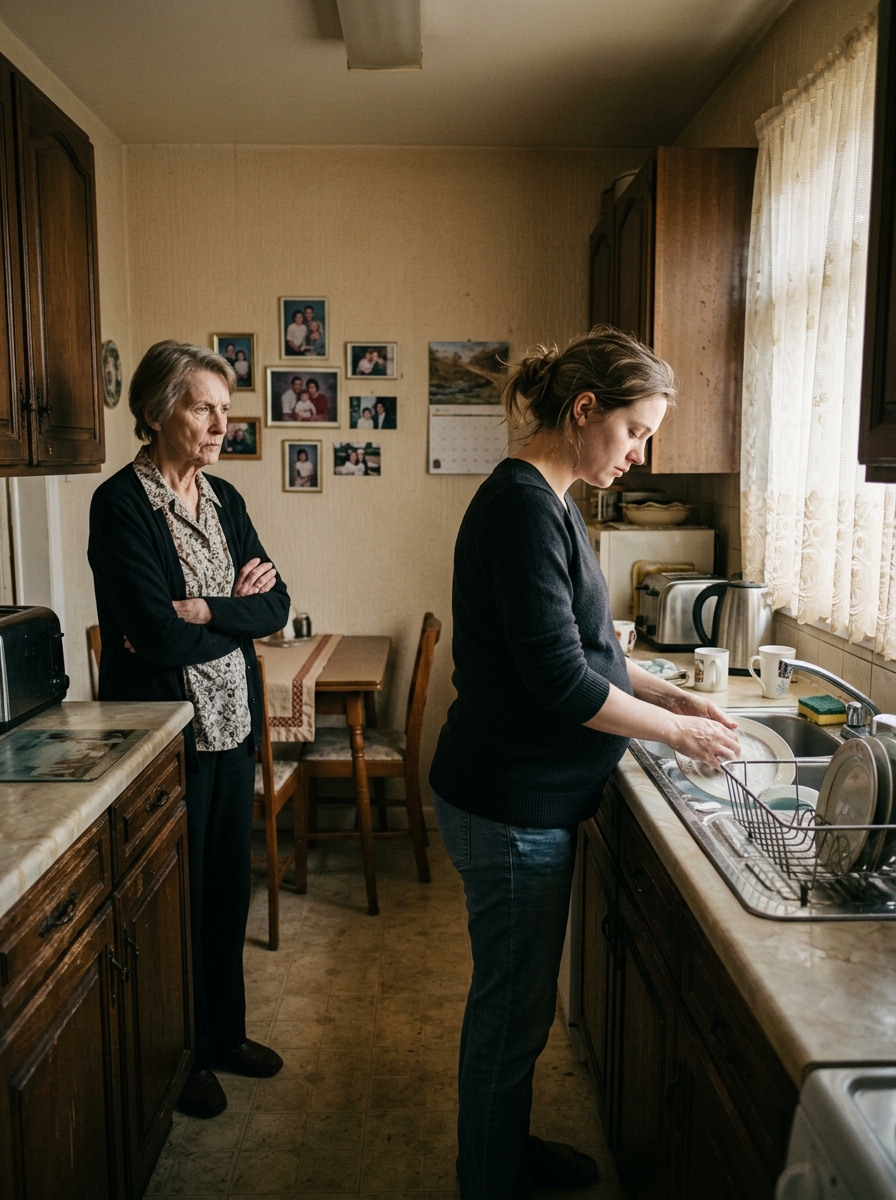
The hostility was not sudden, nor was it loud enough to draw public scandal. It appeared instead in small, relentless acts. Clara was given the coldest room in the house. Her cooking was criticized before anyone tasted it. Her laundry was redone in front of her as if she were a careless servant. When Daniel was away for work, Margaret assigned her chores that began before sunrise and ended after dinner. Visitors saw only a modest, obedient daughter-in-law. Inside the home, Clara lived under constant judgment.
Daniel believed at first that time would soften his mother. He had grown up respecting her strength. Margaret had raised him alone after his father died, and he knew how deeply loss had hardened her. When Clara cried quietly at night, he urged patience. When she considered returning to her parents, he asked her to stay, promising that his mother would come around. Clara stayed not because she was weak, but because she loved him and believed a family could be repaired if someone endured long enough.
Margaret’s anger had roots in a story she rarely told. More than two decades earlier, when Daniel was still a boy, she had been caught in a roadside accident during a storm. Her car had skidded near a bridge, leaving her trapped and bleeding. A man passing through the area pulled her from the wreckage before the vehicle caught fire. He disappeared before she could properly thank him, leaving behind only a name spoken by a police officer: Samuel Reed.
Margaret later searched for the man, but found little. Years passed. Her memory of that night became both sacred and painful, a reminder that she had been spared when many others were not. But the name Reed also became entangled with another memory: a business dispute involving a family with the same surname. Margaret believed, wrongly and without proof, that Clara’s late father had belonged to the same group that had ruined her husband’s small repair shop years earlier. When Daniel introduced Clara Reed as the woman he intended to marry, Margaret saw not a person, but the shadow of an old grievance.
Clara never knew the source of Margaret’s resentment. She only knew that every attempt at kindness was rejected. She prepared Margaret’s medicine each morning and was accused of trying to control her. She accompanied her to medical appointments and was told not to pretend affection. She bought warm slippers before winter and found them thrown into a cupboard unused. Even when Clara became pregnant, Margaret’s behavior did not change. She called the child “Daniel’s baby,” never Clara’s.
The turning point came on a rainy afternoon when Margaret fainted in the kitchen. Clara found her collapsed near the stove, her breathing shallow, one hand still gripping the edge of the counter. Daniel was out of town. Without hesitation, Clara called emergency services, placed a folded towel beneath Margaret’s head, checked her pulse, and followed the dispatcher’s instructions until paramedics arrived. At the hospital, doctors said the quick response had prevented a far worse outcome.
Margaret awoke the next morning to find Clara asleep upright in a chair beside her bed, one hand resting on her swollen belly. The sight unsettled her. She had expected duty, perhaps fear, but not exhaustion born of concern. Still, pride kept her silent.
Later that day, a nurse asked Clara to complete paperwork and requested family medical history. Clara opened an old folder she carried for official documents. Inside were birth certificates, insurance forms, and a faded photograph of her father standing beside a damaged bridge after a storm. Margaret, watching from the bed, froze. The man in the photograph had kind eyes, a work jacket soaked with rain, and a scar above his left eyebrow.
She recognized him before Clara said his name.
“That was my father,” Clara told the nurse softly. “Samuel Reed. He died when I was fourteen.”
The room seemed to narrow around Margaret. She asked for the photograph with trembling hands. Clara hesitated, then passed it to her. On the back, in handwriting faded by time, was a note: “The night he saved a woman from the bridge road accident, 1998.”
For years, Margaret had carried the memory of a stranger who had given her more years with her son. For years, she had also punished that stranger’s daughter for a misunderstanding she had never examined. The truth arrived not as a dramatic announcement, but as a quiet, devastating correction.
Margaret began to weep.
At first, Clara did not understand. She had never seen the older woman cry. Margaret pressed the photograph to her chest and confessed what she had believed, how she had connected Clara’s surname to the collapse of the family business, how bitterness had filled the gaps where evidence should have been. She spoke of the accident, the fire, the man who carried her away from the wreckage, and the debt she had never repaid.
Clara listened without interruption. Her face showed shock, then grief, then something harder to define. Forgiveness did not come instantly, and no honest apology could erase years of humiliation. But when Margaret reached for her hand, Clara did not pull away.
Daniel arrived that evening to find the two women sitting in silence. His mother looked smaller than he remembered, as if the truth had removed the armor she had worn for decades. Clara looked tired but steady. On the hospital blanket between them lay the photograph of Samuel Reed.
In the weeks that followed, Margaret’s change was visible to everyone. She moved Clara into the sunlit room facing the garden. She began asking what Clara wanted to eat instead of criticizing what she cooked. She apologized to neighbors for words she had spoken in anger. Most importantly, she stopped treating remorse as a private feeling and began treating it as a daily responsibility.
Clara accepted the apologies slowly. Some mornings, she remained distant. Some evenings, she cried when Margaret was not in the room. Trust, once broken by repeated cruelty, could not be restored by revelation alone. Margaret seemed to understand this. She no longer demanded affection. She offered help, waited for permission, and spoke of Samuel Reed with reverence.
When Clara gave birth to a daughter, the family named the child Elise Samuelina Hale, a middle name chosen to honor the man whose courage had connected all their lives long before they knew it. Margaret held the newborn with shaking hands and whispered that she had been given two chances: one the night Samuel saved her from the burning car, and another the day his daughter saved her from the person she had become.
The story of Margaret and Clara is not simply about a mistake corrected by coincidence. It is about the damage caused when old pain is allowed to harden into certainty. Margaret had mistaken a surname for a verdict. She had let suspicion replace questions, and pride replace compassion. Clara, meanwhile, endured what no one should have had to endure in the name of family peace.
By the end, no single discovery healed the past. What changed the household was the difficult work that followed: confession, accountability, restraint, and the slow rebuilding of dignity. In a home once defined by bitterness, the photograph of Samuel Reed now rests on the mantelpiece. It is not displayed as a symbol of guilt alone, but as a reminder that every family carries histories its members do not fully know, and that kindness withheld too long can become a wound only truth has the power to expose.
