
A suspected hantavirus cluster aboard the expedition ship MV Hondius has left three people dead, others awaiting medical support, and the international cruise industry facing renewed questions over health readiness at sea.
PRAIA, Cabo Verde — A rare and alarming medical emergency aboard a Dutch-flagged expedition cruise ship off the coast of Cabo Verde has become a new warning sign for the global maritime tourism industry, after health authorities reported a suspected hantavirus cluster linked to three deaths and several severe illnesses among people associated with the voyage.
The vessel, MV Hondius, operated by Oceanwide Expeditions, had been sailing a remote South Atlantic itinerary that began in Ushuaia, Argentina, and included stops in Antarctica, South Georgia, Tristan da Cunha, Saint Helena and Ascension Island before reaching waters off West Africa. By early May 2026, the ship was moored off Cabo Verde as passengers and crew awaited decisions on medical evacuation, screening and eventual disembarkation.
The World Health Organization said it was notified on May 2 of a cluster of severe acute respiratory illness aboard the cruise ship. As of May 4, WHO reported seven cases linked to the event: two laboratory-confirmed hantavirus infections and five suspected cases. The cluster included three deaths, one critically ill patient and three people with milder symptoms. The organization assessed the wider public health risk as low but said investigations were continuing into the source of exposure and the possibility, however uncommon, of limited person-to-person transmission.
For the passengers still on board, the crisis has unfolded in the narrow space between medical uncertainty and maritime logistics. Oceanwide Expeditions said the vessel remained at anchor off Cabo Verde while two crew members, one British and one Dutch, continued to show acute respiratory symptoms and required urgent medical care. The company said no other symptomatic people had been identified at the time of its latest update, but isolation measures, hygiene protocols and medical monitoring remained in place under its highest-level health response plan.
The human toll is already severe. WHO’s case summary described an adult male who developed fever, headache and mild diarrhoea on April 6 before deteriorating rapidly and dying aboard the ship on April 11. His close contact, an adult female who went ashore at Saint Helena with gastrointestinal symptoms, later worsened during travel to Johannesburg and died after arrival at hospital. Laboratory testing later confirmed hantavirus infection in that second case. A third patient, an adult male, became seriously ill with fever, shortness of breath and pneumonia, was evacuated to South Africa and remained in intensive care after testing positive for hantavirus. Another adult female with pneumonia died on May 2, with further testing and investigation still under way.
Hantaviruses are usually associated with infected rodents rather than cruise ships. Humans typically become infected through contact with urine, faeces or saliva from infected rodents, or through contaminated dust or surfaces. The disease can begin with fever, chills, muscle aches and gastrointestinal symptoms before progressing quickly to respiratory distress, shock and, in some cases, death. WHO said symptoms usually appear two to four weeks after exposure, though the range can be as short as one week or as long as eight weeks.
That incubation window has made the Hondius case particularly complex. Investigators must consider exposure before boarding, during shore visits, or potentially on the vessel itself. The itinerary crossed remote ecosystems where human contact with wildlife and rodent habitats may be difficult to reconstruct in detail. WHO noted that passengers and crew had travelled through South America and the South Atlantic, and that the extent of contact with local wildlife during the voyage or before embarkation had not yet been determined.
The uncertainty has placed authorities in several countries under pressure to coordinate quickly. WHO said Cabo Verde, the Netherlands, South Africa, Spain and the United Kingdom were involved in the response, along with international health focal points. Measures included information sharing, case isolation, laboratory testing, medical evacuation planning and the collection of additional samples. Some samples were being sent, with WHO support, to the Institut Pasteur de Dakar in Senegal for further testing.
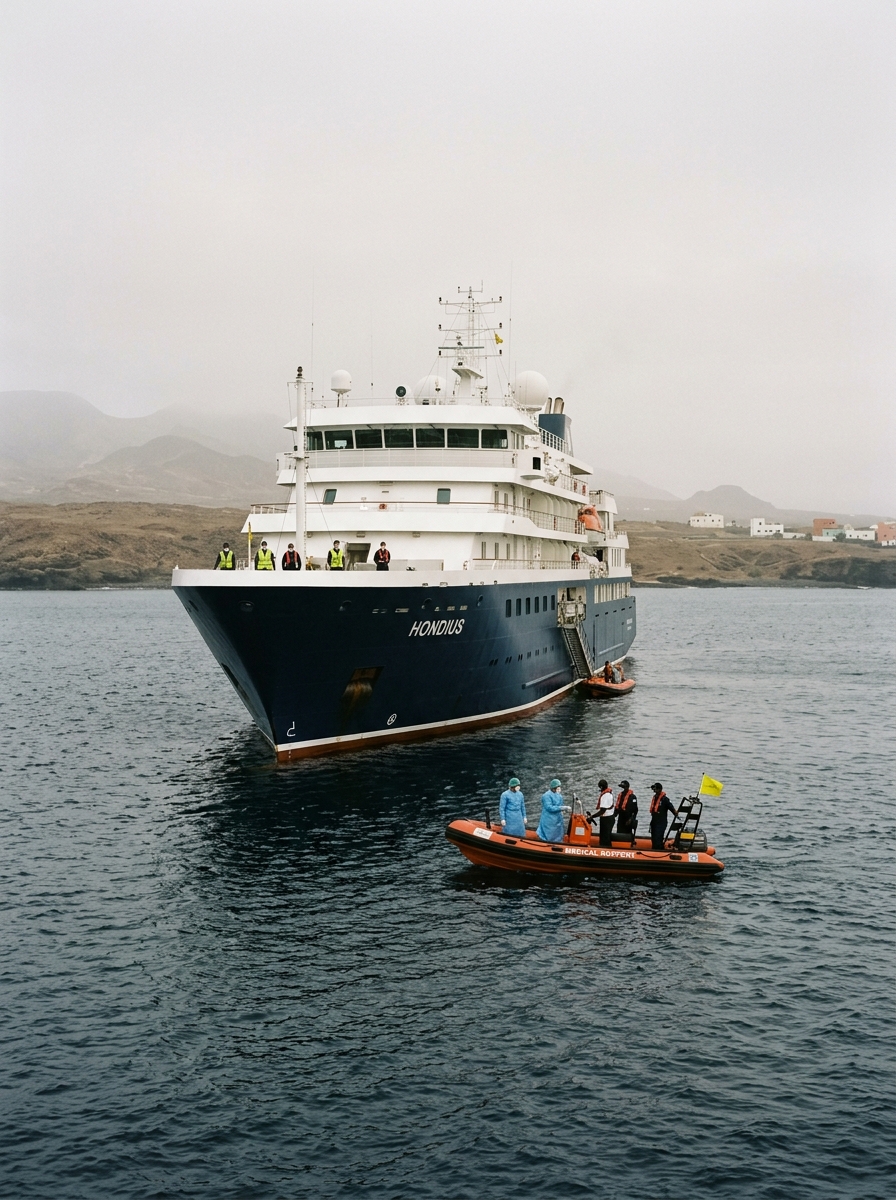
Cabo Verdean authorities faced a difficult balancing act: protecting national public health while ensuring care for those at sea. Oceanwide said remaining guests would not disembark in Cabo Verde except for individuals planned for medical evacuation. The company said sailing onward to Las Palmas or Tenerife in Spain’s Canary Islands was being considered as an option for further medical screening and handling, but no final disembarkation point had been confirmed.
For cruise operators worldwide, the incident lands at a sensitive moment. The industry has spent years rebuilding passenger confidence after the COVID-19 pandemic exposed the vulnerability of ships to outbreaks in confined environments. Cruise companies have since strengthened sanitation, isolation and medical protocols, but the Hondius emergency highlights a different challenge: expedition cruising often takes passengers far from major hospitals, across jurisdictions, and into areas where unusual pathogens may be present.
Unlike large conventional cruise liners that operate predictable routes between major ports, expedition vessels often market remoteness as part of the experience. That model offers passengers access to polar landscapes, isolated islands and wildlife encounters, but it also leaves less margin for rapid medical evacuation when a rare infection is suspected. The Hondius case shows that modern maritime tourism depends not only on onboard doctors and ship sanitation, but also on rapid cooperation among coastal states, flag states, laboratories, emergency medical teams and airline evacuation services.
The event may also sharpen debate over pre-voyage risk assessments. For routes through regions where hantavirus or other zoonotic diseases are known to occur, operators may face pressure to provide more detailed advice about rodent exposure, safe cleaning practices, food storage, shore-landing hygiene and symptom reporting. WHO has advised passengers and crew involved in the current event to practice frequent hand hygiene, monitor for symptoms for 45 days, remain vigilant for respiratory illness and avoid cleaning methods that could aerosolize contaminated material, such as dry sweeping.
There is no specific approved antiviral treatment for hantavirus cardiopulmonary syndrome. Care is largely supportive and can require intensive monitoring, oxygen support, mechanical ventilation, careful fluid management, vasopressors and, in the most severe cases, extracorporeal membrane oxygenation. That reality makes timing critical. Early recognition and transfer to advanced care can improve survival, but at sea, every hour can be shaped by weather, port permission, aircraft availability and international coordination.
Public health officials have tried to avoid panic. WHO has not recommended travel or trade restrictions based on current information. It said most routine tourism activities carry little or no risk of rodent exposure, and that the risk to the global population from the Hondius event remains low. Still, low public risk does not mean low operational risk for the cruise sector. A single cluster aboard one vessel can trigger port restrictions, emergency evacuations, media scrutiny, insurance questions and reputational damage across an industry built on perceptions of safety and control.
For families of the dead and ill, the broader industry implications are secondary to the immediate tragedy. The timeline released by authorities shows how quickly nonspecific symptoms can become life-threatening. Fever and diarrhoea, common complaints during travel, became respiratory distress and shock. A passenger was evacuated to intensive care in Johannesburg. Two crew members remained on board awaiting urgent medical support. Other passengers, many far from home, were left in cabins watching decisions unfold through updates rather than certainty.
The Hondius emergency is still developing, and many questions remain unanswered. Investigators have not yet established the original source of exposure. Not all deaths have been laboratory-confirmed as hantavirus deaths. The role of any possible onboard transmission remains under examination. The final disembarkation plan has not been settled. Those uncertainties are precisely why the case is likely to be studied closely.
For the international cruise industry, the warning is clear. The next test of maritime tourism safety may not come from a familiar stomach virus or a respiratory pathogen already built into standard protocols. It may come from a rare zoonotic infection encountered on a remote itinerary, carried silently across oceans, and detected only when passengers begin to fall critically ill far from the nearest hospital. The MV Hondius, waiting off Cabo Verde with passengers and crew under medical monitoring, has become a stark reminder that in modern travel, distance is no longer a barrier to disease — but it remains a barrier to care.
