
As her adult children argued over responsibility and inheritance, an elderly woman quietly held the document that could change everything.
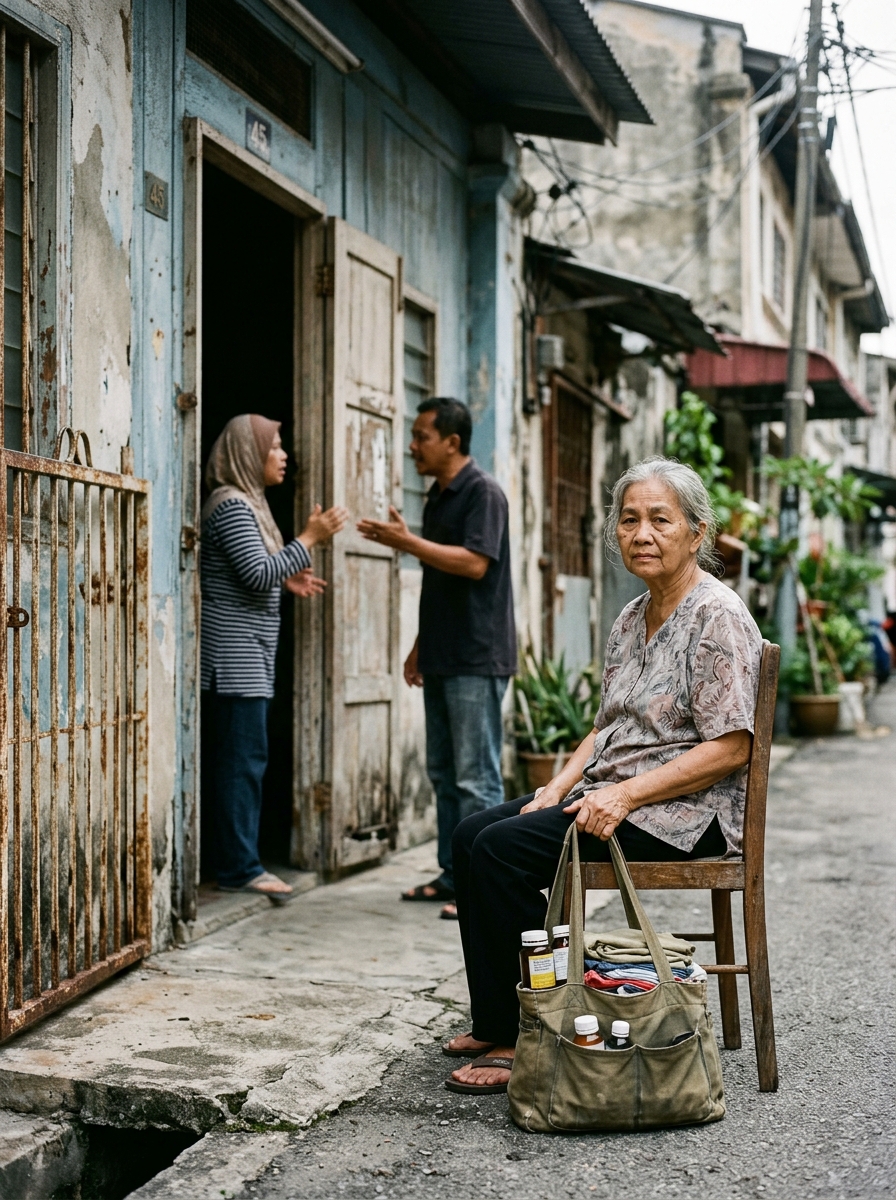
For months, the old woman moved from one household to another with the smallness of someone who had learned not to take up space. Her clothes fit inside a faded canvas bag. Her medicine was packed in a plastic box. Her walking stick, polished smooth where her fingers rested, was often the last thing carried from a doorway as one child delivered her to the next.
To neighbors, the arrangement looked practical at first. She had several adult children, each with a home, a job and a family. Sharing responsibility for an aging parent seemed reasonable. But inside the family, according to people familiar with the matter, the arrangement had become less an act of care than a rotation of inconvenience.
Each child had reasons. One said the apartment was too small. Another said work hours were too long. A daughter-in-law complained that the old woman woke too early and disturbed the children. A son said medical costs were rising and that his siblings were not contributing equally. What began as a schedule turned into a cycle of blame.
At the center of the dispute was not only the mother’s care, but also her house — a modest, aging property on a narrow street where the family had once gathered for holidays, meals and weddings. The house was not large, but land values in the area had increased sharply. To the children, it had become the most valuable thing their mother owned.
They spoke about repairs, sale prices and division of proceeds. They argued over who had spent more money on her medicine, who had visited more often and who had sacrificed more. Rarely, one neighbor said, did anyone ask the old woman what she wanted.
“She used to sit by the gate and watch people pass,” the neighbor recalled. “She was quiet. When her children came, their voices were loud. When they left, she looked smaller.”
The crisis came on a rainy evening. After several days of weakness, poor appetite and dizziness, the woman collapsed in the home of one of her sons. An ambulance was called only after relatives debated whether she merely needed rest. By the time she reached the hospital, doctors found signs of dehydration, exhaustion and poorly managed chronic illness.
Her condition was serious but treatable. She was placed under observation, given fluids and medication, and monitored through the night. Nurses said she repeatedly asked whether her children had eaten, even as she struggled to sit up without assistance.
When the family arrived at the hospital, their first conversations were not only about her condition. They also turned, almost immediately, to money. Who would pay the bill? Who would stay overnight? Who would take her home after discharge?
The attending physician, accustomed to seeing family tensions surface in hospital corridors, listened for a time before asking to speak with the children together. He told them their mother needed stable care, regular meals, medication supervision and emotional support. Moving her from house to house every few weeks, he warned, was damaging her health.
Then he revealed something that shifted the room’s atmosphere.
The mother had asked the hospital’s social worker to retrieve an envelope from her bag. Inside was a notarized document related to the family home. It showed that the property had not been left equally to the children as they had assumed. Nor had it been promised to the son who claimed to have spent the most on her care.
Instead, the woman had signed an agreement placing the house under conditions. It could not be sold while she was alive. After her death, the property would be transferred to a charitable trust supporting elderly people without family care, unless her children could demonstrate that they had provided consistent, documented support during her final years.
The room fell silent.
For years, the children had treated the house as an eventual inheritance. Their mother had treated it as her final form of protection. According to the doctor, she had not hidden the document out of revenge. She had kept it because she wanted to know whether her children saw her as a mother or as a burden attached to an asset.
Her decision, though painful, was legally deliberate. She had consulted a local legal aid adviser months earlier, after a fall left her alone for several hours before anyone came to check on her. At the time, she reportedly told the adviser she feared becoming “a suitcase passed from door to door.”
The doctor did not accuse the children. He did not need to. The facts in the hospital room were plain enough: an elderly woman in a bed, weakened by neglect that no one wanted to name; her children standing around her, suddenly aware that the house they had argued over was no longer guaranteed to them.
One son protested first. He said the arrangement was unfair and that he had paid for repairs. A daughter said she had cooked meals and washed clothes. Another child insisted that the mother had been confused and pressured. The physician reminded them that the hospital was not a court and that their immediate concern should be her recovery.
The mother, listening from the bed, reportedly said only one sentence: “I did not need the house to be loved.”
That sentence, according to a nurse who heard it, ended the argument for the moment.
The case reflects a wider strain facing many families as populations age and traditional expectations of family care collide with financial pressure, migration, smaller homes and rising medical costs. Across many societies, elderly parents are still expected to rely on children, yet the emotional and physical labor of caregiving often remains unplanned until a crisis occurs.
Experts in elder care say disputes over inheritance can worsen neglect when family members begin calculating care as an investment. Money spent on medicine becomes a claim. Nights spent at the hospital become evidence. A parent’s needs are converted into a ledger, and affection becomes entangled with property.
But care, professionals say, cannot be measured only after a hospital admission. It is found in daily routines: checking whether medicine was taken, preparing food that can be swallowed easily, making sure the floor is not slippery, listening without impatience, and allowing an older person to keep dignity even as the body becomes fragile.
In this family, the hospital stay forced a reckoning. Over the following days, the children arranged a more stable plan. A caregiver would assist during the day. Medical appointments would be scheduled and shared. Expenses would be recorded transparently, not as weapons but as responsibilities. Whether those promises would last remained uncertain.
The mother’s health improved slowly. She began eating small portions of porridge and fruit. She asked to see the morning light through the window. She also asked that no one discuss the house in her room again.
The legal document remained in the hands of her adviser. Its conditions did not guarantee reconciliation, but they changed the balance of power. The old woman who had been passed from one home to another had quietly drawn a boundary around the only property her children valued.
Her secret was not merely about ownership. It was about recognition.
For years, the house had been described as an inheritance waiting to be divided. To her, it was the place where she had raised children, stretched meals, saved coins, endured storms and waited at the gate for people who increasingly arrived only to argue. By deciding its future herself, she reclaimed a voice her family had stopped hearing.
The story left those who knew the family with an uncomfortable question: when an aging parent becomes weak, does love remain love if it is offered only in expectation of reward?
In the hospital corridor, after the doctor’s disclosure, one daughter was seen sitting alone, crying into her hands. Whether from guilt, fear or regret, no one could say. Inside the room, her mother slept, one hand resting on the blanket, her breathing steadier than before.
The house still stood on the narrow street, its walls weathered, its gate rusting, its rooms filled with memories no document could fully describe. For the children, it had become a disputed asset. For their mother, it had become a final lesson: a home is not proven by who inherits it, but by who is willing to care for the person who built it.”””
