
With the dress code “Fashion Is Art,” the annual fundraiser turned celebrity clothing into cultural spectacle, digital content and worldwide conversation.
The Met Gala was once described mainly as a high-society fundraiser for the Metropolitan Museum of Art’s Costume Institute. In 2026, it looked increasingly like something larger: a global media event in which fashion, celebrity, art, technology and social media converged on a single staircase in New York.
This year’s gala, held on May 4, celebrated the Costume Institute exhibition “Costume Art.” The dress code, “Fashion Is Art,” gave guests a broad but demanding instruction. It was not enough to look expensive, dramatic or beautiful. The strongest appearances treated the body as a canvas, sculpture, archive or performance. Clothing became a way to ask what art means when it moves, breathes and poses for millions of cameras.
The theme was especially suited to the Met Gala’s modern identity. Fashion has always borrowed from painting, sculpture, architecture and theater. But the 2026 carpet made that relationship explicit. Designers and celebrities used molded bodices, draped gowns, jeweled body forms, hand-painted surfaces, historical references and sculptural silhouettes to transform a red carpet into a living gallery. The museum provided the intellectual frame; celebrities provided the visibility; social media provided the distribution system.
Beyoncé’s return to the Met steps was one of the clearest examples of how celebrity presence can turn clothing into a global headline. As a co-chair, she arrived in an Olivier Rousteing look that used a crystal-covered skeleton motif and a dramatic feathered cape to connect glamour with anatomy. The outfit was instantly readable from a distance but rich enough for online close-ups, fan analysis and fashion commentary. It was not only a dress. It was a highly shareable image built for television cameras, professional photography and vertical video.
Lisa’s custom Robert Wun gown offered a different interpretation. Her look used 3D-scanned details inspired by her own arms and traditional Thai dance positions, turning the body into both reference and artwork. For a global pop figure with a massive fan base, the effect traveled far beyond fashion media. It invited discussion of Asian performance traditions, digital craftsmanship and the relationship between couture and personal identity. That is the modern Met Gala formula: a garment succeeds when it can operate as art history, celebrity branding and social media language at the same time.
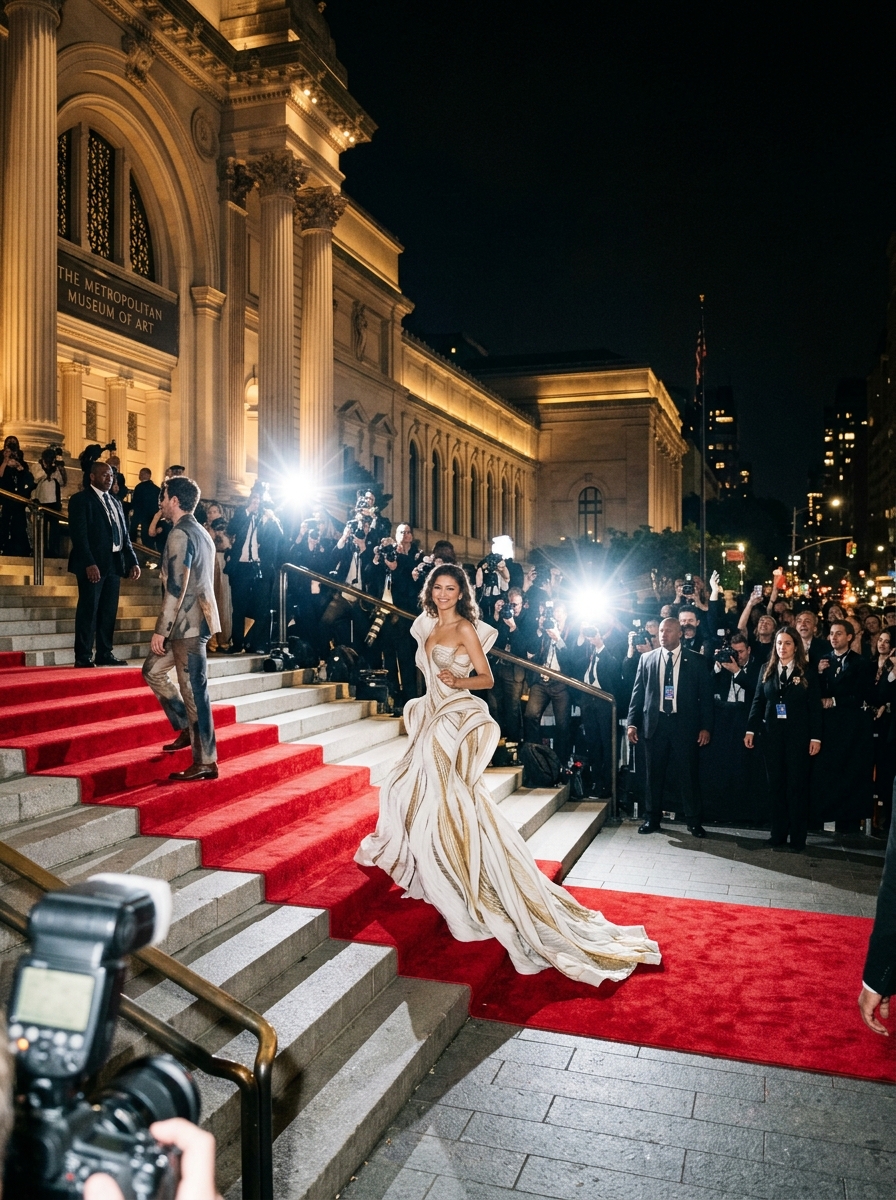
Other notable looks emphasized the range of the theme. Rihanna’s sculptural Maison Margiela gown drew attention for its architectural presence, while A$AP Rocky’s Chanel look brought menswear into the same conversation about construction and performance. Emma Chamberlain’s hand-painted Mugler look made the “Fashion Is Art” concept unusually literal. Nicole Kidman’s Chanel dress, with its meticulous handcraft and ruby-toned embellishment, represented the old language of couture labor. Venus Williams, in Swarovski, connected athletic legacy and personal symbolism with the visual drama expected on the Met steps.
These outfits mattered not only because they were beautiful, but because they were legible in fragments. A modern Met Gala look must survive being consumed as a full-length photograph, a five-second TikTok clip, an Instagram carousel, a YouTube short, a meme, a fan edit and a close-up of makeup, jewelry or tailoring. The event is no longer experienced only by the guests in the room or readers of fashion magazines the next morning. It is experienced in real time by global audiences who pause, zoom, repost, criticize and reinterpret.
That shift has changed the stakes for designers. A gown is no longer judged only by editors and museum patrons. It is judged by millions of viewers who may know the celebrity better than the designer, the meme better than the reference, or the fan narrative better than the exhibition text. This can be frustrating for traditional fashion authorities, but it has also made fashion more visible and more democratic. People who may never enter the Met can still debate whether a look understood the theme.
TikTok plays a central role in that transformation. Its short-form format rewards immediate visual impact. A dramatic entrance, a train unfolding on the stairs, a celebrity turning toward the camera or a surprising accessory can become a viral moment within minutes. TikTok does not require viewers to understand the full history of couture. It asks whether the image stops the thumb. For the Met Gala, that means the first impression matters enormously. A look must communicate quickly, even if its deeper meaning unfolds later.
Instagram remains the platform of polish and aspiration. It gives celebrities, stylists and fashion houses a controlled space to present official images, close-up details and behind-the-scenes preparation. A Met Gala post can become part of a star’s identity architecture: the hotel exit, the fitting, the makeup chair, the red carpet pose, the after-party look. Instagram turns the event into a sequence of visual chapters, each one reinforcing celebrity status and brand partnership.
YouTube extends the life of the event. Livestreams, red-carpet interviews, fashion breakdowns, beauty tutorials and commentary videos allow viewers to revisit the night after the initial rush has passed. A single outfit can generate reaction videos, designer explainers, fan compilations and critical essays. The Met Gala, in this sense, is not a one-night event. It is a content ecosystem that begins with anticipation and continues through analysis, ranking, backlash and nostalgia.
Facebook, though less associated with fashion youth culture, still matters because it carries the conversation into broader public spaces. Clips and photo galleries circulate among older viewers, community pages and entertainment groups. There, the discussion may be less technical but more social: Was the outfit elegant? Was it too revealing? Did the celebrity look confident? Was the theme understandable? The event becomes not only a fashion debate but a family, workplace and pop-culture conversation.
The power of celebrities is the engine behind this global reach. The Met Gala’s guest list now operates like a cross-industry summit. Film actors, pop stars, athletes, influencers, models, designers, business figures and digital creators all appear in the same visual field. Their audiences overlap and compete. A fan of a K-pop star may watch the carpet for one person, then discover a designer. A sports fan may follow Venus Williams and end up engaging with couture symbolism. A beauty follower may care less about the dress than the hair, nails or makeup.
This is why the Met Gala has become one of the most effective branding stages in modern culture. For celebrities, it offers a chance to reset an image, announce a new era or reinforce cultural power. For designers, it is a high-risk, high-reward exhibition platform. For luxury houses, it is advertising disguised as art and philanthropy. For the museum, it is fundraising and global visibility. For social platforms, it is premium visual content that users distribute for free.
The “Fashion Is Art” dress code sharpened a long-running debate: when does clothing become art? The 2026 carpet suggested that the answer may depend on context. A dress in a closet is a garment. A dress on a celebrity’s body, framed by a museum exhibition, photographed by global media and interpreted by millions online, becomes something else. It becomes performance, commerce, identity and public image at once.
That complexity also brings criticism. The Met Gala is often accused of excess, exclusivity and spectacle detached from ordinary life. Those criticisms are not baseless. The event thrives on luxury at a time when many people face economic pressure. Yet its cultural influence is difficult to dismiss. Precisely because it is extravagant, it becomes a stage where societies debate taste, wealth, beauty, representation, gender, race, labor and celebrity power.
The 2026 edition showed that fashion’s future will not be decided only in ateliers, museums or magazines. It will also be shaped by algorithms, fan communities and the speed at which images move across screens. The most memorable looks were not simply worn. They were circulated, decoded, defended and transformed into digital memory.
The Met Gala has become a global media event because it understands the age it lives in. It offers scarcity in a world of endless content, celebrity in a world of fragmented attention, and visual drama in a culture built around sharing. “Fashion Is Art” may have been the dress code, but the night’s larger message was broader: in the digital era, fashion becomes powerful when it can be seen, felt, argued over and instantly transmitted around the world.
“””
