
A new University of Cambridge report says talking AI toys may help language practice, but can misread children’s emotions, mishandle pretend play and leave parents without clear standards.
LONDON — The newest companion in the nursery may not be a teddy bear, a wooden puzzle or a picture book. It may be a plush toy with a microphone, a speaker and a generative artificial intelligence system designed to answer a child in real time.
For technology companies, the pitch is simple: a screen-free toy that talks, listens, tells stories and keeps children engaged. For many parents, the appeal is understandable. In homes where adults are stretched by work, childcare costs and digital fatigue, an AI toy that can hold a conversation seems to offer learning, entertainment and perhaps even a small measure of support.
But a University of Cambridge report has added weight to a more cautious question: are these toys a helpful innovation, or a new category of risk entering children’s bedrooms before regulators, schools and parents have caught up?
The report, published through Cambridge’s AI in the Early Years project, examined how generative AI toys capable of human-like conversation may affect children up to age five. Researchers described the work as an early but systematic effort to study a fast-growing market that is already being promoted to families as educational, friendly and emotionally responsive.
Their findings were mixed. Some parents and early-years practitioners saw possible benefits, particularly in language development and communication practice. A responsive toy, in theory, could encourage children to speak, ask questions and try new words. For children who are shy, isolated or in need of extra conversational practice, that possibility is not insignificant.
Yet the Cambridge team also found that AI toys can struggle with the very forms of interaction that matter most in early childhood: emotional recognition, social play and pretend play. In observed sessions, children sometimes tried to express affection, sadness or imaginative scenarios, only to receive responses that were irrelevant, awkward or emotionally mismatched.
The concern is not that a toy failed to behave like a perfect adult. Traditional toys do not comfort children by themselves. A doll cannot interpret grief. A stuffed animal cannot resolve fear. But traditional toys also do not create the impression that they understand, remember or reciprocate a child’s feelings. A generative AI toy, by speaking fluently and presenting itself as a companion, may blur that boundary.
That distinction is central to the Cambridge warning. Young children are still learning what friendship means, what comfort feels like and how people respond when someone says they are sad. If an AI toy repeatedly misses those cues, dismisses them or redirects the conversation, researchers worry the child may be left without the support they were seeking — and without an adult noticing that support was needed.
In one observed case cited by Cambridge, a young child told the toy they were sad. The toy responded with a cheerful line that failed to acknowledge the emotion. In another example, a child offered an imaginary present, but the toy treated the interaction literally and moved away from the pretend scenario. These may appear to be minor glitches, but in early childhood, pretend play is not a minor activity. It is one of the ways children develop language, empathy, problem-solving and social understanding.
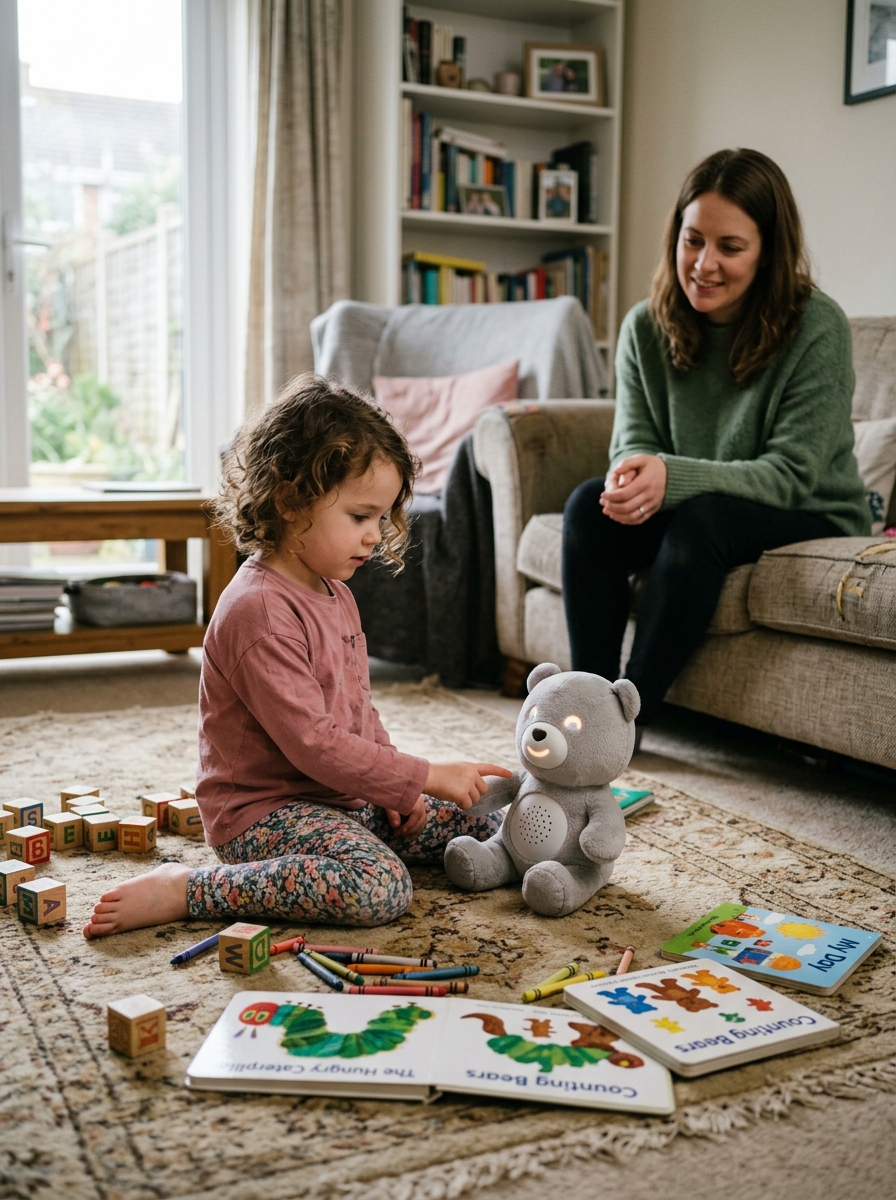
The study was deliberately small, built around detailed observation rather than broad statistical claims. Researchers worked with early-years practitioners, children’s charity leaders, parents and 14 children who played with a conversational AI soft toy called Gabbo, developed by Curio Interactive. The goal was not to declare all AI toys harmful, but to identify risks that current product labels and safety rules may not adequately address.
The report’s recommendations point to a regulatory gap. Toys are already tested for physical hazards such as choking risks, sharp edges and toxic materials. But AI toys create a different safety question: what does psychological safety mean when a toy can ask questions, encourage attachment, store information, simulate friendship and respond unpredictably?
Cambridge researchers argue that clearer standards are needed. Those could include safety labels, limits on how strongly toys encourage children to treat them as friends, transparent privacy policies and stronger controls over third-party access to AI systems. The report also urges manufacturers to test products with real children and consult safeguarding specialists before putting new AI toys on the market.
Privacy is another concern. A toy that converses with a child may collect sensitive information, including names, family routines, fears, preferences and emotional disclosures. Many parents already struggle to understand how apps and smart devices use data. AI toys add another layer of uncertainty because their value depends on listening and responding naturally.
The Cambridge research found that many parents and educators were unsure where conversations were stored or who might have access to them. It also found that many early-years practitioners wanted more guidance on AI safety. That matters because nurseries, preschools and childcare centers could become testing grounds for new technology before staff have the training to evaluate it.
Industry representatives have generally argued that AI toys can be designed responsibly, with parental controls, filters, transparency tools and monitoring features. Some companies say their systems are improving and that independent research can help them refine products. That position should not be dismissed. The technology is developing quickly, and there may be uses in which AI supports storytelling, language practice or guided play under adult supervision.
But the central issue for parents is not whether AI can produce fluent sentences. It already can. The harder question is whether fluency creates trust that the toy has not earned.
Children under five are not miniature adults. They are developing emotional regulation, imagination, attachment patterns and social expectations. They often treat toys as alive during play, even when the toy is silent. When the toy talks back, remembers earlier conversations and claims to be a friend, the emotional stakes change.
That does not mean every AI toy should be banned from every home. It does mean the burden should not fall entirely on parents reading dense privacy policies, comparing vague marketing claims and guessing whether a device is developmentally appropriate. A clear safety framework would help families distinguish between toys built for healthy supervised play and products that rely on emotional bonding without adequate safeguards.
For now, the safest guidance is practical. Parents who choose to use AI toys should keep them in shared family spaces, listen to interactions, talk with children about the difference between people and machines, and avoid allowing a toy to become a private confidant. Adults should pay close attention when children express strong affection for the toy or turn to it for comfort instead of a caregiver.
The Cambridge report arrives at a moment when AI is moving from screens into objects that feel familiar, soft and intimate. That shift may make the technology easier to accept, but it also makes scrutiny more urgent. A chatbot on a phone is recognizable as software. A talking bear in a child’s bed is something else.
For parents, the debate is not simply about whether AI toys are clever. It is about whether childhood should become another environment where experimental technology arrives first and safety standards follow later.
The promise of AI toys is convenience, companionship and learning. The risk is that a machine designed to sound caring may fail at the moments when care matters most. Until clear rules exist, the smartest toy in the room may still need an adult close by.”””
