
A Boeing 767 arriving from Venice struck a light pole and a truck near Newark Liberty International Airport, but the safe landing of all passengers underscored both the resilience and the fragility of modern air travel.
NEWARK, New Jersey — For the passengers aboard United Airlines Flight 169, the final moments before landing may have seemed like the ordinary end of a transatlantic journey: seat belts fastened, window shades open, the runway approaching below. Outside the aircraft, however, a far more alarming scene was unfolding over one of America’s busiest stretches of highway.
The Boeing 767, arriving from Venice, Italy, was on approach to Newark Liberty International Airport on Sunday afternoon when it struck a light pole on the New Jersey Turnpike. Authorities said the aircraft also made contact with a tractor-trailer traveling on the highway. The light pole then hit a Jeep. Despite the chain of impacts, the aircraft landed safely, taxied to the gate and no injuries were reported among the 221 passengers and 10 crew members on board.
The only reported injury was to the truck driver, who was taken to a hospital with minor injuries and later released. The fact that the episode ended without loss of life has already made it a case study in aviation’s uneasy balance: a system built with extraordinary layers of protection, yet still dependent on precise calculations, disciplined procedures and margins sometimes measured in feet.
The Federal Aviation Administration said Flight 169 struck the light pole around 2 p.m. local time while on approach to Newark. The agency and the National Transportation Safety Board opened investigations, with the NTSB leading the inquiry. The board classified the event as an accident because of the extent of damage to the aircraft, according to reports citing investigators.
In aviation, that classification matters. It does not determine blame. It signals that the event crossed a threshold requiring a deeper technical examination. Investigators are expected to examine flight data, cockpit voice recordings, weather conditions, the aircraft’s approach path, runway use, crew actions, air traffic control communications and the physical layout of the runway environment.
For the public, the images and video were immediate and visceral. Dashboard-camera footage from the truck captured the moment of impact, showing how close the aircraft came to vehicles moving beneath the approach path. Such footage can be shocking because it compresses a complex event into a few seconds. But investigators will need much more than video to understand why the aircraft was low enough to contact objects outside the airport perimeter.
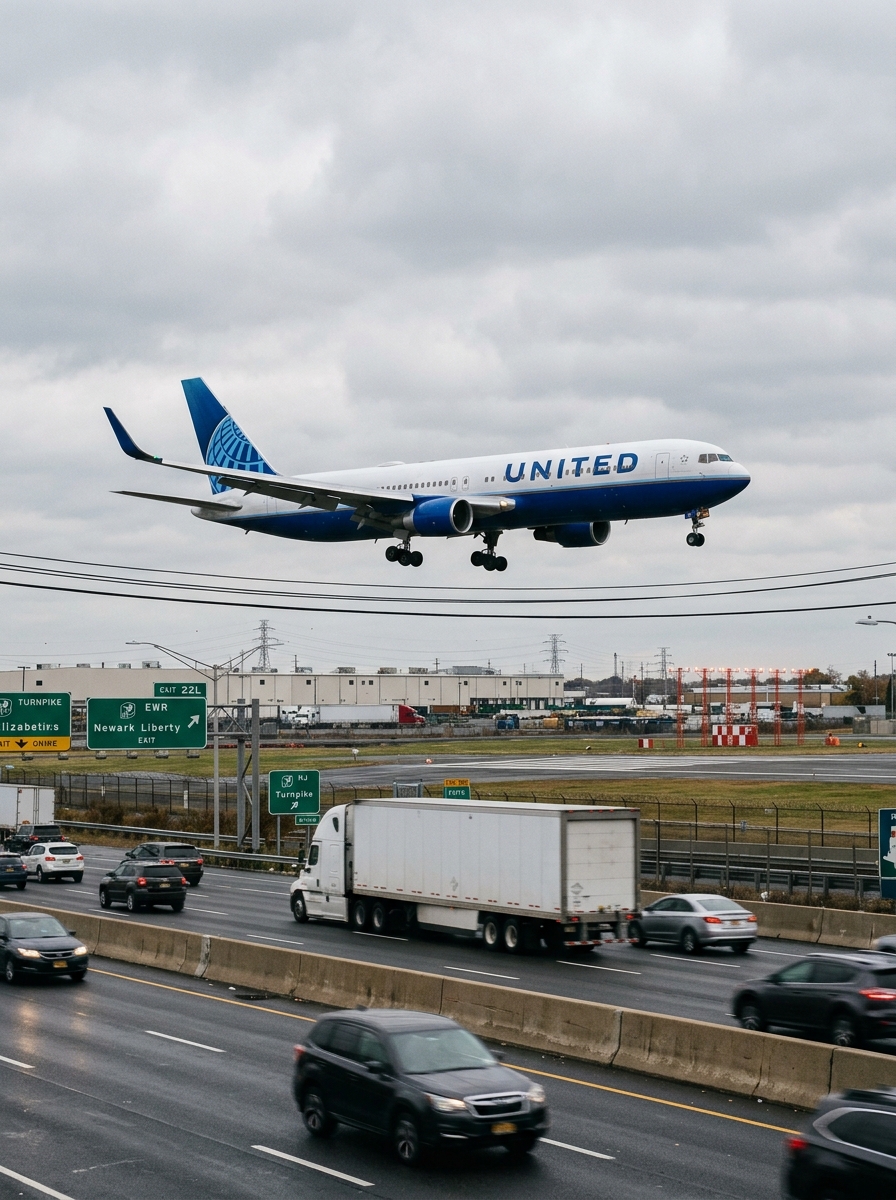
Newark is a demanding airport even in normal conditions. It handles dense traffic, sits amid highways, rail lines and industrial infrastructure, and operates in one of the world’s most complex airspace systems. Aircraft approaching certain runways can appear startlingly low to motorists on the New Jersey Turnpike because the runway threshold lies close to the highway. That proximity is legal and common at many urban airports, but it leaves little room for abnormal deviations.
The runway involved has drawn attention because of its shorter length and its use under particular wind conditions. Reports said winds were gusting strongly at the time, and aviation specialists noted that investigators will study whether wind, approach speed, descent rate or navigation setup played a role. None of that should be read as a conclusion. In aviation safety, early assumptions are often wrong, and official findings may take months.
The safe outcome, however, points to several strengths in the system. The aircraft remained controllable after contact. The pilots were able to land and taxi normally. Emergency response and airport inspection procedures followed. Passengers and crew were not injured. The truck driver survived with minor injuries despite being in the path of a heavy jet on final approach.
Those facts should not minimize the severity of the incident. A wide-body aircraft contacting highway infrastructure moments before touchdown is a serious event. Had the aircraft been lower, had the truck been positioned differently, had debris struck a critical component, or had the crew been forced into an unstable landing, the consequences could have been far worse.
That is why the main lesson is not that the system worked perfectly. It is that aviation safety works best when near-disasters are treated with the same seriousness as disasters. The absence of fatalities is not an excuse for relief alone; it is an opportunity for scrutiny.
The first area of focus is likely to be approach stability. Airlines train pilots to meet strict criteria before landing: correct speed, correct descent path, proper aircraft configuration, stable engine thrust and clear alignment with the runway. If an approach becomes unstable below a defined altitude, the safest option is usually a go-around. Investigators will determine whether Flight 169 met those criteria and whether the crew had indications that the aircraft was lower than intended.
Another area is obstacle clearance. Airports are designed with protected surfaces around runways to reduce the risk of collisions with terrain, vehicles or structures. But when roads sit close to approach paths, the boundary between airport operations and public infrastructure becomes especially important. The investigation may examine whether lighting structures, highway traffic and approach geometry provided sufficient safety margin.
A third issue is communication. If the crew did not immediately realize the aircraft had struck objects, investigators will review what information was available in the cockpit, what was transmitted to air traffic control, and how quickly airport authorities were alerted. Modern aviation depends not only on avoiding incidents but on detecting them quickly when they occur.
United Airlines said it was reviewing the aircraft and cooperating with the investigation. The crew was removed from service as part of the airline’s safety review, a standard step in serious events and not, by itself, a finding of fault. The aircraft’s recorders are expected to be central to the inquiry, offering investigators a second-by-second account of altitude, speed, aircraft configuration and cockpit conversation.
For passengers, the incident may raise a familiar anxiety: how can a commercial flight be considered safe if something like this can happen? The answer is that aviation is safe not because errors or abnormal events never occur, but because systems are designed to absorb them and learn from them. Every major improvement in air travel has come from investigating what nearly went wrong as much as what went catastrophically wrong.
That culture has produced remarkable results over decades. Aircraft design, pilot training, air traffic procedures, runway safety systems and maintenance standards have evolved through relentless analysis. But the Newark incident is a reminder that complacency is always the enemy. A safe landing does not erase a dangerous approach. A minor injury does not make a collision minor.
The event also highlights a broader challenge for airports built into dense urban regions. As air traffic grows and cities expand around airports, the interaction between aircraft, roads and nearby infrastructure becomes more complicated. Runway protection zones, approach lighting, highway design and emergency response planning must be reviewed continuously, not only after tragedy.
For regulators, the question is whether existing safeguards around Newark’s approach paths are sufficient. For airlines, the question is whether training and operational guidance fully account for the risks of landing on shorter or less commonly used runways in difficult wind conditions. For airport authorities, the question is whether surrounding roads and structures can be managed to reduce exposure when aircraft are low on final approach.
The passengers of Flight 169 reached the gate safely. That is the most important fact for the families who were waiting for them. But aviation safety is built on refusing to stop at the most comforting fact. The deeper lesson lies in the narrow space between a frightening near miss and a catastrophe.
A light pole can be replaced. A truck can be repaired. An aircraft can be inspected and grounded. What cannot be replaced is the safety culture that insists every warning sign must be examined before the next flight follows the same path over the same highway toward the same runway.
In Newark, disaster was avoided. The responsibility now is to understand why it came so close.”””
