
Driven by international stars, social video, streaming platforms and a year-round entertainment machine, the NBA has turned its championship series into a worldwide event that travels far beyond the United States.
NEW YORK — The NBA Finals is still decided on a hardwood court in North America, under bright lights, before a roaring arena crowd. But the audience watching it now stretches far beyond the city names printed on the jerseys.
In Manila, fans gather before work to watch morning tipoffs. In Paris, highlights move across phones before the final buzzer reaches late-night viewers. In Lagos, Belgrade, Shanghai, Madrid and Melbourne, young players study footwork, step-back jumpers and pregame fashion with the same intensity once reserved for local heroes. The Finals has become more than the end of an American basketball season. It is one of the clearest symbols of how U.S. sports culture has learned to travel globally.
The NBA’s global power is not accidental. It is the product of decades of marketing, television distribution, international talent development, digital media and celebrity storytelling. The league has built an ecosystem in which games, players, sneakers, video clips, documentaries, fashion and gaming all reinforce one another. The Finals sits at the center of that system, offering a concentrated drama that even casual viewers can understand: one trophy, two teams, a handful of stars and a nightly stream of moments designed for global circulation.
The numbers show how large that machine has become. The 2025 NBA Finals between the Oklahoma City Thunder and Indiana Pacers reached 75 million viewers in the United States on ABC, according to the league. Game 7 averaged 16.6 million viewers and peaked at 19.6 million, while NBA Finals content generated a record 5 billion views globally across social media platforms, up sharply from the previous year. Those figures reveal the central paradox of modern sports: traditional television still matters, but the game’s cultural reach is increasingly measured in clips, shares and feeds.
For international fans, the NBA is often consumed differently from domestic audiences. Time zones can make live viewing difficult. A fan in Southeast Asia may follow a Finals game through a mix of live streams, short highlights, box scores, social posts and commentary from creators. A teenager in Europe may know a player first from TikTok or YouTube before watching a full game. A fan in Africa may follow the Finals through local basketball communities, WhatsApp discussions and jerseys worn on outdoor courts. The NBA’s challenge has been to make that fragmented attention feel like participation rather than distance.
Its answer has been ubiquity. The league says the 2025-26 season reaches fans in 214 countries and territories in more than 50 languages through broadcast partners and NBA League Pass. The NBA App, League Pass, team channels and social media accounts give the league direct relationships with fans who may never attend a game. In an earlier sports media era, international reach depended mainly on television rights. Today, it also depends on whether a single dunk, stare-down or postgame quote can become global content within minutes.
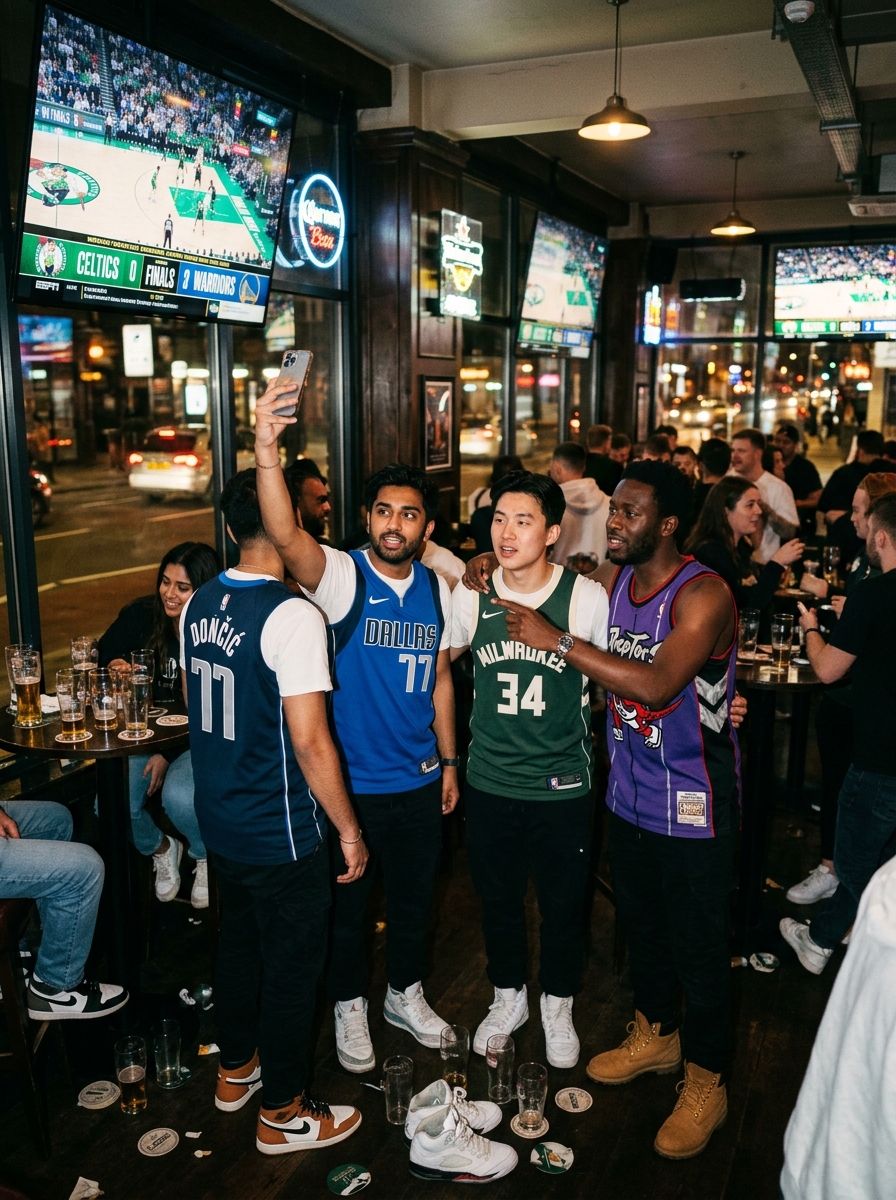
The players are the strongest carriers of that culture. Michael Jordan made the NBA a global aspiration in the 1990s. Kobe Bryant and Allen Iverson helped spread its identity through style, individual expression and relentless competitiveness. LeBron James turned the modern superstar into a media company, activist, investor and generational athlete. Stephen Curry changed how children around the world understand what a good shot looks like. Now the league’s global face is no longer only exported from the United States; it is being shaped by stars from across the world.
The 2025-26 NBA opening-night rosters featured a record 135 international players from a record-tying 43 countries across six continents. The list included Nikola Jokic of Serbia, Giannis Antetokounmpo of Greece, Luka Doncic of Slovenia, Shai Gilgeous-Alexander of Canada and Victor Wembanyama of France. Four international players have won the last seven MVP awards, a shift that would have seemed unlikely when the NBA first began aggressively promoting itself abroad. The league is no longer selling American basketball to the rest of the world. It is selling a global version of basketball headquartered in America.
That distinction matters. When a Serbian center becomes the sport’s most creative passer, a Greek-Nigerian forward becomes a Finals icon, a Slovenian guard becomes a global offensive artist and a French prospect arrives as one of the most scrutinized young athletes in the world, fans outside the United States see themselves not only as consumers but as contributors. National pride blends with club loyalty. A child in Ljubljana, Athens or Montreal can watch the Finals and see a pathway, not just a spectacle.
The league has reinforced that pathway through Basketball Without Borders, NBA Academy programs, youth clinics and international games. Regular-season games in Europe are part of the same strategy. The NBA has announced games in Berlin and London in 2026, Manchester and Paris in 2027, and Berlin and Paris again in 2028. These events are not only exhibitions of elite basketball. They are live brand experiences, combining game action, community programs, sponsor activations and media events that make the NBA feel physically present in markets where most fans follow it from screens.
The Finals also succeeds globally because basketball is unusually portable. It requires less space and equipment than many other major sports. A hoop, a ball and a small court can produce a recognizable version of the game. The NBA has turned that simplicity into a powerful cultural export. A crossover move can be copied in Manila. A celebration can be imitated in Dakar. A jersey can become streetwear in Tokyo. A shoe release can connect a teenager in Mexico City to an athlete in Los Angeles or Boston.
The league’s media strategy has adapted to that reality. Its new 11-year agreements with Disney, NBCUniversal and Amazon, running from the 2025-26 season through 2035-36, place NBA games across broadcast television and major streaming platforms. The NBA has said its app will direct fans to national games across those partners, reflecting a future in which fans expect access across devices rather than loyalty to a single network. For younger international audiences, that flexibility is not a bonus. It is the basic condition for relevance.
Still, global growth brings challenges. Subscription costs can limit access. Time zones remain a barrier. Social media can flatten complex games into isolated highlights. The internationalization of the NBA can also create tension with local leagues, which may benefit from rising basketball interest but struggle to compete with the glamour, salaries and marketing strength of the American league. For some fans, the NBA is both inspiration and competitor.
There is also a cultural question. The NBA’s appeal has always depended on personality, but the same celebrity machine that expands its reach can overshadow the sport itself. Fashion tunnels, podcasts, signature shoes, trade rumors and online debates keep the league visible every day. They also risk turning players into content streams rather than athletes. The Finals cuts through that noise because the games still decide something real. Legacy is tested. Pressure is visible. Greatness must be performed, not posted.
That is why the Finals remains the league’s most valuable global stage. It offers the emotion of live competition with the distribution power of modern media. A blocked shot, a fourth-quarter run or a championship celebration can move instantly from the arena to a phone in another hemisphere. The moment becomes American sport, global entertainment and local conversation at the same time.
The NBA did not merely export basketball. It exported a style of watching, talking, dressing and dreaming around basketball. The Finals is where that culture becomes most concentrated. It is a championship series, but also a global broadcast ritual, a social media festival, a sneaker showcase, a celebrity gathering and a talent map of the modern game.
The ball is still orange. The court is still 94 feet long. The trophy is still lifted by one team. But the meaning of the moment has changed. When the NBA Finals begins, the crowd is no longer only inside the arena. It is everywhere the game has taught people to look up at a hoop and imagine the world watching.”””
