
The world’s oldest Grand Slam endures through grass courts, white clothing, royal ritual, legendary champions and an atmosphere unlike any other event in the sport.
LONDON — In a sporting world increasingly driven by speed, spectacle and reinvention, Wimbledon still begins with restraint. The lawns are cut low and exact. The players step onto court in white. The scoreboards carry names that may soon enter history. Around the All England Club, spectators move through a summer landscape of ivy, flowers, strawberries, cream and expectation. The atmosphere is polished but not cold, traditional but not lifeless. Wimbledon’s power lies in making the modern game feel connected to something older than itself.
The Championships began in 1877, when 22 men entered a lawn tennis tournament at the All England Croquet and Lawn Tennis Club in Wimbledon. A crowd of about 200 watched Spencer Gore become the first champion. Nearly a century and a half later, the tournament has become one of the defining institutions in global sport, a Grand Slam that still carries the aura of a garden party, a cathedral and a theater of pressure all at once.
Wimbledon is the oldest of tennis’s four majors, but age alone does not explain its status. Its identity comes from the way it has preserved symbols that other tournaments might have abandoned. The white clothing rule remains one of its most visible traditions. The grass courts still shape the game in ways that hard courts and clay cannot. The Royal Box, the queue, Centre Court, the hill where fans gather to watch on giant screens, and the quiet choreography of officials, ball boys and ball girls all contribute to a sense that Wimbledon is not merely played, but performed.
Grass is the heart of that performance. It is the game’s original surface, and Wimbledon is now the only Grand Slam still played on it. The court rewards precision, balance and nerve. The ball can skid, stay low and accelerate after contact, forcing players to bend, react and shorten their swings. On grass, movement is an art of controlled risk. A champion must trust the feet as much as the racket.
The surface has shaped generations of champions. Serve-and-volley players once ruled Wimbledon, charging the net behind slicing serves and ending points with decisive touch. Bjorn Borg changed perceptions by winning from the baseline with calm endurance and heavy topspin. Boris Becker exploded into the tournament as a teenager, diving across grass with fearless power. Pete Sampras turned the Centre Court serve into a weapon of authority. Roger Federer made grass-court tennis look almost weightless, blending balance, disguise and attacking instinct into a style that seemed designed for the lawns.
Federer’s eight men’s singles titles remain a benchmark of modern Wimbledon mastery. His game matched the setting: graceful, economical and ruthless beneath the elegance. Yet Wimbledon’s history is too broad for any one champion. Rod Laver, John McEnroe, Jimmy Connors, Stefan Edberg, Novak Djokovic and Rafael Nadal all left different marks on the tournament. Djokovic brought elastic defense and mental control to a surface once thought to favor only instinctive attackers. Nadal’s 2008 victory over Federer in the fading light remains one of the sport’s most enduring finals, a match remembered as both contest and epic.
The women’s game has given Wimbledon some of its deepest legends. Martina Navratilova, with nine singles titles, became the tournament’s most successful singles champion through athleticism, net play and competitive hunger. Billie Jean King made Wimbledon a stage not only for excellence but for wider arguments about equality and respect. Steffi Graf brought speed, discipline and a devastating forehand. Venus and Serena Williams transformed the modern Wimbledon imagination with power, serve dominance and presence. Serena’s victories carried the force of an era; Venus’s success on grass showed how reach, timing and athletic grace could command the surface.
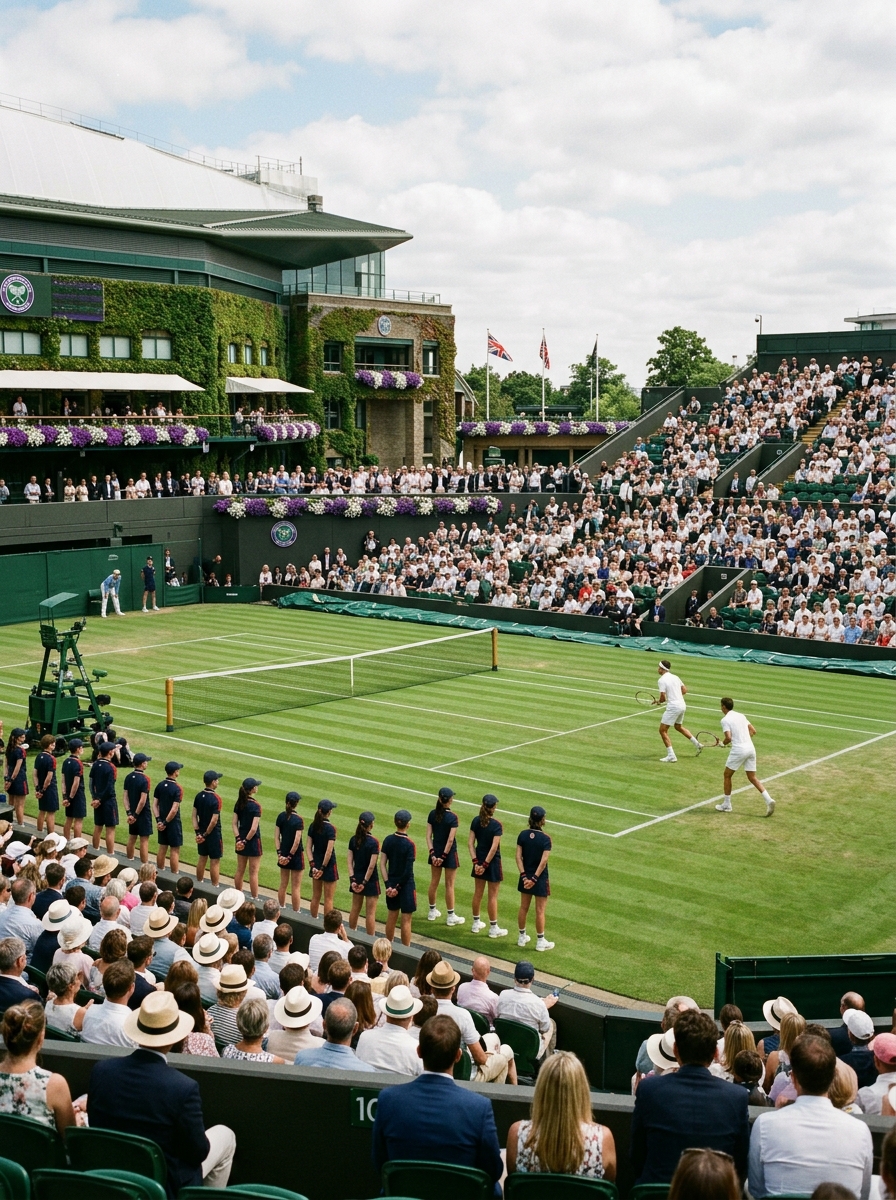
Wimbledon has also been a place where national emotion gathers. For Britain, the tournament has long been a mirror of hope and pressure. Generations waited for a homegrown men’s singles champion before Andy Murray won in 2013, ending a 77-year gap and turning Centre Court into a place of collective release. His victory was more than a sporting result. It was a national moment, the kind Wimbledon can still produce because its history makes every new breakthrough feel attached to old longing.
The tournament’s beauty is not limited to champions. It belongs equally to the early rounds, when outer courts bring spectators within touching distance of elite tennis. On those smaller lawns, a rising player can upset a seed, a veteran can resist decline, and a doubles match can produce the kind of intimacy lost in larger arenas. Fans lean over green railings, follow the sound of applause from court to court, and discover that Wimbledon’s grandeur is built from many small stages.
The crowd is part of the character. Wimbledon spectators are often described as polite, but politeness should not be mistaken for indifference. They understand tension. They know when a second serve carries danger, when a volley required courage, when a player is fighting both an opponent and the occasion. Centre Court can be quiet enough to hear shoes on grass, then suddenly loud enough to feel like a football stadium. The silence before a championship point may be the tournament’s most dramatic sound.
Tradition also creates contrast. A player may arrive with global fame, advanced coaching teams, nutrition plans and data analysis, yet still must pass through a ritual setting governed by old rules. Technology has entered Wimbledon, from retractable roofs to electronic review systems, but it has not erased the tournament’s visual code. The white clothes against green grass remain one of sport’s most recognizable images. The restraint gives the drama sharper edges.
The elegance of Wimbledon, however, should not obscure its intensity. The tournament is physically demanding and emotionally severe. Grass offers few long adjustments. A poor service game can decide a set. Rain delays can break rhythm. The pressure of history can tighten the arm. Players speak of Wimbledon with reverence because they know that winning there changes reputation. A title at the All England Club carries a weight that extends beyond ranking points and prize money.
Wimbledon’s global impact is equally significant. It exports a particular idea of tennis: disciplined, international, ceremonial and aspirational. Children watching from Asia, Africa, Europe, the Americas and Oceania see not only a tournament but a dream of entry into a tradition. The event has helped define tennis as a global professional sport while retaining the atmosphere of a private club opened briefly to the world.
That balance is fragile. Wimbledon must continue to modernize without losing the qualities that make it distinct. It faces the same pressures as other major events: commercial growth, broadcast demands, climate concerns, player welfare, accessibility and global competition for attention. Yet its advantage is clear. Wimbledon does not need to become louder to matter. Its prestige comes from confidence in its own language.
The Championships return each year as a reminder that sport can be both elite and emotional, refined and brutal, historic and immediate. The grass will wear down as the fortnight progresses, turning from perfect green to dusty brown near the baselines. The draw will narrow. The crowd will become more tense. At the end, two champions will hold trophies that connect them to generations before them.
Wimbledon endures because it offers tennis something rare: a sense of place that feels inseparable from the meaning of victory. To win there is not only to defeat opponents. It is to master grass, silence, weather, ritual, memory and expectation. In an era of constant change, the tournament’s greatest luxury may be its refusal to hurry. The world comes to Wimbledon, and for two weeks each summer, tennis still wears white, plays on grass and remembers where it began.
