
From Boston’s historic road to London’s charity crowds and New York’s five-borough spectacle, major marathons have become stages for endurance, identity and ordinary human courage.
On a cold spring morning in Massachusetts, runners gather in Hopkinton and look toward Boston. In London, they cross Tower Bridge beneath a roar that feels less like sport than a citywide celebration. In New York, they surge from Staten Island across the Verrazzano-Narrows Bridge, beginning a 26.2-mile journey through five boroughs and countless stories. These are not only races. They are moving portraits of human endurance.
The world’s great marathons have become among the most powerful community events in modern sport. They bring together Olympic champions, wheelchair racers, amateur runners, charity fundraisers, first-timers, survivors, veterans, parents, students and spectators who may never run a mile but understand the language of effort. A marathon is simple to explain and difficult to complete. That contradiction is the source of its appeal.
Boston, London and New York stand at the emotional center of this global running culture. Each has a distinct personality. Boston carries history and qualification. London carries charity, pageantry and public warmth. New York carries scale, noise and immigrant energy. Together, they show how a race can become a civic ritual and how long-distance running has moved from elite athletics into everyday life.
The Boston Marathon is the oldest annual marathon in the world, first run in 1897 after the revival of the marathon at the 1896 Olympic Games in Athens. Its route from Hopkinton to Boylston Street is one of the most storied courses in sport. To many runners, simply earning a Boston qualifying time is a life goal. The race is difficult not only because of the distance, but because of the hills, the weather and the psychological weight of history.
Boston’s course has its own vocabulary. The early downhill miles tempt runners to move too fast. The Newton hills test discipline. Heartbreak Hill, arriving late in the race, has become both a physical climb and a metaphor. The finish on Boylston Street is one of running’s sacred spaces, made even more meaningful after the 2013 bombing and the city’s response. Since then, Boston has represented not only endurance but resilience, memory and public defiance against fear.
London offers a different kind of power. Founded in 1981 by Chris Brasher and John Disley, the London Marathon was imagined as a festival as much as a competition. Its course passes landmarks known around the world, but its spirit is often found in the runners wearing charity vests, costumes and handwritten names on their shirts. London is where elite speed and mass participation meet with unusual ease.
The city turns into a corridor of encouragement. Spectators line the roads from Blackheath to The Mall. Bands play. Volunteers hand out water. Families wait at chosen corners, scanning faces for someone they love. Some runners chase personal bests. Others are carrying grief, recovery or gratitude. London has become one of the strongest examples of the marathon as a fundraising engine, linking athletic effort to hospitals, research foundations, local causes and community organizations.
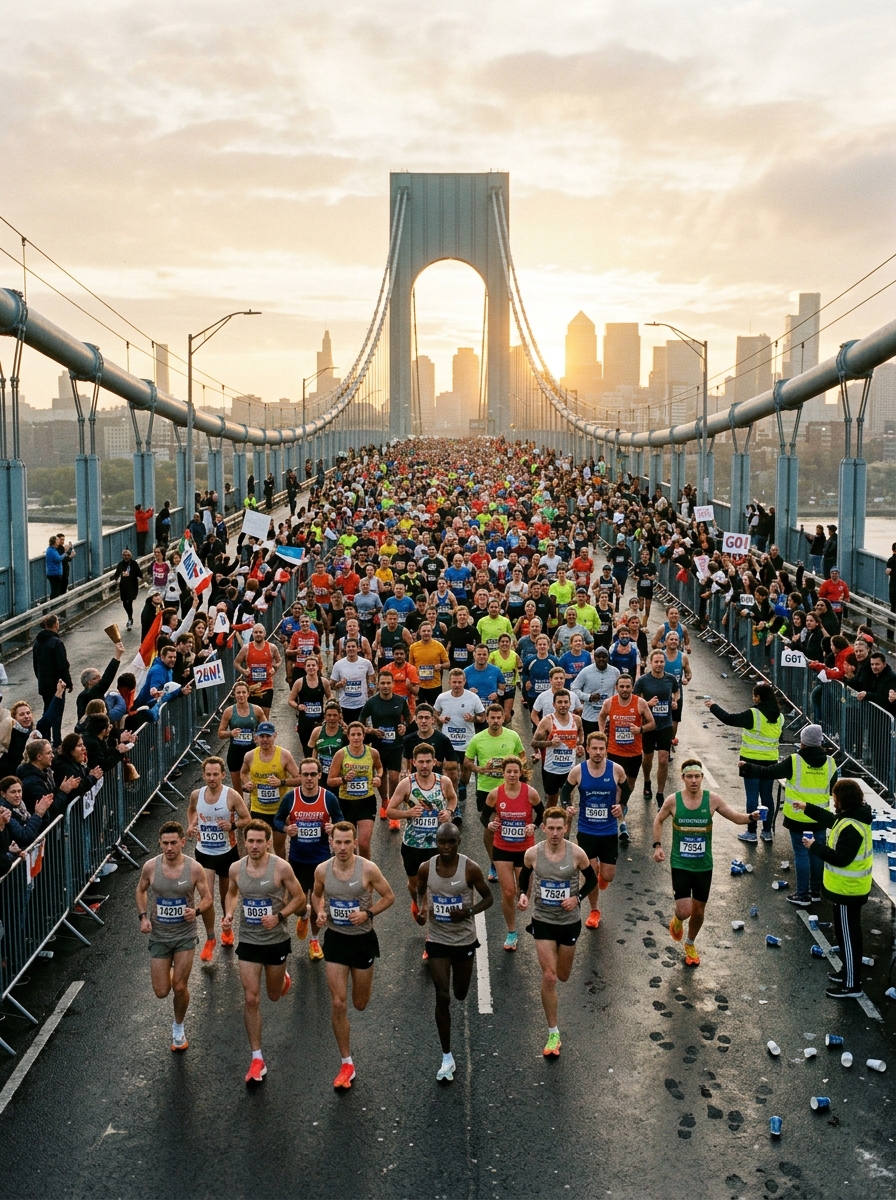
New York City Marathon may be the most theatrical of the great races. It began in 1970 as a small Central Park event and evolved into a five-borough journey that reflects the city itself. The race crosses bridges, languages, neighborhoods and social worlds. It begins with openness and scale, then narrows into individual suffering, then expands again into the crowds of Manhattan and the finish in Central Park.
In New York, the sound is part of the course. Brooklyn’s long avenue of cheering spectators can feel like a second engine. Queens offers transition and concentration. The Queensboro Bridge is famously quiet, forcing runners inward before they descend into the wall of noise on First Avenue. The Bronx gives one last burst of civic pride before the course returns to Manhattan. By the time runners enter Central Park, the race has become less about distance than survival.
Beyond these three, the marathon world has grown into a global circuit. Berlin is known for speed and world records on a flat, fast course. Chicago combines elite racing with Midwest scale and accessibility. Tokyo brings precision, urban energy and deep public enthusiasm. Sydney’s arrival as an Abbott World Marathon Major has extended the series into Oceania, giving the global marathon map a new landmark. The Six Star Medal, and now the expanding Majors journey, has turned marathon running into an international pilgrimage for committed amateurs.
The attraction is not limited to athletes seeking records. In fact, most marathon participants will never appear on a podium. Their victories are private and often more moving. A middle-aged runner may be returning from illness. A daughter may be running in memory of her father. A teacher may be raising money for students. A wheelchair athlete may be proving that public roads belong to everyone. A first-time marathoner may be trying to discover whether discipline can rebuild a life.
This is what separates marathons from many major sports events. In football, tennis or basketball, spectators watch professionals perform. In a marathon, ordinary people share the stage with the best in the world. The elite runners finish long before the masses, but the course remains open for stories that are slower, heavier and no less meaningful. The marathon democratizes greatness by measuring everyone against the same distance.
The physical challenge is severe. A marathon punishes poor pacing, inadequate preparation and impatience. Around mile 20, many runners encounter the famous “wall,” when energy stores fade and the body begins to resist every instruction from the mind. The final miles often become a negotiation between pain and purpose. That is why the finish line produces such raw emotion. People do not simply stop running. They arrive changed.
The community surrounding the race is equally important. Training groups meet before sunrise in city parks. Online communities compare shoes, nutrition and long-run routes. Local clubs help beginners learn that running is not only about speed. Charity teams transform solitary training into shared mission. Volunteers make the race possible, from medical tents to baggage trucks to water stations. Spectators become temporary coaches, shouting the names printed on bibs as if they know the runner personally.
The rise of recreational running also reflects broader changes in public life. In a digital age marked by isolation, marathon training offers structure, embodiment and community. It requires people to leave screens, enter streets and measure progress in weeks and months. It is difficult to fake. The body records the work. For many runners, that honesty is part of the appeal.
Major marathons also shape cities. They close roads but open public imagination. For one day, cars give way to bodies in motion. Neighborhoods become stages. Landmarks become emotional checkpoints. Local businesses benefit from visitors, but the deeper impact is symbolic. A marathon shows a city to itself: diverse, loud, generous, impatient, proud and capable of collective care.
There are challenges. Entry demand has outpaced available places in many major races. Costs for travel, lodging, shoes and registration can make participation difficult. Climate change threatens race conditions, with heat becoming a greater concern for organizers and runners. The growth of the sport also raises questions about sustainability, accessibility and how to preserve community spirit as marathons become global brands.
Yet the essence remains durable. The marathon’s appeal does not depend on perfection. It depends on effort made visible. When a runner slows to a walk and then begins again, the crowd understands. When strangers cheer someone through cramps, tears or exhaustion, the race becomes more than competition. It becomes a public agreement that persistence matters.
Boston, London and New York endure because they offer different versions of the same promise. Boston says history can be joined. London says running can serve others. New York says every borough, every background and every voice can be part of one moving city. Together with the other major marathons, they have turned 42.195 kilometers into a global language.
At the finish line, medals are placed around tired necks, but the real reward is often harder to photograph. It is the knowledge that the runner continued when stopping seemed easier. It is the face of a family member behind the barrier. It is the memory of a name carried on a shirt. It is the realization that a crowd of strangers can help a person cross a line they once thought impossible.
That is why the world keeps running. The marathon is ancient in inspiration, modern in scale and deeply human in meaning. It asks for discipline, but gives back belonging. It hurts, but it heals. In the great races of Boston, London, New York and beyond, the road becomes a shared story, and every finisher adds one more proof that endurance is not only a measure of speed, but of spirit.
