
The championship game has become a rare cultural stage where sport, advertising, music, technology and national identity meet before an audience that now reaches far beyond the United States.
NEW YORK — The Super Bowl is officially a football game. For four quarters, two teams compete for the National Football League championship, coaches make high-pressure decisions, quarterbacks are judged against history and players spend a lifetime’s preparation on a few decisive snaps.
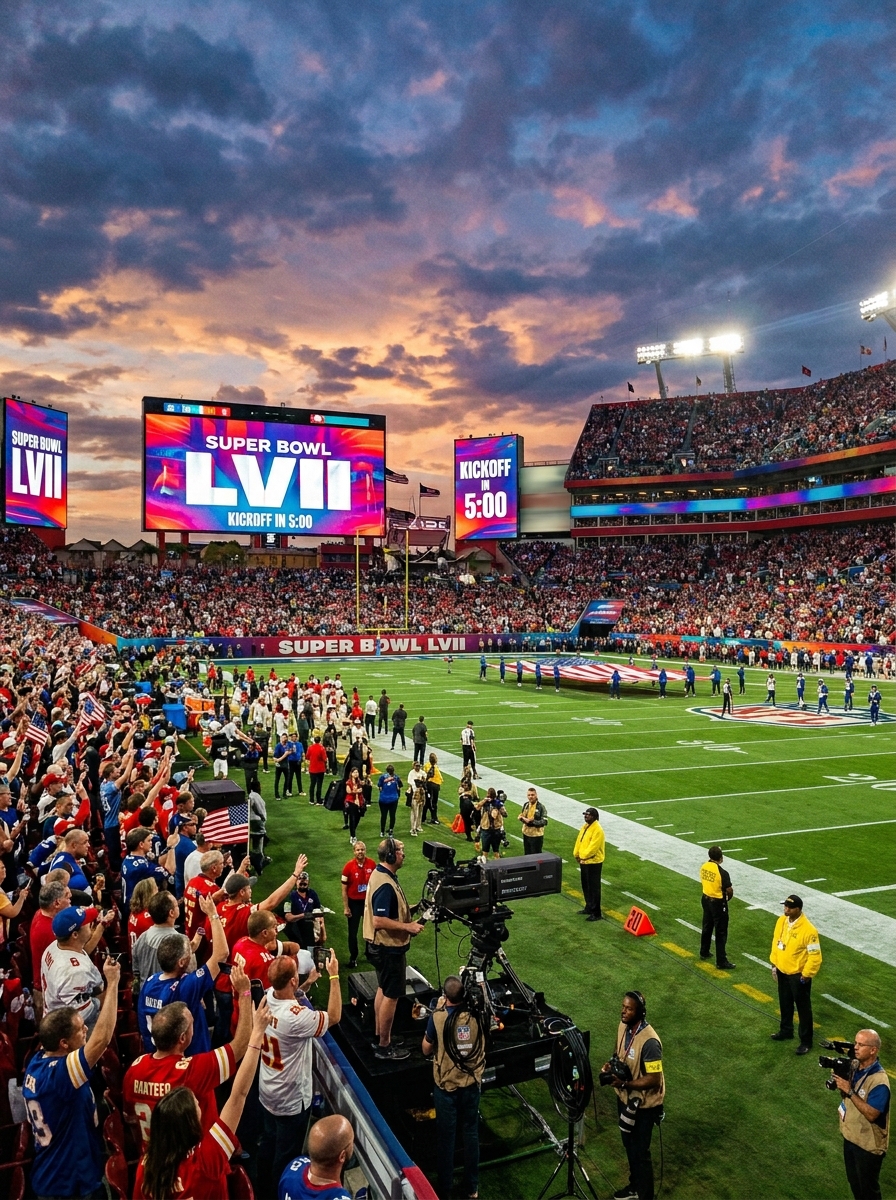
But the modern Super Bowl is no longer only a contest. It is America’s largest annual entertainment platform, a television ritual, an advertising marketplace, a music showcase, a food holiday, a political mirror and an increasingly global cultural event. Even people who do not follow the NFL often know who is performing at halftime, which brands bought the biggest commercials and which celebrities appeared in the luxury suites.
Super Bowl LX, played on Feb. 8, 2026, at Levi’s Stadium in Santa Clara, California, showed again why the event remains so powerful. The Seattle Seahawks defeated the New England Patriots 29-13 in a game that was not remembered as one of the sport’s great thrillers. Yet the broadcast still drew one of the largest television audiences in U.S. history. That contrast explains the Super Bowl’s unusual strength: the event can be commercially and culturally massive even when the game itself is not dramatic.
The football still matters. Without the championship stakes, the rest of the spectacle would lose its foundation. A Super Bowl is built on months of injuries, tactical adjustments, roster decisions and playoff pressure. For fans of the winning team, the night becomes permanent family memory. For the losing team, it can define an era. A single interception, fourth-down call or missed assignment may follow a player or coach for years.
Yet the Super Bowl’s broader appeal comes from how it reduces a complex sport into a shared national moment. Casual viewers do not need to understand every coverage rotation or blocking scheme. They understand pressure, momentum, comeback hopes, celebrity reactions and the image of a champion lifting the Lombardi Trophy. The NFL has learned to package that emotional clarity better than almost any sports league in the world.
Advertising is the clearest example. In most television programming, commercials are interruptions. During the Super Bowl, they are part of the show. Viewers rank them, replay them, debate them and sometimes remember them longer than the score. Brands spend extraordinary sums not merely to sell a product, but to enter a national conversation at the one moment when fragmented audiences briefly gather in the same place.
That is why Super Bowl advertising remains so expensive even as traditional television faces pressure from streaming, social media and on-demand viewing. Live sports is one of the few media products that still creates urgency. A viewer can watch a drama series later. A viewer can skip a digital ad. But the Super Bowl is built around immediacy. To be absent from that moment, for some major brands, is to miss the year’s loudest marketplace.
The ads have also changed with the culture. Earlier Super Bowl commercials often relied on broad comedy, talking animals, slapstick or simple slogans. Modern Super Bowl ads increasingly mix celebrity casting, cinematic production, nostalgia, social causes, product launches and online extensions. A 30-second spot is no longer only 30 seconds. It may begin with a teaser a week earlier, appear in full online before kickoff, generate reaction videos during the game and continue as a campaign after the trophy ceremony.
That structure reflects a deeper shift in attention. The Super Bowl is watched on television, but it is experienced across many screens at once. Fans text during plays, post during commercials, search halftime songs, follow memes and watch clips that reach millions who may not be watching the full broadcast. The event is no longer contained inside the telecast. It moves instantly into social media, streaming platforms and global news feeds.
The halftime show is the center of that transformation. Once a midgame diversion, it is now one of the most scrutinized music performances in the world. The stage must be assembled and removed in minutes. The artist must reach stadium spectators, television viewers, streaming audiences, critics, fans and political commentators at once. The performance has become a compressed statement of pop culture power.
Bad Bunny’s 2026 halftime show demonstrated how global the platform has become. As a Puerto Rican superstar performing largely in Spanish before a U.S. football audience, he represented more than entertainment booking. His appearance reflected the changing demographics of American popular culture and the NFL’s desire to reach younger, bilingual and international audiences. The halftime stage has become a place where the country sees not only who is famous, but which cultures are commanding attention.
That role can make the halftime show controversial. Some viewers want escapism. Others look for representation, identity and commentary. The NFL wants global reach without losing its traditional fan base. Artists want spectacle without surrendering their voice. The result is a performance slot that carries unusual pressure: it must entertain, unify, trend online and survive political interpretation.
The Super Bowl’s cultural scale also depends on ritual. Families plan meals around it. Friends who do not watch football attend parties anyway. Restaurants, grocery stores, betting platforms, apparel companies and local bars build promotions around the day. The game has become a civic calendar event without being a public holiday. It offers the United States something rare in a divided media age: a shared appointment.
That shared appointment is increasingly international. The NFL has spent years expanding abroad through regular-season games in London, Germany, Mexico, Brazil, Ireland and Spain, as well as team marketing rights in international markets and youth flag football programs. The Super Bowl benefits from that work. It is the league’s most accessible export because it combines sport with music, celebrity and advertising — elements that travel more easily than the rules of American football.
Still, the Super Bowl’s global future is not guaranteed. American football remains complicated for new audiences. Time zones make live viewing difficult in Europe and Asia. The game’s stop-start rhythm can feel unfamiliar to fans raised on soccer, basketball or cricket. Player safety concerns, including brain injuries, remain part of the sport’s public debate. The event’s commercial excess can also appear uniquely American, impressive to some and excessive to others.
But that excess is also part of the appeal. The Super Bowl does not pretend to be modest. It is big by design: big screens, big stars, big prices, big hits, big anthems, big emotions. Its cultural force comes from the fact that it gathers many American industries into one night. Sports, television, music, advertising, food, fashion, gambling, technology and celebrity all converge on the same broadcast.
That convergence explains why the Super Bowl continues to grow even in an era of audience fragmentation. It is not merely protected from fragmentation; it profits from it. Because people watch for different reasons, the event can attract many publics at once. Football purists watch the line of scrimmage. Music fans wait for halftime. Marketers study the commercials. Casual viewers follow celebrity appearances. International audiences sample a piece of American spectacle.
The Super Bowl’s greatest achievement may be that it has turned a championship game into a cultural operating system. It gives brands a deadline, musicians a global stage, broadcasters a ratings summit, cities an economic showcase and fans a communal story. Some years, the game is unforgettable. Other years, the ads or halftime show dominate memory. But the event itself remains powerful because it is larger than any one component.
At its best, the Super Bowl is a celebration of competition and creativity. At its worst, it can feel overproduced, overcommercialized and too willing to turn every emotion into inventory. Both truths are part of its identity.
The final whistle decides a champion. The rest of the night explains why the Super Bowl has become something more than a game. It is America performing for itself and, increasingly, for the world.”””
