
From Olympic disciplines to traditional regional sports, the Asian Games have become a powerful arena for athletic excellence, cultural identity and friendship among nations across the world’s most populous continent.
The Asian Games are more than a medal table. They are a mirror of a continent in motion: fast-growing, diverse, ambitious and increasingly influential in global sport. Every four years, athletes from across Asia gather not only to compete for gold, silver and bronze, but to measure the progress of national sports systems, celebrate regional traditions and build connections across borders that are often divided by language, politics and history.
First held in New Delhi in 1951, the Asian Games emerged in the aftermath of war with a clear ideal: to rebuild bonds among Asian nations through sport. Over the decades, that ideal has expanded into one of the world’s largest multi-sport events. Today, the Games bring together 45 countries and regions under the Olympic Council of Asia, making them the most important continental sporting event in Asia and a major step on the road to the Olympic Games for many athletes.
Their scale reflects Asia itself. The continent includes global economic powers, small island nations, rapidly developing sports programs and countries where athletic success carries deep national meaning. At the Asian Games, a sprinter from the Gulf, a swimmer from China, a badminton player from Indonesia, a wrestler from Iran, a gymnast from Japan, a weightlifter from Uzbekistan and a kabaddi player from India may all share the same village, the same pressure and the same dream of standing on a podium.
That diversity is what makes the event distinctive. Unlike the Olympics, which are built almost entirely around global sports, the Asian Games also preserve and promote regional disciplines. Kabaddi, sepak takraw, wushu, kurash and other traditional or Asia-rooted sports give the program a cultural identity that cannot be replicated elsewhere. These events remind viewers that sport is not only about universal rules and records. It is also about heritage, community and the way physical skill is shaped by local history.
Kabaddi, with its breath control, speed, wrestling strength and tactical raids, carries deep roots in South Asia. Sepak takraw, spectacular and acrobatic, turns a rattan ball into a test of flexibility, timing and aerial courage across Southeast Asia. Wushu transforms martial tradition into competitive performance, balancing power, precision and artistry. Kurash, with origins in Central Asia, brings a historic form of jacket wrestling into a modern arena. At the Asian Games, such sports stand beside athletics, swimming, gymnastics, football and basketball, creating a program that is both international and unmistakably Asian.
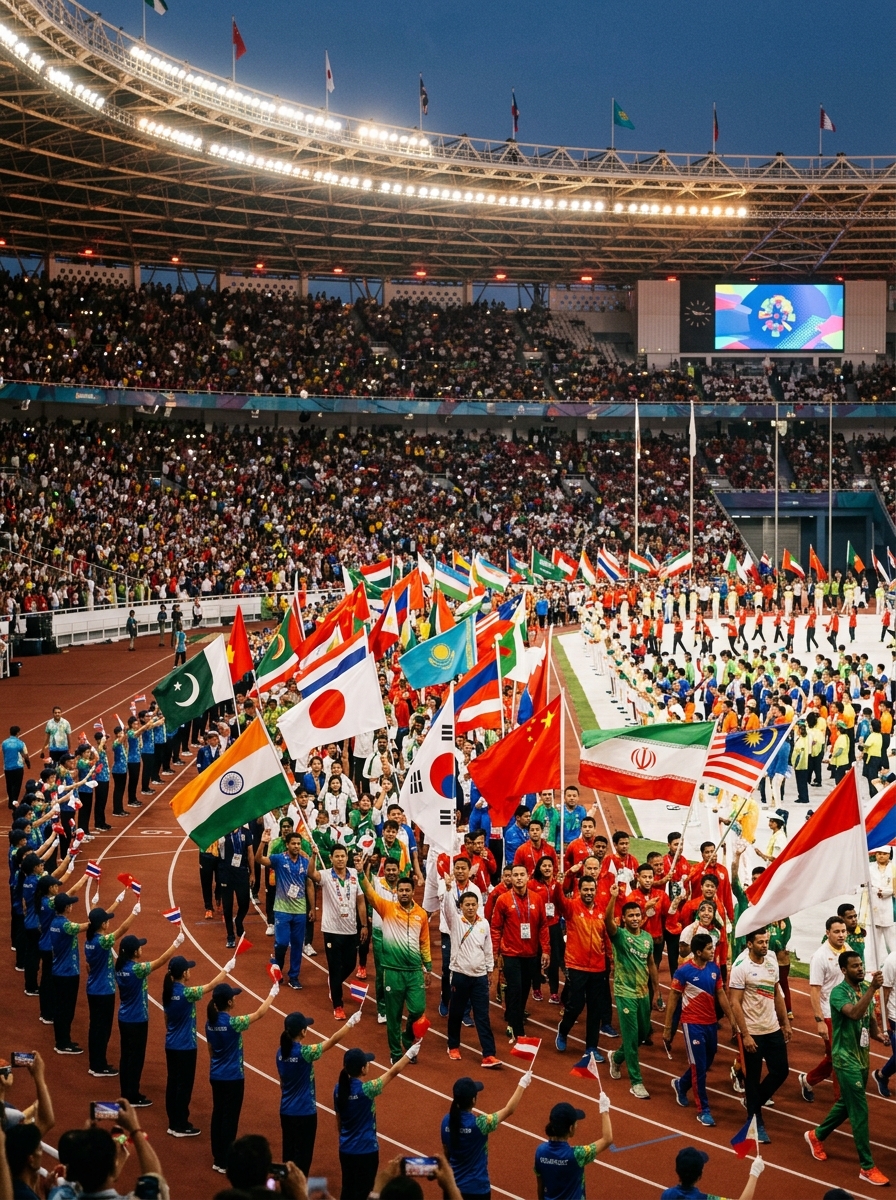
The growth of Asian sport can be seen most clearly in performance. China has long been dominant across many Olympic disciplines, particularly diving, table tennis, weightlifting, badminton and swimming. Japan and South Korea remain major forces in judo, gymnastics, baseball, archery, fencing and team sports. India’s rapid rise in athletics, shooting, archery, cricket and kabaddi has added new energy to the competition. Central Asian nations have become increasingly strong in boxing, wrestling, judo and weightlifting. Southeast Asian countries continue to excel in badminton, martial arts, sepak takraw and emerging urban sports.
Hangzhou 2022, held in 2023 after a pandemic postponement, showed how broad the Asian Games have become. The event featured 40 sports, 61 disciplines and hundreds of medal events, while also placing new attention on esports and youth-focused competitions. China finished on top of the medal table with 201 gold medals, while Japan and South Korea remained major contenders. India crossed 100 medals for the first time in its Asian Games history, a landmark that reflected years of investment, professional coaching and broader national ambition.
But the Asian Games are not only a story of the largest delegations. For smaller countries, a single medal can become a defining national moment. A bronze in wushu, a silver in sailing or a surprise victory in martial arts may inspire investment, change public attitudes and give young athletes a reason to believe that international success is possible. The Games offer a platform where sporting identity is not reserved for superpowers. Every delegation arrives with its own measure of success.
The emotional power of the event often comes from contrast. In one venue, a world champion may confirm dominance with clinical precision. In another, an unknown athlete may produce the performance of a lifetime. A favorite may collapse under pressure, while a teenager announces herself to the continent. Some victories are expected and celebrated as confirmation. Others feel like the beginning of a new sporting era.
Behind every medal is a larger story of preparation. Asian sport has professionalized rapidly in recent decades. National training centers, sports science, nutrition, biomechanics, psychology and data analysis now shape performances in ways unimaginable when the Games began. Coaches study marginal gains. Federations identify talent earlier. Athletes travel more widely for competition and training. The Asian Games have become a measure of how well countries can connect grassroots development to elite success.
Technology has also changed the Games. Timing systems, video review, performance tracking and digital broadcasting have made competitions more transparent and more accessible. Esports, once viewed as entertainment outside the traditional sporting world, has entered the medal program, reflecting the interests of younger audiences and Asia’s central role in global gaming culture. This evolution has raised debate, but it also demonstrates the Games’ willingness to adapt to changing definitions of competition.
Still, the most enduring value of the Asian Games may be human exchange. Athletes who may know each other only as rivals often share meals, training spaces and conversations in the athletes’ village. Volunteers welcome visitors in multiple languages. Fans encounter sports they may never have watched before. Nations compete fiercely, but the structure of the Games requires them to gather under shared rules. In a region marked by political tensions and historical disputes, that act of gathering still matters.
The ceremonial language of the Games often speaks of unity, friendship and peace. Such words can sound formal, but they are not empty when seen through the daily life of the event. A handshake after a bruising judo bout, a bow between martial artists, a shared photograph between medalists, or applause for an opponent after a record can express something larger than competition. Sport cannot solve geopolitics, but it can create moments in which respect becomes visible.
The Games also influence host cities. From Bangkok and Seoul to Hiroshima, Doha, Guangzhou, Jakarta-Palembang and Hangzhou, Asian Games hosts have used the event to upgrade venues, transport, urban branding and international visibility. The challenge is to ensure that the legacy lasts beyond the closing ceremony. Successful hosting is not measured only by spectacular ceremonies or medal counts, but by whether facilities remain useful, local communities benefit and sport participation grows.
Aichi-Nagoya 2026 will continue that test. Scheduled for September 19 to October 4, 2026, the 20th Asian Games in Japan are expected to feature 41 sports, including Olympic disciplines and regional sports from across the OCA zones. The program reflects the Games’ dual identity: a pathway toward global competition and a celebration of Asian sporting culture.
For athletes, the Asian Games can be a destination, a stepping stone or a turning point. A gold medal can secure national fame. A strong performance can lead to Olympic qualification, sponsorship or professional opportunity. A defeat can expose the gap between promise and world-class readiness. For many, the Asian Games are the hardest competition outside the Olympics because the field is filled with continental giants and rising challengers.
That is why the event carries such intensity. It is familiar enough to feel regional, yet large enough to feel global. It honors ancient traditions while welcoming new sports. It rewards established powers but leaves space for surprise. It is a meeting place where Asia competes with itself and reveals itself to the world.
In the end, the Asian Games endure because they give form to a simple idea: a continent’s strength can be expressed not only through economics or politics, but through athletes who run, lift, dive, fight, shoot, jump, paddle, serve, raid and perform under pressure. Each medal tells one story. Together, they tell a larger one about Asia’s sporting rise and its continuing search for excellence, identity and connection.
