
As the 2026 edition prepares to open in Taipei, the technology industry is watching a race that now stretches from processors and laptops to AI servers, cooling systems, robots and smart devices.
TAIPEI — The future of computing does not arrive as a single product. It appears as a motherboard under glass, a laptop running an AI model without the cloud, a server rack cooled by liquid pipes, a robot moving across an exhibition floor, and a chip executive explaining why the next decade of technology will depend on power, memory and heat as much as software.
That is the world COMPUTEX Taipei is preparing to showcase from June 2 to 5, 2026. Once known primarily as a meeting point for personal computers and components, COMPUTEX has become one of the most important stages for the hardware foundations of artificial intelligence. Its 2026 theme, “AI Together,” captures a shift already visible across the industry: AI is no longer only a cloud service or a research breakthrough. It is becoming an architecture problem, a supply-chain problem and a consumer-product problem.
The event’s location gives it unusual weight. Taiwan sits at the center of the global semiconductor and electronics manufacturing ecosystem. Its companies help design, fabricate, assemble and supply many of the components that power laptops, servers, graphics cards, storage devices, networking systems and consumer electronics. When COMPUTEX opens in Taipei, it is not simply hosting a technology show. It is gathering many of the companies that make the physical world of computing possible.
The race begins with chips. Artificial intelligence has made processors the most strategically important hardware category in technology. CPUs, GPUs, NPUs, accelerators and custom silicon are now judged not only by speed, but by how efficiently they handle AI workloads. The old consumer question — how fast is this computer? — has expanded into a more complex one: how much intelligence can it run locally, how much power does it consume, and how much data must be sent elsewhere?
That question is especially urgent for AI PCs. The term has moved quickly from marketing slogan to product category. An AI PC is expected to run certain artificial intelligence tasks directly on the device, using specialized neural processing units alongside traditional processors and graphics chips. The goal is faster response, better privacy, lower cloud dependence and new features in productivity, creativity, translation, search, gaming and communication.
At COMPUTEX 2026, AI PCs are likely to be everywhere: ultrathin laptops, gaming notebooks, workstation machines, mini PCs and business systems. The competition will not only be between brands, but between ecosystems. Chipmakers will try to prove that their processors can deliver useful AI performance without destroying battery life. Laptop makers will try to show that AI features are more than background demos. Software companies will be under pressure to prove that local AI changes daily work in ways consumers can feel.
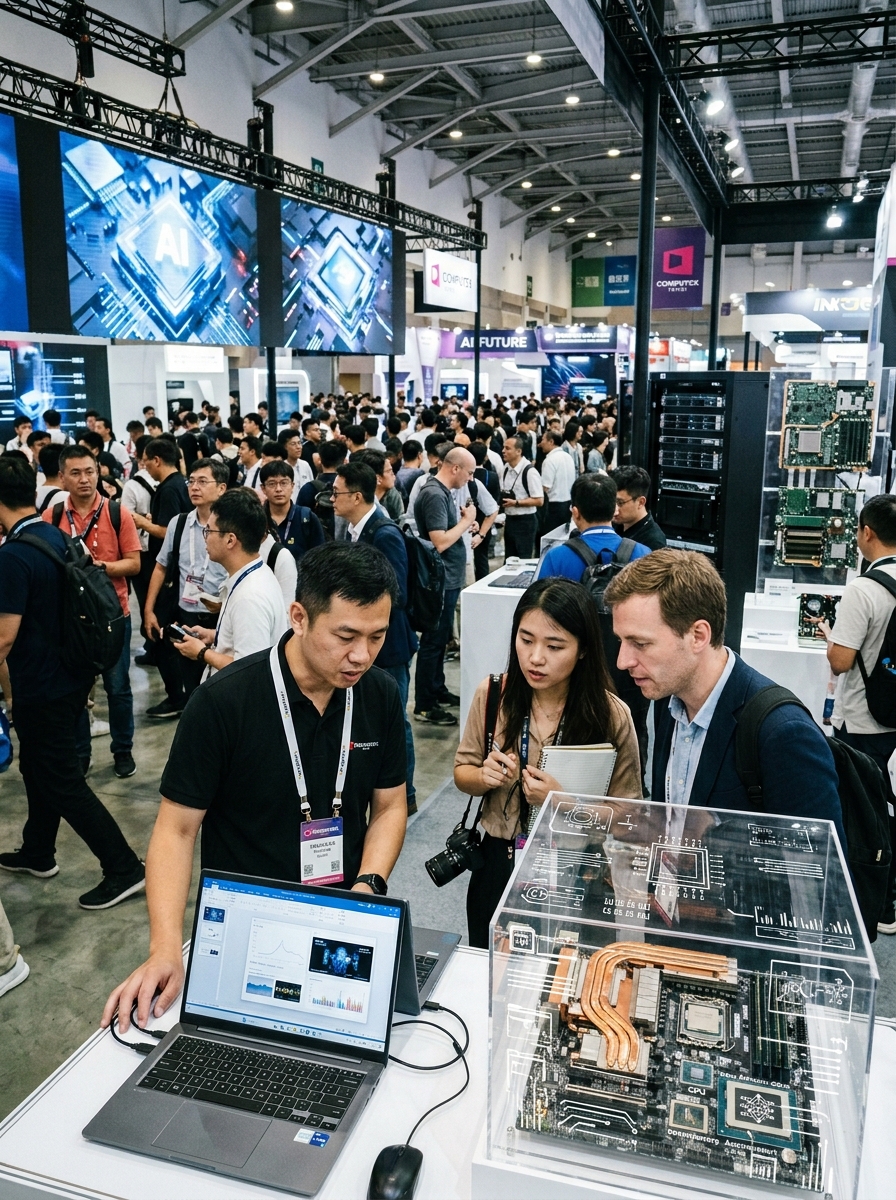
This is the challenge facing the entire AI hardware market. The industry has already persuaded businesses that AI matters. It must now persuade users that AI on a personal computer is not just another feature buried in a settings menu. A laptop that can summarize documents, enhance video calls, search local files, generate images, translate speech and protect private information may sound powerful. But it must do these tasks reliably, securely and without becoming expensive novelty.
Behind the laptop race is an even larger contest in servers and data centers. AI models require enormous computing capacity, and that demand is reshaping the server market. COMPUTEX has increasingly become a place where visitors see not only consumer devices, but rack-scale systems built for AI training and inference. These machines depend on advanced GPUs and accelerators, high-bandwidth memory, fast networking, dense power delivery and increasingly sophisticated cooling.
The server rack has become one of the defining objects of the AI age. It is not glamorous in the way a phone or laptop can be, but it is essential. Every chatbot response, image-generation request, enterprise AI workflow and autonomous system depends on data-center infrastructure. At COMPUTEX, the rack is no longer hidden backstage. It has become the main stage.
That has created a new spotlight for components once known mainly to engineers. Power supplies, connectors, server chassis, memory modules, SSDs, networking cards, motherboards and thermal materials are now part of the AI conversation. A bottleneck in any one of them can slow deployment. A more efficient design can reduce operating cost. A better cooling system can decide how densely a company can deploy AI hardware.
Cooling may become one of the most important stories of COMPUTEX 2026. AI servers generate extraordinary heat. Traditional air cooling remains important, but liquid cooling, cold plates, immersion systems, heat exchangers and advanced airflow design are moving from niche engineering topics into mainstream business strategy. The energy cost of AI is forcing companies to think about performance per watt, not just performance alone.
For Taiwan’s hardware suppliers, that shift is an opportunity. The AI boom does not only reward the companies whose logos appear on chips. It also rewards the firms that build the boards, enclosures, power systems, thermal designs and manufacturing processes that make those chips usable at scale. COMPUTEX offers these suppliers a global audience at precisely the moment when the world is looking for faster and more efficient AI infrastructure.
Robotics is another pillar of the 2026 exhibition. AI has made robots feel newly plausible, but robotics remains a hardware problem as much as a software one. A robot needs sensors, motors, batteries, processors, cameras, connectivity, safety systems and durable industrial design. It must move through physical space, not just answer a prompt. That makes COMPUTEX a natural place for the industry to demonstrate progress.
The robots on display may range from industrial arms and warehouse machines to service robots, drones, smart mobility devices and experimental humanoids. Some will be ready for factories or logistics centers. Others will be designed for hospitals, hotels, retail stores or homes. The most important question will be practical: can these machines solve labor shortages, improve safety, assist aging populations or automate repetitive work without creating new risks?
Smart devices will extend the same logic into daily life. AI-enabled cameras, home hubs, appliances, wearable devices, health monitors, gaming gear and edge-computing products will compete for attention. The direction is clear: more intelligence is moving from distant cloud servers into local devices. That shift could improve response times and privacy, but it also increases the need for secure hardware, reliable updates and clear data protection rules.
Security will be an unavoidable theme. AI PCs, smart appliances, robots and connected industrial systems all increase the number of devices collecting and processing sensitive information. A computer that understands a user’s files, a robot that maps a home, or a camera that identifies people creates value only if users trust it. Hardware companies must now build security into firmware, chips, identity systems and update pipelines, not add it after launch.
The future hardware race is also geopolitical. Chips and advanced computing have become central to national competitiveness, supply-chain resilience and economic security. COMPUTEX takes place against a background of export controls, manufacturing investment, cloud infrastructure expansion and concern over dependence on concentrated supply chains. Taipei’s role in this ecosystem gives the show commercial energy but also strategic significance.
For buyers, COMPUTEX is a marketplace. For engineers, it is a technical map. For investors, it is a signal of where money may flow next. For governments, it is a reminder that the AI economy depends on physical capacity: fabs, substrates, servers, cooling systems, energy infrastructure and skilled labor. Software may define the user experience, but hardware defines the limits.
The event also reveals a quieter truth about innovation. The future rarely depends on one spectacular invention. It depends on thousands of improvements: a more efficient fan curve, a stronger hinge, a better chip package, a faster interconnect, a cooler rack, a lighter laptop, a safer battery, a cheaper sensor, a smarter motherboard layout. COMPUTEX is where those details become visible.
The 2026 edition will likely be judged by how clearly it answers the industry’s biggest question: what comes after the first wave of AI hype? The answer may not be a single breakthrough. It may be the normalization of AI across every layer of computing, from personal devices to factory robots and from gaming laptops to liquid-cooled server halls.
That makes COMPUTEX Taipei more than a trade show. It is a measurement of where the technology industry believes the next platform shift will be built. In Taipei, the future of AI will not appear only as software on a screen. It will appear as silicon, circuits, machines, heat pipes, laptops, racks and robots — the physical architecture of a digital era still being assembled.
