
As Apple prepares its June developer conference, the company’s biggest challenge is not only adding AI, but making it feel private, useful and natural across everyday devices.
CUPERTINO, California — Apple’s next major product story may not begin with a new iPhone, a thinner iPad or a faster Mac. It may begin with software — the invisible layer that decides how hundreds of millions of people message, work, search, create and trust their devices every day.
Apple has announced that its Worldwide Developers Conference, WWDC 2026, will take place online from June 8 to 12, with a special in-person event at Apple Park on the opening day. The conference will showcase the company’s latest software, developer tools and artificial intelligence advancements, setting expectations for the next generation of iPhone, iPad, Mac, Apple Watch, Apple Vision Pro and other Apple platforms.
WWDC has always been more than a developer gathering. It is Apple’s annual statement of direction. Hardware may define the shape of the device, but software defines the daily relationship between user and machine. In 2026, that relationship is being rewritten by artificial intelligence.
For Apple, the stakes are high. The company entered the consumer AI race later and more cautiously than some rivals, emphasizing privacy, device integration and personal context instead of building a standalone chatbot as the center of the experience. That strategy reflects Apple’s traditional strength: it controls the hardware, operating system, core apps, chips and developer ecosystem. But it also creates pressure. Users now expect AI to be fast, conversational, context-aware and genuinely helpful. Apple must prove that privacy-first AI can also be competitive AI.
The next iOS, iPadOS and macOS updates are expected to be judged by that standard. Consumers will not measure success only by the number of new features shown in a keynote. They will measure it by whether their phone can summarize a long message thread accurately, whether their Mac can help organize work without exposing sensitive documents, whether their iPad can become a better creative and learning tool, and whether Siri can finally behave less like a command line and more like an assistant that understands context.
That is the promise Apple has attached to Apple Intelligence. First introduced as a personal intelligence system for iPhone, iPad and Mac, it combines generative models with user context to help write, summarize, create images, take actions across apps and make sense of information already on the device. Apple’s argument is that AI becomes more useful when it understands the personal details stored across a user’s calendar, messages, photos, notes and apps — but only if that understanding does not become a privacy risk.
The company’s technical answer is a mix of on-device processing and Private Cloud Compute. Many Apple Intelligence tasks are designed to run directly on Apple silicon, keeping data on the user’s device. More complex requests can be routed to Apple silicon servers under a system Apple says does not store user data and can be inspected by independent security researchers. It is a bet that the future of consumer AI will be decided not only by model size, but by trust architecture.
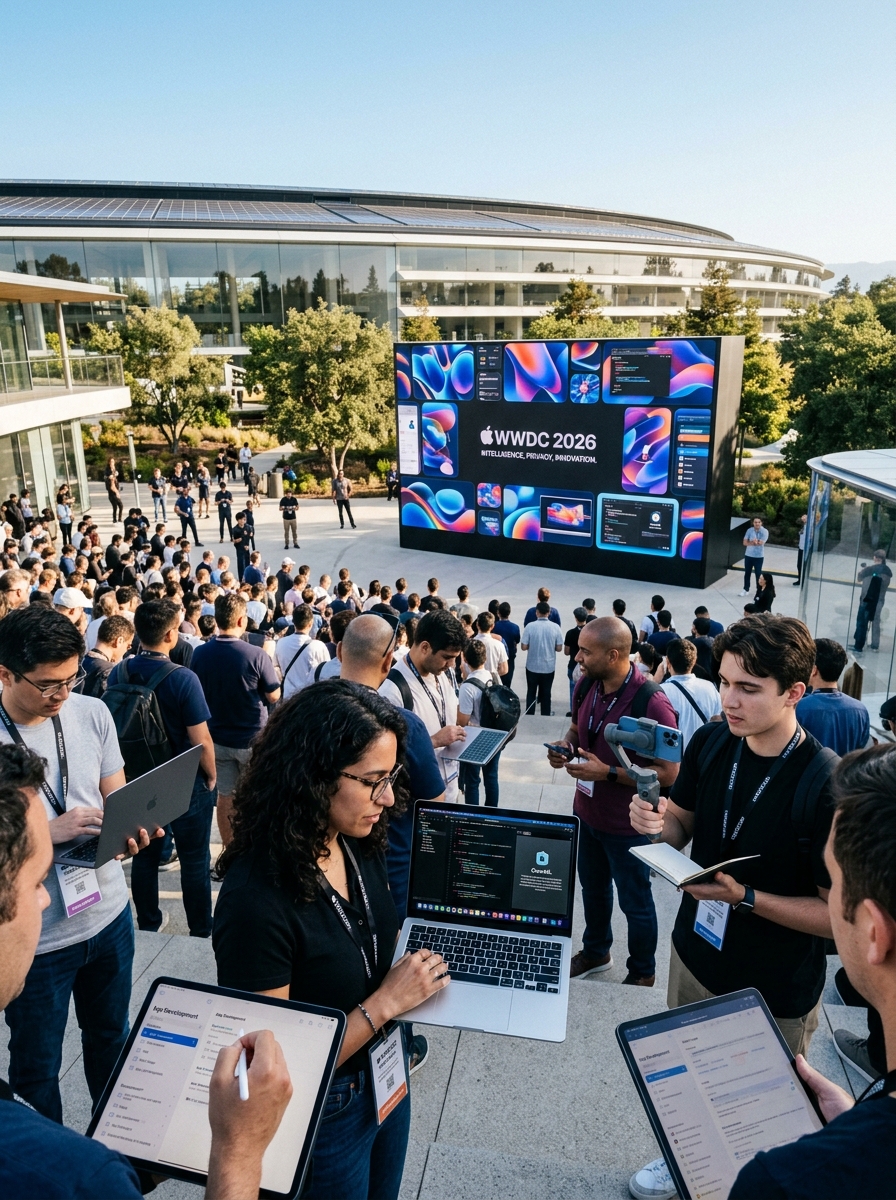
That bet is central to WWDC 2026. Apple is likely to frame AI not as a separate destination, but as a layer across the experience: inside messages, calls, notes, photos, calendars, reminders, shortcuts, search, accessibility and developer apps. The most important AI feature may not be the most spectacular demo. It may be the one that reduces friction so quietly that users stop thinking about it as AI at all.
On the iPhone, the challenge is intimacy. A smartphone contains the modern private life: conversations, payments, health data, family photos, work documents and location history. Any AI system that operates deeply inside the phone must overcome a basic fear that convenience could become surveillance. Apple’s privacy message gives it an advantage with users who are wary of cloud-based AI services. But the company must also avoid overpromising. Generative AI can still make mistakes, misunderstand context and produce confident but inaccurate results.
On the iPad, Apple faces a different question: identity. The iPad has long sat between the iPhone and the Mac, powerful enough for professional work but still defined by touch, portability and simplicity. AI could sharpen that identity. A student could turn class notes into study questions. An artist could search references more naturally. A small business owner could summarize documents, draft replies and manage tasks from one screen. But the iPad’s software must make those features feel fluid rather than bolted onto a tablet interface that has sometimes struggled to satisfy advanced users.
On the Mac, the opportunity is productivity. The Mac is where many users write, code, edit, design, analyze and manage complex workflows. AI on macOS could become most valuable when it works across documents, windows and apps without forcing users to copy information into separate tools. Developers will be watching closely to see how much access Apple gives them to on-device models and system frameworks. The more capable those tools become, the more likely third-party apps can deliver AI features without relying entirely on expensive external cloud services.
That developer dimension is why WWDC matters. Apple says WWDC 2026 will include more than 100 video sessions, group labs and appointments where developers can work with Apple engineers and designers. For the public, the keynote is the main event. For developers, the real significance is often in the frameworks, application programming interfaces and rules that determine what apps can do for years.
A stronger AI framework could reshape the App Store. Education apps could generate lessons privately. Health and fitness apps could personalize guidance while limiting data exposure. Travel apps could summarize itineraries offline. Productivity apps could classify notes, extract tasks and prepare drafts without sending everything to outside servers. If Apple makes these tools reliable and accessible, AI could move from a premium novelty into ordinary app design.
User experience will be the decisive test. Apple’s best software historically succeeds when complex technology disappears behind simple gestures, clean language and predictable behavior. AI is difficult because it is inherently probabilistic. It does not always produce the same answer. It can be creative, but also inconsistent. Apple’s design challenge is to make AI feel helpful without making it feel uncontrollable.
That may require restraint. Not every button needs an AI feature. Not every notification needs a summary. Not every photo needs a generated effect. The strongest version of Apple’s AI strategy may be one that appears only when it clearly saves time, reduces confusion or makes a task easier. In consumer technology, intelligence without judgment becomes clutter.
Privacy will remain the company’s strongest message and its hardest promise. Apple has built its brand around the idea that personal technology should protect the individual. AI raises the difficulty of that claim because the most useful systems often need access to personal context. Users may accept that trade only if they understand when data stays on device, when it goes to a private cloud system, when a third-party model is involved and how they can control or audit the process.
WWDC 2026 arrives at a moment when the industry is moving AI from apps into operating systems. That shift makes the technology more powerful and more sensitive. When AI sits inside the OS, it is no longer just answering questions. It can become part of how people navigate memory, work, communication and identity.
For Apple, the coming software generation is a chance to define AI in its own language: personal, integrated, private and designed for everyday use. The risk is that users may compare it with faster-moving rivals and find it too cautious. The opportunity is that caution may become an asset if the public grows more concerned about data, accuracy and dependence on remote AI systems.
The June keynote will likely include polished demos, new interface ideas and developer tools designed to show that the iPhone, iPad and Mac are entering a more intelligent phase. But the real verdict will come later, in daily use: when a message is summarized correctly, when a document is handled privately, when a shortcut saves time, when Siri understands the intent, and when the user feels helped rather than watched.
Apple’s next software era will not be defined by AI alone. It will be defined by whether AI can become part of the Apple experience without breaking the trust that made that experience valuable in the first place.”””
