
From batteries and charging networks to autonomous cars, intelligent maps and software-defined vehicles, the world’s mobility exhibitions are revealing how automakers and technology companies are fighting to define the future of transport.
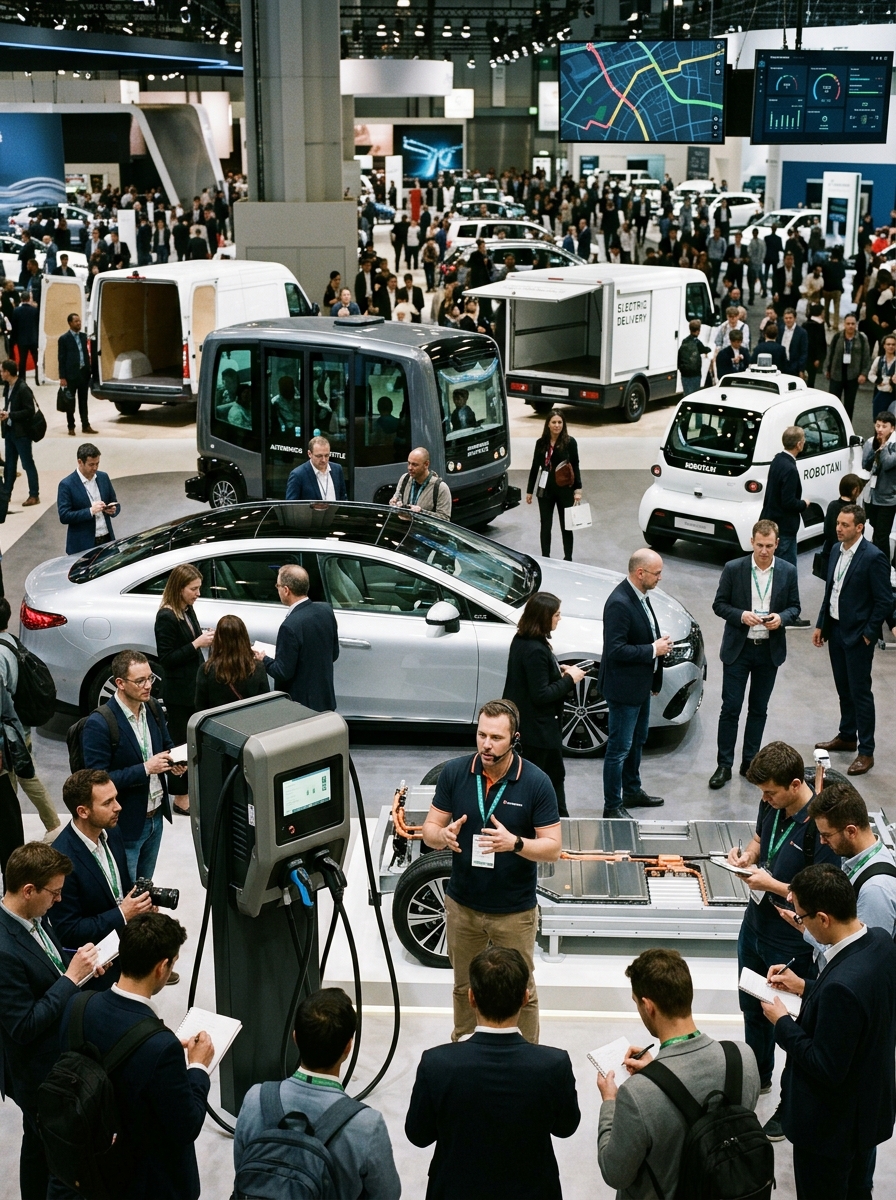
MUNICH — The modern auto show no longer begins with the roar of an engine. It begins with a screen lighting up, a battery pack displayed under glass, a charging cable locked into a prototype, a robotaxi gliding across a test area and a software engineer explaining how the car will improve after it leaves the showroom.
Across the world, exhibitions dedicated to electric vehicles and smart mobility have become some of the most important stages in the technology economy. At events such as IAA Mobility in Munich, Auto Shanghai, CES in Las Vegas, Japan Mobility Show in Tokyo and specialized electric vehicle forums, the automobile is being presented not only as a product of mechanical engineering, but as a connected device, energy platform, data machine and increasingly autonomous companion.
The shift reflects a deeper transformation inside the global car industry. Electric vehicles are moving from early adoption toward mass competition. Battery costs, range, charging speed, safety and production scale remain central concerns, but they are no longer the only story. Automakers now compete over software, driver assistance, in-car entertainment, mapping systems, user interfaces, artificial intelligence and the ability to update a vehicle long after purchase.
That is why mobility exhibitions have changed so dramatically. The old auto show was built around design reveals, horsepower, luxury cabins and brand prestige. Those elements still matter, but they now share space with chipmakers, cloud companies, battery suppliers, mapping specialists, charging operators, lidar developers, robotics firms and artificial intelligence startups. The car has become a meeting point for industries that once operated separately.
At IAA Mobility, the change is visible in the way the event spreads beyond traditional exhibition halls into city streets, public spaces and test-drive zones. Munich has become a stage not only for vehicles, but for debates about urban transport, cycling, public mobility, autonomous shuttles and the relationship between cars and cities. The event’s message is that mobility is broader than ownership. It includes how people move, how goods are delivered, how streets are designed and how energy is managed.
Auto Shanghai offers a different but equally powerful view of the future. China has become the most important electric vehicle market in the world, and its auto shows reflect the speed of that transformation. Domestic brands compete fiercely on price, battery technology, cockpit software, driver assistance and digital services. Foreign automakers arrive under pressure to show that they can match the pace of Chinese innovation. At Shanghai, the electric vehicle is not a distant future. It is a crowded, aggressive, highly competitive present.
CES in Las Vegas has pushed the industry in another direction by treating the vehicle as a technology platform. Automakers and suppliers use the show to present software-defined cars, autonomous driving systems, AI assistants, advanced sensors, immersive displays and connected mobility services. The presence of car companies at a consumer technology event shows how much the definition of the automobile has expanded. A vehicle is now expected to behave more like a smartphone, a cloud-connected device and a personal digital space.
This is the rise of the software-defined vehicle. In older cars, hardware determined most of what the vehicle could do. In newer systems, software increasingly controls performance, safety features, comfort, entertainment, battery management and driver assistance. Over-the-air updates can fix problems, add functions or change the driving experience. That creates new possibilities, but also new risks. A car that depends heavily on software must be secure, reliable and supported for years.
The competition over software is becoming one of the industry’s most difficult battles. Traditional automakers have decades of experience building safe, durable machines at scale. Technology companies move faster in data, interfaces, cloud systems and artificial intelligence. Electric vehicle startups often present themselves as software companies that happen to build cars. The result is a contest not only over vehicles, but over operating systems, digital ecosystems and control of customer relationships.
Autonomous driving remains one of the most visible promises at these exhibitions. Demonstration vehicles equipped with cameras, radar, lidar, high-performance processors and mapping systems are now familiar sights. Companies show cars that can change lanes, park themselves, navigate highways or operate as robotaxis within defined areas. The ambition is enormous: fewer crashes, more efficient cities and transport access for people who cannot drive.
Yet the path to autonomy remains complicated. Real roads are unpredictable. Weather, construction zones, cyclists, pedestrians, emergency vehicles and human behavior create edge cases that are difficult to solve. Exhibitions often show the most polished version of the technology, but regulators, insurers and the public must judge whether systems are safe enough for broad deployment. The robotaxi is a powerful symbol of the future, but trust will be earned slowly.
Batteries remain the foundation of the electric vehicle revolution. At mobility shows, battery makers display cells, packs, management systems and new chemistries designed to reduce cost, improve safety and increase range. Fast charging is a major focus because charging time remains one of the most important consumer concerns. Solid-state batteries, sodium-ion technologies, improved lithium iron phosphate cells and advanced thermal management systems are all presented as possible answers to the same problem: how to make electric driving easier, cheaper and more reliable.
Charging infrastructure is the other half of that equation. The most impressive electric car is limited if drivers cannot charge conveniently. Exhibitions increasingly feature high-power chargers, home energy systems, battery-swapping concepts, fleet charging software and vehicle-to-grid technology. The charging station is becoming part of a larger energy network, connecting cars with homes, renewable power, utilities and commercial fleets.
Smart maps are also moving from the background to the center of mobility. Navigation is no longer only about choosing the fastest route. Electric vehicles need routes that consider battery level, charger availability, traffic, elevation, weather and waiting times. Autonomous vehicles need high-quality location data and real-time awareness of road conditions. Fleet operators need maps that optimize delivery, energy use and maintenance. In this new environment, the map becomes an active layer of intelligence.
The cabin of the car is changing just as quickly. New vehicles displayed at major shows often feature panoramic screens, voice assistants, personalized profiles, gaming, streaming, health monitoring and AI-powered recommendations. For some consumers, the cockpit experience may become as important as acceleration or exterior design. That shift creates opportunities for technology companies, but it also raises concerns about distraction, privacy and the commercialization of attention inside the vehicle.
Smart mobility also extends beyond private cars. Electric buses, delivery vans, scooters, e-bikes, drones, autonomous shuttles and urban logistics platforms are now part of the exhibition landscape. Cities are looking for ways to reduce emissions, manage congestion and improve access without simply replacing every gasoline car with an electric one. The future of mobility may include fewer owned vehicles, more shared services and better integration between public and private transport.
The competition among companies is intense because the stakes are enormous. Established automakers must protect their brands while reinventing their technology stacks. Chinese manufacturers are expanding globally with aggressive pricing and rapid product cycles. American technology firms are pushing into software, chips, autonomy and user experience. European companies emphasize safety, engineering and regulatory credibility. Battery suppliers, semiconductor companies and charging networks are becoming strategic players in their own right.
For consumers, the exhibitions offer excitement and confusion in equal measure. The future appears cleaner, smarter and more connected, but it also appears more complex. Buyers must consider range, charging access, battery warranty, software support, data privacy, autonomous features and the long-term reliability of digital systems. The vehicle is no longer only a mechanical purchase. It is a technological commitment.
For governments, these exhibitions are policy laboratories. They reveal how quickly markets are moving and where public infrastructure may lag. Electric vehicles require charging networks, grid planning, battery recycling, safety standards, cybersecurity rules and industrial strategies. Autonomous vehicles require regulation and public trust. Smart mobility requires cooperation between cities, automakers, technology firms and energy providers.
The most important lesson from the world’s mobility exhibitions is that transportation is no longer changing in one direction at a time. Electrification, autonomy, connectivity, software and artificial intelligence are advancing together. Each depends on the others. A better battery changes vehicle design. Better maps improve autonomy. Better software improves charging and safety. Better data creates new services. The car is becoming a platform within a larger mobility system.
That system is still unfinished. Some prototypes will never reach production. Some autonomous promises will be delayed. Some electric vehicle startups will disappear. Some charging networks will struggle. But the direction is clear. The future of transport is being shaped in exhibition halls where automakers stand beside chip designers, battery engineers, software developers and city planners.
The age of the car as a purely mechanical object is ending. In its place is a new contest over energy, intelligence and control. The winners will not be the companies that merely build attractive vehicles. They will be the ones that can combine batteries, software, charging, maps, safety and trust into a mobility experience that ordinary people can depend on.
That is why electric vehicle and smart mobility exhibitions matter. They are not just showcases of what companies hope to sell. They are early maps of how the world may move.
