
From cleaning robots and AI assistants to connected cameras, sensors and energy-saving systems, the next wave of home technology promises convenience — but also raises new questions about privacy, security and trust.
SHANGHAI — The future home no longer appears as a science-fiction fantasy of silver walls and humanoid servants. At technology exhibitions from Las Vegas to Shanghai, it increasingly looks like an ordinary apartment filled with devices that listen, watch, learn and act: a robot vacuum that climbs over thresholds, a camera that distinguishes a stranger from a family member, a thermostat that adjusts before anyone feels cold, and a voice assistant that turns scattered commands into a coordinated household routine.
The smart home has entered a new phase. For years, connected devices were marketed as remote controls with internet access. A phone could switch off a light, unlock a door, check a camera or start an appliance. Useful, but limited. The new ambition is different. Manufacturers now want the home to become an intelligent environment: aware of occupancy, energy use, security risks, air quality, schedules and habits.
That shift was visible at AWE 2026 in Shanghai, where the Appliance & Electronics World Expo displayed what organizers and local media described as the largest number of robots in the show’s history. Exhibitors presented domestic service robots capable of cooking, picking up objects, tidying surfaces, handling laundry and cleaning stairs. Just as important, appliance makers showed televisions, kitchen devices and cleaning systems embedded with AI models designed to understand natural language and coordinate with other devices.
The message was clear: the robot of the home may not arrive as a single humanoid machine. It may arrive as an ecosystem.
For now, the most successful domestic robots are still practical and specialized. Robot vacuums, mops and lawn mowers have solved narrow problems well enough to become mass-market products. According to the International Federation of Robotics, consumer service robots recorded solid growth in 2024, with close to 20 million units sold in the sampled market, and domestic-task robots formed by far the largest consumer category. That says something important about the future: people do not necessarily buy robots because they are amazed by them. They buy them when the machines remove chores.
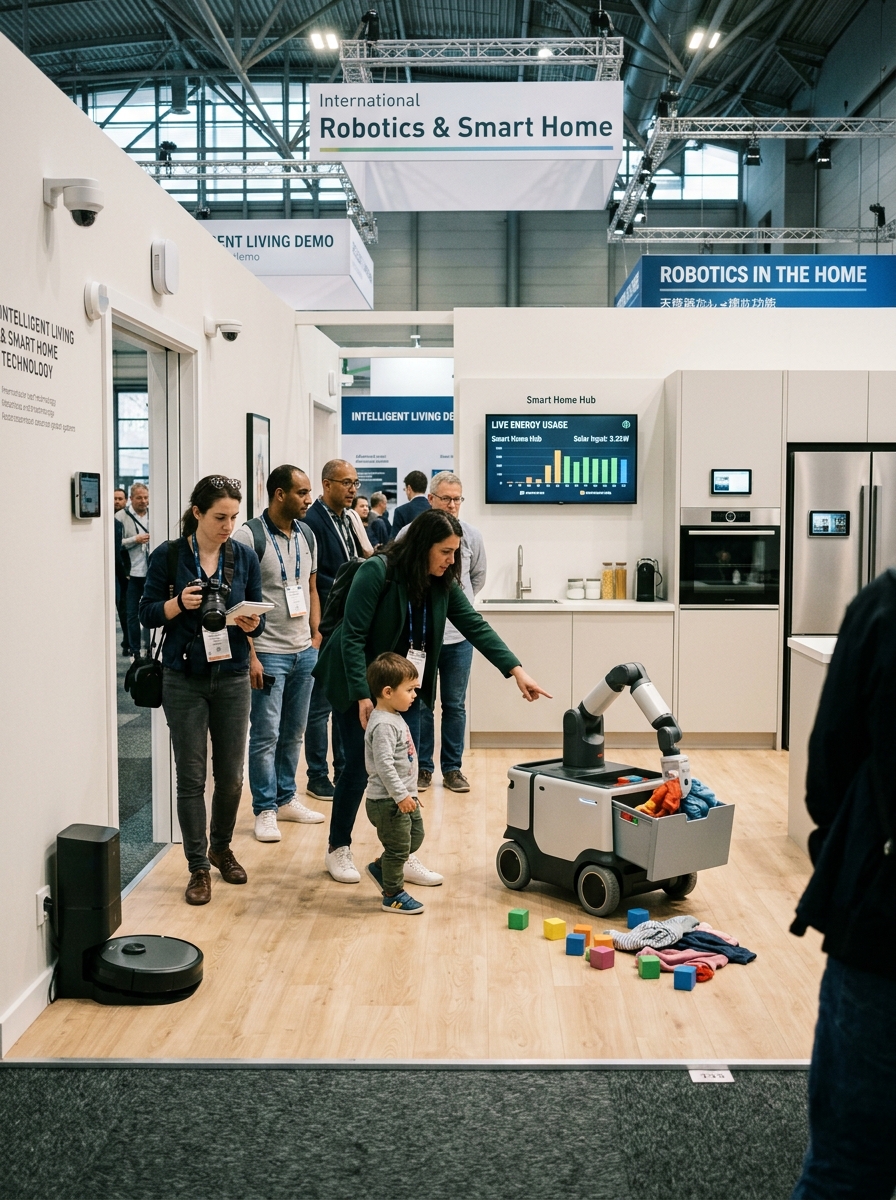
The next challenge is manipulation. Cleaning a floor is easier than folding clothes, loading a dishwasher or picking up toys from a messy living room. A home is unpredictable. Objects vary in shape, weight and fragility. Children leave items in strange places. Pets interrupt paths. Furniture moves. Lighting changes. A kitchen counter can hold a knife, a glass, a banana peel and a phone charger at the same time. For a robot, that is not a simple room. It is a difficult test of perception, movement and judgment.
AI is helping close that gap, but slowly. Computer vision allows devices to identify objects. Large models can interpret commands more naturally. Better chips enable more processing on the device. Sensors help robots map rooms and avoid hazards. Still, a household robot that can reliably perform many general tasks at an affordable price remains more promise than reality. The most credible near-term future is not a robot butler. It is a network of smaller machines, each doing one or two jobs better.
Virtual assistants are becoming the control layer for that network. Voice assistants once struggled with rigid commands and awkward phrasing. The rise of generative AI has raised expectations. Users now want to speak naturally: “Make the house ready for movie night,” “Check whether I left the garage open,” or “Lower energy use while we are away.” A useful assistant must understand context, ask clarifying questions when needed and coordinate lights, locks, speakers, thermostats, cameras and appliances without forcing users into separate apps.
This is where interoperability becomes essential. A smart home fails when every device behaves like an island. Consumers do not want one app for the lights, another for the lock, another for the thermostat and another for the camera. The Matter standard, developed by the Connectivity Standards Alliance, aims to solve that problem by helping compatible devices from different brands work together through a shared, secure connectivity protocol. Its goal is simple but difficult: make the smart home less confusing.
If interoperability is the foundation, sensors are the nervous system. Motion sensors, door sensors, humidity sensors, smoke detectors, leak detectors, light sensors, air-quality monitors and power meters allow the home to respond to conditions rather than commands. A leak sensor under a sink can alert a homeowner before serious water damage. An occupancy sensor can switch off lights in empty rooms. A window sensor can tell the air conditioner not to work against an open window. A power-monitoring plug can reveal which appliance is wasting electricity.
Energy efficiency may be the most practical argument for home automation. A smart home should not only impress guests; it should reduce waste. ENERGY STAR’s Smart Home Energy Management Systems program recognizes packages that combine at least a certified smart thermostat, smart lighting and plug-load controls, with systems designed to suggest energy-saving actions and automatically control devices based on occupancy. Certified smart thermostats are also required to reduce heating and cooling runtime by at least 8 percent in field testing, a reminder that small automated changes can matter when repeated every day.
Security cameras and smart locks are another major driver. For families, cameras can provide reassurance: a package delivered, a child arriving home, a parent living alone, a movement near the door at night. AI can reduce false alerts by distinguishing people, pets, vehicles and wind-blown branches. Doorbells with video and two-way audio have changed how many households think about entrances. The front door is no longer only a physical boundary. It is a monitored digital checkpoint.
But connected security creates its own vulnerability. A camera that protects a home can also expose it if poorly secured. A smart lock that adds convenience can become a risk if updates stop. A baby monitor, pet camera or home assistant may collect intimate information about daily life. The U.S. Federal Trade Commission advises consumers to change default passwords, enable encryption, update firmware and monitor access logs for internet-connected cameras. The U.S. Cyber Trust Mark program also reflects a growing recognition that consumers need clearer signals about which connected devices meet cybersecurity standards.
This is the central tension of the smart home: convenience requires trust. The more a home knows, the more useful it becomes. It can warm a room before a person enters, detect a fall, close blinds during extreme heat, alert owners to smoke, remind someone to take medicine or reduce power use during peak hours. But the more a home knows, the more sensitive the data becomes. Movement patterns reveal when a family sleeps, works, travels or leaves children alone. Voice recordings can capture private conversations. Cameras can turn domestic space into stored evidence.
Manufacturers are responding by emphasizing local processing, encryption, privacy dashboards and user controls. Those features will become as important as battery life or camera resolution. In the future, a premium smart home device may be judged not only by what it can do, but by what data it does not collect, what it processes on device and how long the company promises security updates.
The social impact may be especially important for older adults and people with disabilities. Home robots and sensors could support independent living by helping with cleaning, reminders, fall detection, medication schedules and remote check-ins. A smart appliance could guide a user through cooking. A voice assistant could control lights and doors for someone with limited mobility. A robot companion could reduce loneliness, though emotional machines bring their own ethical questions about dependence and substitution for human care.
The future home, then, will not be defined by a single invention. It will be defined by orchestration. The lights, thermostat, locks, cameras, appliances, robots and assistant must work together quietly enough that the technology disappears into daily life. The best smart home will not feel like a showroom. It will feel like a house that wastes less, protects more and asks less of the people living inside it.
That future is arriving unevenly. Wealthier households will adopt advanced systems first. Renters may be limited by landlords. Older devices may not support common standards. Cheap cameras and sensors may create security risks. Consumers may grow tired of subscriptions. A truly smart home must be affordable, repairable, secure and understandable, not merely impressive on an exhibition stage.
Still, the direction is clear. Domestic technology is moving from remote control to automation, from automation to prediction, and from isolated devices to coordinated systems. The question is no longer whether homes will become smarter. They already are.
The more important question is whether they will become wiser: saving energy without creating surveillance, improving safety without adding anxiety, helping people live independently without replacing human contact, and turning the promise of automation into a form of everyday dignity rather than another layer of complexity.
The future home will not be built only by engineers. It will be shaped by families deciding what they want machines to do, what they want to keep human and how much intelligence they are willing to invite through the front door.”””
