
From AI and fintech to education, digital health and e-commerce, startup gatherings have become launchpads where founders test products, meet investors and turn personal struggles into global ambitions.
A technology startup event may look, at first glance, like a crowded exhibition hall filled with bright screens, quick pitches and ambitious slogans. But beneath the noise is a more serious economic ritual. Founders arrive carrying prototypes, slide decks and uncertain dreams. Investors arrive searching for the next scalable company. Corporations look for new tools. Governments look for signs of innovation. For a few days, small ideas are placed under global pressure and asked a simple question: can they survive outside the room where they were born?
These events matter because startups rarely grow through technology alone. A good product needs capital, customers, mentors, regulatory understanding, talent and timing. A founder may spend years building a solution in a small office, university lab or rented apartment, but expansion often begins with one introduction. A short meeting with a venture capitalist, a pilot project with a bank, a conversation with a hospital director or a partnership with an overseas distributor can change a company’s direction.
The startup event has therefore become more than a conference. It is a marketplace of possibility. On one side are early-stage companies trying to prove they are more than ideas. On the other are investors and buyers trying to separate genuine innovation from attractive presentations. The best events do not merely celebrate entrepreneurship. They create conditions for deals, feedback, hiring and market entry.
Artificial intelligence now dominates much of this landscape. AI startups appear in nearly every category: customer service, software development, marketing, logistics, cybersecurity, finance, education and healthcare. Some build large models. Many more build practical tools on top of existing AI systems. At startup events, the strongest AI founders are no longer judged only by technical ambition. They are asked harder questions: Who pays for this? What data does it use? How accurate is it? Can it be trusted? What happens when it makes a mistake?
This marks a shift from the early excitement around generative AI. Investors still want growth, but they increasingly look for defensible products, real customers and measurable efficiency. A founder who says AI can transform an industry must also explain the cost of computing, the quality of training data, the risk of bias and the path to revenue. The pitch has become more disciplined. The market is still enthusiastic, but less easily impressed.
Fintech remains another powerful category. In emerging markets, fintech startups often begin with a very practical problem: people and small businesses lack access to affordable financial services. A payment app, lending platform, fraud detection tool or digital wallet can quickly become essential infrastructure. At startup events, fintech founders often attract attention because their products are easy to understand. Money movement, credit scoring, insurance, savings and merchant tools all connect directly to daily life.
But fintech also faces some of the toughest regulatory questions. A company handling payments or credit cannot grow recklessly. It must protect users, comply with financial rules, prevent fraud and build trust with banks or licensed partners. For fintech founders, the startup stage is not only a place to impress investors. It is a place to meet regulators, compliance experts and financial institutions that can decide whether innovation becomes legal, safe and scalable.
Education technology has followed a different path. During the pandemic years, edtech gained enormous attention as schools and families moved online. After that surge, the sector faced a reality check. Not every learning app improves education. Not every digital classroom works for every child. At technology events today, stronger edtech startups usually focus on measurable outcomes: better literacy, more effective tutoring, teacher support, test preparation, vocational training or affordable access to skills.
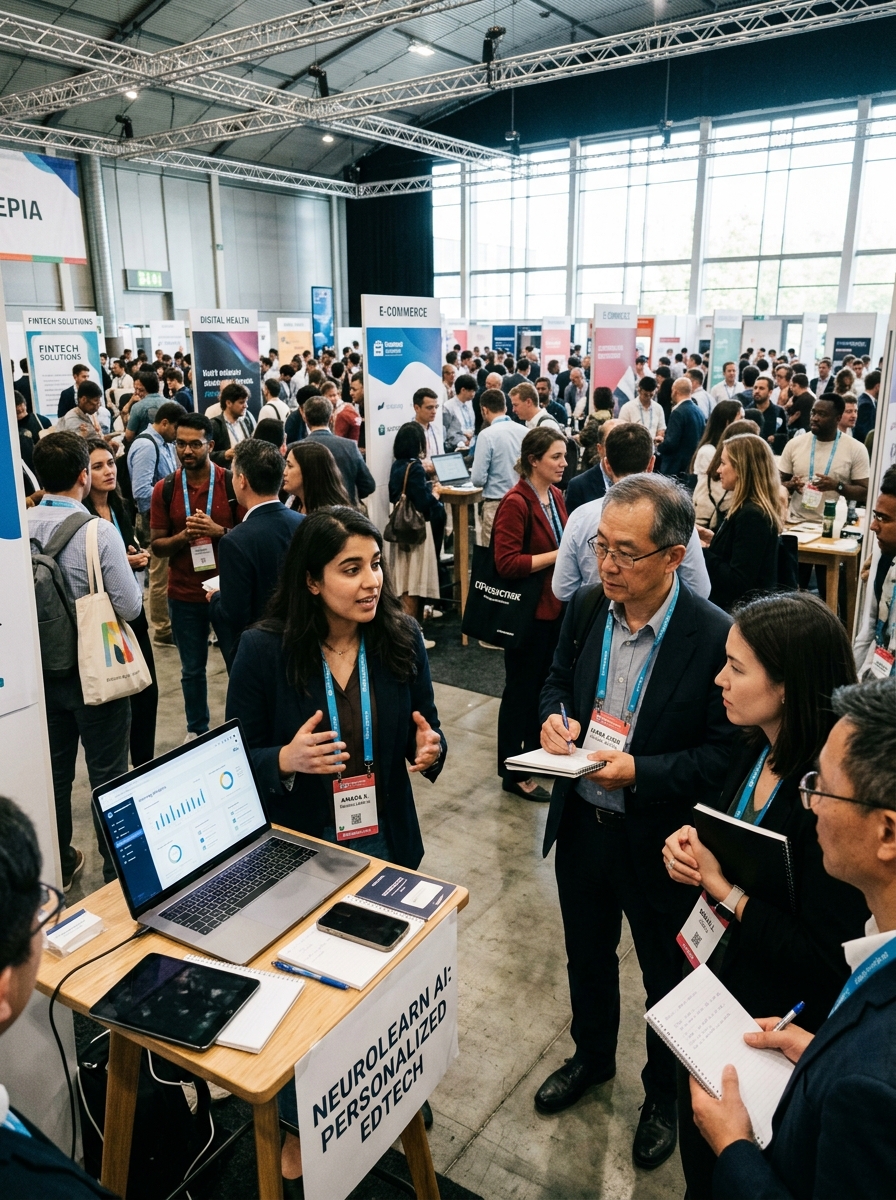
AI is also changing education startups. Adaptive learning platforms can personalize lessons. Language tools can help students practice conversation. Teacher assistants can draft exercises or grade routine work. But education is a human field, and the best founders understand that technology should support teachers, not pretend to replace them. Investors increasingly ask whether an edtech product improves learning, reduces teacher workload or expands access for underserved students. A beautiful app is not enough.
Digital health startups face even higher expectations. Their promise is enormous: remote consultations, AI-assisted diagnostics, chronic disease management, mental health support, electronic medical records, home monitoring and hospital efficiency. In countries with crowded hospitals or rural populations, digital health can help patients reach care faster. A small startup with the right tool may save time for doctors and reduce costs for families.
Yet healthcare is not a normal consumer market. A mistake can affect a person’s body, privacy or life. That is why digital health founders at startup events must speak the language of medicine as well as software. They need clinical validation, data protection, hospital partnerships and ethical safeguards. A health app that looks promising on stage must still prove itself in real medical environments. The most credible founders are those who admit the limits of technology while showing how it can improve care safely.
E-commerce startups remain important because they connect directly with small merchants, logistics networks and consumer behavior. Some build online marketplaces. Others provide inventory tools, live commerce platforms, cross-border selling services, warehouse software, last-mile delivery systems or payment integration. In many markets, e-commerce is no longer just about selling products online. It is about giving small businesses access to a broader economy.
At startup events, e-commerce founders often bring the clearest stories. A small shop that once sold only to one neighborhood can now reach national customers. A farmer can sell directly to urban buyers. A local brand can test overseas demand through digital channels. But competition is intense. Margins are thin, customer acquisition is expensive and logistics failures can destroy trust. Investors want to know whether the startup can grow without burning money endlessly on discounts and advertising.
Fundraising is the visible drama of these events. Pitch competitions, investor lounges and demo days create the impression that success happens through a single powerful presentation. In reality, funding is usually the result of many conversations. A five-minute pitch may open the door, but due diligence decides what happens next. Investors study the team, market size, revenue, technology, legal risks, customer retention and the founder’s ability to adapt.
For founders, raising money can be both empowering and dangerous. Capital allows a startup to hire, build and expand. But money also brings pressure. Investors expect growth, reporting and strategic clarity. A company that raises too much too early may spend carelessly or chase unrealistic targets. A company that raises too little may fail before reaching product-market fit. The best founders treat funding as fuel, not proof of success.
The founder story remains the emotional center of the startup world. Behind every polished booth is usually a more difficult beginning: a failed first product, a family loan, a co-founder conflict, a rejected pitch, a night spent fixing code before a customer demo. Some founders are engineers solving technical problems. Others are former teachers, doctors, bankers, merchants or patients who saw a broken system and decided to build an alternative.
These stories matter because investors often back people before numbers become convincing. A founder who understands the problem deeply, listens to customers and survives setbacks can be more persuasive than one with a fashionable idea. At startup events, the most memorable pitches are not always the loudest. They are the ones where the problem feels real, the customer is clear and the founder has earned the right to solve it.
The global nature of startup events is equally important. A company from a smaller market may use an event to meet foreign investors, test international demand or learn how competitors operate elsewhere. A local problem may turn out to be regional or global. A health tool built for one country’s clinics may work in another. A fintech service designed for small merchants may fit several emerging markets. A language-learning product may cross borders faster than expected.
Still, not every startup event produces real value. Some become expensive stages where founders collect business cards but no commitments. The difference lies in structure. Effective events offer curated meetings, investor matching, corporate buyers, mentorship, follow-up systems and honest feedback. They help founders leave with more than photographs. They help them leave with pilots, leads, term sheets, partnerships or clearer direction.
Technology startup events are powerful because they compress the startup journey into a visible form. Hope meets skepticism. Vision meets numbers. Code meets customers. Founders learn whether their idea can survive contact with the market. Investors learn where the next wave of change may begin. Cities and countries learn whether they are building ecosystems or merely hosting exhibitions.
In the end, the most important companies at these events may not be the ones with the largest booths or the loudest announcements. They may be the small teams standing beside unfinished products, explaining a problem that others have ignored. For them, the event is not the destination. It is the first open door. Through that door, a small idea may begin its long and uncertain journey into the world.
“””
