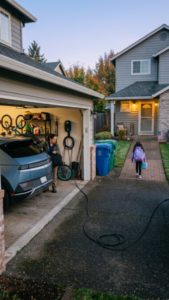
For many American EV owners, the real advantage is not found at a highway fast charger but in the quiet routine of plugging in at home before bed.
LOS ANGELES — The most important electric vehicle charging station in America is often not marked on a map. It sits beside a garage wall, hangs from a carport, or rests near an outdoor outlet at the edge of a driveway. It does not have a convenience store, a glowing canopy or a line of cars waiting for a pump. Most of the time, nothing dramatic happens there. A driver comes home, plugs in and walks inside.
That ordinary act has become the center of the electric vehicle lifestyle.
For years, the public conversation around EVs has focused on range, fast chargers and cross-country trips. Those questions still matter, especially for drivers who travel long distances or live far from reliable public infrastructure. But for many current owners, the defining experience of electric driving is more domestic than futuristic. The vehicle becomes another household device that recharges while the family sleeps, much like a phone, laptop or cordless vacuum.
The U.S. Department of Energy says about 80% of EV charging happens at home. That single figure explains why home charging has become both the strongest selling point of electric cars and one of the biggest barriers to wider adoption. For households with a garage, driveway and suitable electrical service, an EV can remove regular gas station visits from daily life. For renters, apartment dwellers and people who park on the street, the same technology can feel less convenient, more uncertain and sometimes out of reach.
The divide is shaping the next phase of America’s EV market.
Electric vehicle sales in the United States remain meaningful but uneven. Cox Automotive said 2025 was the second-best year on record for U.S. EV sales, with electric vehicles accounting for 7.8% of new-vehicle sales, down slightly from 8.1% in 2024. The market surged in the third quarter before federal incentives expired, then fell sharply in the fourth quarter. The U.S. Energy Information Administration separately reported that battery-electric vehicle sales declined in 2025 while hybrids continued gaining share, underscoring how sensitive many consumers remain to price, incentives and charging confidence.
For EV owners who can charge at home, however, the ownership equation often looks very different from the public debate. They may not think much about public chargers during a normal week. A commute of 30 or 40 miles can be replaced overnight. Errands, school runs and grocery trips draw down only a portion of the battery. Instead of watching fuel prices posted on a roadside sign, the owner watches an app or dashboard estimate how many miles will be ready by morning.
This is the lifestyle shift automakers and charging companies are trying to sell: not simply lower emissions, but less friction. The gas station becomes an emergency or road-trip stop rather than a routine destination. Refueling is no longer an errand; it is a background process.
The technology behind that routine is straightforward but important. Level 1 charging uses a common 120-volt household outlet. It is slow, but it can work for some plug-in hybrid owners or EV drivers with short daily mileage and long overnight dwell times. Level 2 charging, which uses 240-volt service, is the more powerful home option. The Department of Transportation says Level 2 equipment can charge a battery-electric vehicle to 80% from empty in about four to 10 hours, making it well suited to overnight charging. Direct current fast chargers can do that much faster, but they are mainly public tools for long-distance travel or quick top-ups.
That difference changes behavior. Gasoline drivers tend to refuel when the tank is low. EV owners with home charging often plug in before the battery is near empty. The car is not treated like a fuel tank waiting to be filled; it is treated like a reserve that is maintained. Many owners set charging schedules to start after electricity demand falls or when utility rates are lower. Some pair EV charging with rooftop solar, home batteries or smart chargers that track electricity prices.
The savings can be real, though they vary by state, utility and driving pattern. J.D. Power’s 2025 U.S. Electric Vehicle Experience Home Charging Study found that owners reported spending an average of $58 on home charging in the previous 30 days, up slightly from the prior year. The study also showed that home charging remains central to owner satisfaction, especially when drivers have reliable Level 2 equipment. Yet satisfaction slipped in some areas because owners complained about charging speed, cord length, connectivity problems and rising electricity prices.
In other words, home charging is convenient, but not invisible. It turns the garage into part of the transportation system. The household electrical panel, Wi-Fi signal, utility bill and parking layout suddenly matter to mobility.
The Environmental Protection Agency says Level 2 charger equipment can cost roughly $400 to $1,000, with installation commonly ranging from about $300 to $2,000 depending on the home. Costs can rise if a panel upgrade, long wiring run or complex permitting is needed. A newer house with 200-amp service and an attached garage may be relatively simple. An older home with limited electrical capacity, detached parking or street parking can be more complicated.
That reality shows why home charging is also a housing issue. The EV lifestyle is easiest for people who own single-family homes, control their parking space and can authorize electrical work. It is harder for renters who need landlord permission, condo residents who must navigate homeowners associations, and city drivers whose cars sleep on the curb. In those cases, charging may depend on workplace access, public stations, curbside programs or building retrofits.
Deloitte’s 2026 Global Automotive Consumer Study highlighted the tension. Among U.S. EV intenders surveyed, 77% said they planned to charge at home, but 53% said they did not currently have access to a dedicated home charger. The finding captures a central contradiction in the American EV transition: many consumers understand the appeal of waking up to a charged car, but a large share cannot yet count on that experience.
That gap helps explain why public charging remains such an emotional issue even for a technology that is mostly charged privately. AAA’s 2025 survey found that concerns about long-distance travel, lack of convenient public charging stations and fear of running out of charge remained major barriers for consumers who were undecided or unlikely to buy an EV. Public charging reliability is improving, according to J.D. Power’s 2025 public charging study, but satisfaction with cost and payment remains uneven. For a household without home charging, those public-system weaknesses are not occasional inconveniences. They are ownership risks.
Weather adds another layer. AAA’s 2026 testing found that cold temperatures can reduce EV efficiency and calculated range significantly, while also increasing operating costs, especially when drivers rely on expensive public charging. But the same study showed why home charging can protect the economics of EV ownership: under both cold and hot conditions, EVs charged at home remained cheaper per 1,000 miles than hybrids in AAA’s comparison, while public charging could make EV operation more expensive.
That reinforces the central pattern. The EV experience is not one experience. It is radically different depending on where the car sleeps.
For a suburban homeowner with a Level 2 charger, the EV can feel quieter, cheaper to operate and more convenient than a gasoline vehicle. For an apartment renter competing for public chargers after work, it can feel like a planning exercise. For a rural driver, the question may be whether the vehicle has enough range and whether fast chargers are reliable along regional routes. For a two-car household, an EV may handle daily driving while a gasoline or hybrid vehicle remains available for long trips.
Automakers are adjusting to that complexity. Some now bundle home charger installation support with EV purchases. Utilities are offering rebates, time-of-use rates and managed charging programs to reduce grid strain. Builders and local governments are increasingly treating EV readiness as part of residential infrastructure, especially in new housing and multifamily developments. Charging companies are also looking beyond highway fast chargers to workplaces, apartments, retail parking lots and curbside locations.
The stakes are larger than convenience. Transportation is one of the largest sources of U.S. emissions, and electrification is a major part of plans to reduce pollution. But the path depends on whether charging can become mundane for more people, not just early adopters. A car that needs a special weekly trip to a public charger may struggle to compete with a gasoline vehicle. A car that charges while its owner sleeps has a much stronger case.
That is why the future of EV adoption may be decided as much by electricians, landlords, utility regulators and homebuilders as by automakers. The vehicle itself is only one part of the system. The parking space is another. So is the power panel, the rate plan and the rulebook that decides whether a tenant can install a charger.
For now, the home charging lifestyle is both an advertisement and a warning. It shows how easy electric driving can become when the infrastructure is personal, private and reliable. It also exposes how unequal that convenience remains. The EV revolution may be powered by batteries, but in everyday America it begins with a place to plug in.